


Utah DMV Sign Test 4

5 out of 5 (85 votes)
80% Passing score
20 Questions
4 Mistakes allowed
A Utah road signs practice test should do more than ask what red and yellow mean. It should make you comfortable with how signs are tested inside Utah’s regular Class D written knowledge exam, where they show up alongside traffic laws, signals, safe driving practices, impaired driving rules, and the broader driver responsibility material from the Utah Driver Handbook. The official learner permit test is a 50-question, closed-book exam through the Utah Driver License Division, so this Utah road signs test is focused preparation for one important part of that bigger test—not a separate shortcut, not a magic pass, just targeted practice where people often need it. This Utah DMV road signs test gives you 20 multiple-choice questions built around the sign colors, shapes, and meanings drivers are expected to recognize quickly. Red signs call for immediate action. Yellow signs usually warn that something is coming. Green signs point you toward permitted movements or directions. The shapes matter too, in that quiet little way people forget about until a question uses the shape as the clue and the wording barely helps. Octagons, diamonds, rectangles, pennants, railroad crossings—none of it is complicated on its own, but mixed together, under test pressure, it can get a bit fuzzier than expected. Utah’s official knowledge test requires 40 correct answers out of 50, or 80%, to pass. That means you can miss 10 questions, though it is not much of a safety net when road signs, right-of-way rules, safety judgment, and Utah-specific laws are all competing for space. Applicants may test twice in one day, and after three failed attempts, another fee is required. The permit and written-test score stay valid for 18 months, which is generous enough, but still not a reason to wander in half-prepared. Use this Utah practice permit test alongside the official handbook if you are preparing for a learner permit, reviewing before renewal, or cleaning up those signs you keep recognizing “mostly,” which is not really a test-taking category. And yes, signs matter after the written exam too. During the Utah driving skills test, examiners may evaluate how well you observe traffic signs and signals, whether you are in Salt Lake traffic, canyon roads, winter conditions, construction areas, or park routes where one missed sign can make the whole drive much more dangerous.
FREE DMV Practice Test App
Study for your Utah permit test or driver’s license with the NextDoorDriving app. 700+ DMV questions and answers, 100% free!
Download on the App Store

Sample Utah Permit Test Questions

Question 1

A red circular light is displayed with a green arrow. Which movement is permitted?

  1. A Travel straight through the intersection only
  2. B Proceed only in the direction shown by the green arrow
  3. C Remain stopped despite the green arrow
  4. D Proceed in any direction after slowing

Correct answer: B – Proceed only in the direction shown by the green arrow

Utah permits a driver facing a green arrow to enter cautiously only for the movement indicated by the arrow or another indication displayed at the same time. The driver must still yield to pedestrians lawfully in an adjacent crosswalk and to traffic lawfully using the intersection. The red light continues to prohibit movements not authorized by the arrow.

Source: Utah Code § 41-6a-305(2)(b), (4)(a) — Traffic-control signal -- At intersections -- At place other than intersection -- Color of light signal -- Inoperative traffic-control signals -- Affirmative defense.
Question 2

On a two-way road with double solid yellow centerlines, which maneuver is prohibited?

  1. A Turning left into a private driveway
  2. B Turning left onto a side road
  3. C Entering the opposing lane to pass another vehicle
  4. D Turning left into a business entrance

Correct answer: C – Entering the opposing lane to pass another vehicle

In Utah, double solid yellow markings indicate a two-direction no-passing zone. A driver may not use the left side of the roadway or cross the no-passing striping to overtake another vehicle. State law expressly allows a left turn across double solid yellow lines, including turns to or from a private road or driveway, when the turn can otherwise be made lawfully.

Source: Utah Code § 41-6a-708(2), (3) — Signs and markings on roadway -- No-passing zones -- Exceptions., Utah Code § 41-6a-801(2)(c) — Turning -- Manner -- Traffic-control devices.

Question 3

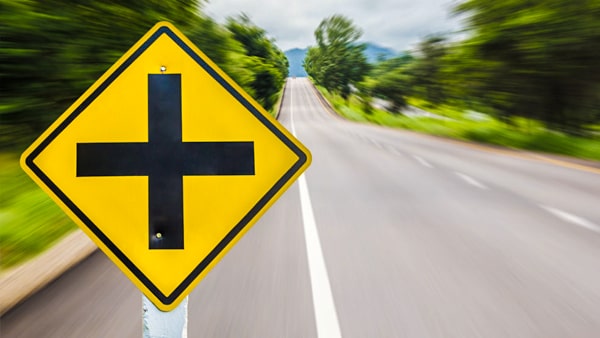
A yellow diamond sign displaying a black cross warns of:

This sign shows one type of:
  1. A A crossroad intersection ahead
  2. B A winding roadway ahead
  3. C A required right turn ahead
  4. D A traffic lane ending ahead

Correct answer: A – A crossroad intersection ahead

The crossroad warning sign gives advance notice that another road crosses the driver’s roadway. Its symbol depicts the general configuration of the approaching intersection. Drivers should watch for vehicles that may turn onto or enter from the intersecting road.

Source: Utah Code § 41-6a-301 — Standards and specifications for uniform system of traffic-control devices and school crossing guards., Manual on Uniform Traffic Control Devices for Streets and Highways, 11th ed. — § 2C.41, “Intersection Warning Signs”

Question 4

Your signal is green, but traffic ahead leaves no room beyond the intersection. You should:

  1. A Enter and wait in the intersection
  2. B Enter if you can drive around the stopped vehicles
  3. C Remain outside until enough space is available beyond the intersection
  4. D Enter because the green signal gives you priority

Correct answer: C – Remain outside until enough space is available beyond the intersection

Utah law prohibits entering an intersection unless sufficient space is available on the other side for your vehicle. This rule applies even when a traffic signal indicates that you may proceed. Wait before the intersection until you can continue through without obstructing vehicles or pedestrians.

Source: Utah Code § 41-6a-1707 — Entering intersection, crosswalk, or railroad grade -- Sufficient space required.

Question 5

Orange traffic signs and devices alert drivers to:

  1. A Permanent road closures only
  2. B Work zones, workers, or temporary roadway conditions
  3. C Posted speed limits outside work zones
  4. D High-occupancy vehicle restrictions

Correct answer: B – Work zones, workers, or temporary roadway conditions

Orange signs and traffic-control devices identify highway work zones. They may warn of workers, lane closures, detours, machinery, reduced speeds, or changes in the road surface. Watch for cones, barriers, equipment, and flaggers, and be prepared to slow or stop as directed.

Source: Utah Driver Handbook — § 9, “Work Zone Signs”, Utah Driver Handbook — § 11, “Highway Work Zones”

Question 6

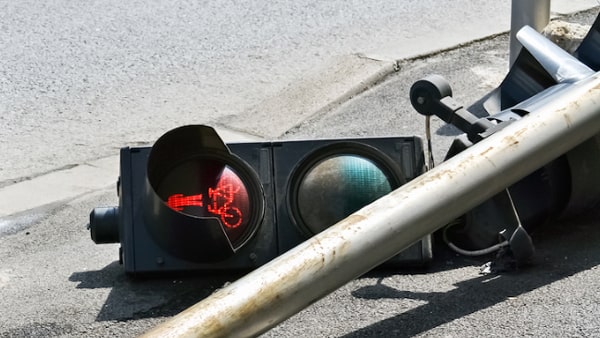
At an intersection with an inoperative traffic signal, a driver must:

When a traffic signal light is not working, you should:
  1. A Stop only when another vehicle is present
  2. B Slow down without stopping unless necessary
  3. C Stop before entering, yield as required, and proceed when safe
  4. D Continue as though the signal were green

Correct answer: C – Stop before entering, yield as required, and proceed when safe

Utah requires a driver approaching an intersection with an inoperative signal to stop before entering. After stopping, apply the right-of-way rules governing an unregulated intersection and yield as required. Enter only when the movement can be completed safely.

Source: Utah Code § 41-6a-305(6) — Traffic-control signal -- At intersections -- At place other than intersection -- Color of light signal -- Inoperative traffic-control signals -- Affirmative defense., Utah Code § 41-6a-901 — Right-of-way between vehicles -- Unregulated intersection.