


Utah Road Signs Test Simulator

4.9 out of 5 (98 votes)
80% Passing score
25 Questions
5 Mistakes allowed
Utah road signs deserve more attention than most people give them while studying for the DMV written test. Sign questions are built into Utah’s main closed-book knowledge test, the one first-time learner permit applicants take through the Driver License Division. That test is 50 questions, and the practical target is 40 correct answers — 80% — so every sign question you do not have to guess on gives you a little more breathing room. This Utah permit practice test keeps the focus tight: road signs, road signs, and then a few more road signs, because that is where visual memory actually matters. Each session gives you 20 questions, with 16 correct answers needed to pass. The questions rotate from a larger bank, so you are not just memorizing one neat little sequence and congratulating yourself too early, which, to be fair, is a very easy trap to fall into when practice tests start feeling familiar. The point here is quick recognition. Regulatory signs, warning signs, guide signs, school-zone signs, lane-use signs, construction signs — they all ask you to connect shape, color, symbol, and meaning without taking half a minute to think it over. And yes, the real Utah permit test also covers traffic laws, signals, impaired driving, safe driving habits, and driver responsibility, so this is not a replacement for the Utah Driver Handbook. It is a focused drill for one part of the test that can feel simple in study mode and less simple when the answer choices start looking annoyingly similar. It is useful for first-time drivers, teens working through Utah’s licensing steps, adults who have never held a license, and experienced drivers who want a sharp refresher before dealing with the DLD again. Utah roads do not exactly stay in one personality, either — Salt Lake traffic, mountain grades, snow in the Wasatch, long desert stretches, construction zones that seem to move around when you are not looking. Road signs are often your first warning before the road gets interesting. Take the test more than once. Review the misses. Notice the patterns. That is how road signs stop being vague pictures and start becoming information you can read fast, which is exactly what you want before the real Utah DMV permit test.
FREE DMV Practice Test App
Study for your Utah permit test or driver’s license with the NextDoorDriving app. 700+ DMV questions and answers, 100% free!
Download on the App Store

Sample Utah Permit Test Questions

Question 1

At a railroad crossing, flashing red warning lights require you to:

  1. A Stop only when a train is visible
  2. B Stop exactly 10 feet from the signal
  3. C Stop 15 to 50 feet from the nearest rail and wait for the warning to end
  4. D Cross slowly once the gate begins rising

Correct answer: C – Stop 15 to 50 feet from the nearest rail and wait for the warning to end

Utah law requires a driver to stop between 15 and 50 feet from the nearest rail when a crossing signal warns of an approaching train or other on-track equipment. Normally, remain stopped until the lights stop flashing and any gate is fully raised. A narrow exception applies to a suspected malfunction at a crossing without a gate, but only after all statutory safety conditions are met.

Source: Utah Code § 41-6a-1203 — Railroad grade crossing -- Duty to stop -- Malfunctions and school buses -- Driving through, around, or under gate or barrier prohibited., Utah Driver Handbook — § 14, “Trains and Railroad Crossings”
Question 2

What do yellow centerline markings generally separate?

  1. A Traffic traveling in opposite directions
  2. B Lanes traveling in the same direction
  3. C Traffic lanes from railroad tracks
  4. D Through lanes from parking spaces

Correct answer: A – Traffic traveling in opposite directions

Yellow centerline markings are used on two-way roadways to separate opposing traffic. The pattern of the line—broken, solid on one side, or solid on both sides—indicates whether passing is permitted. White lane markings generally separate lanes moving in the same direction.

Source: Utah Driver Handbook — § 9, “Pavement Markings”

Question 3

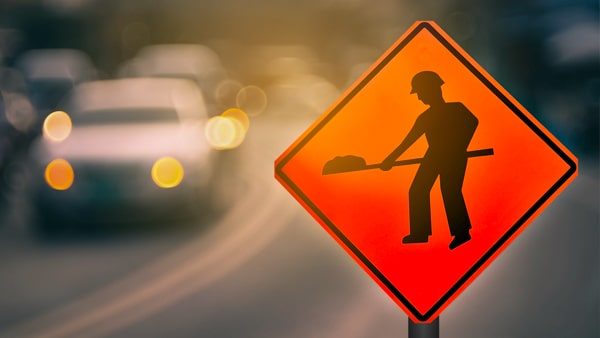
An orange diamond sign showing a worker with a shovel warns that:

This sign means that:
  1. A A volunteer cleanup area is ahead
  2. B Workers may be in or near the roadway ahead
  3. C A playground is located ahead
  4. D A pedestrian crosswalk is ahead

Correct answer: B – Workers may be in or near the roadway ahead

The Workers Ahead symbol warns that workers may be in or near the roadway. Orange signs are used for construction, maintenance, and utility work zones. Reduce speed as conditions require, watch for workers and equipment, and be prepared to stop or follow a flagger’s directions.

Source: Utah Driver Handbook — § 9, “Work Zone Signs”, Manual on Uniform Traffic Control Devices for Streets and Highways, 11th ed. — § 6H.18, “Workers Signs (W21-1 and W21-1a)”

Question 4

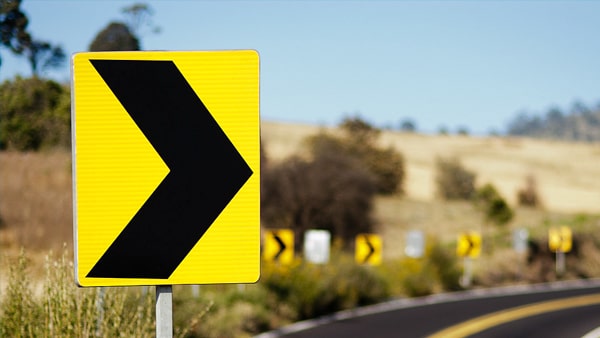
A rectangular chevron sign pointing to the right indicates that:

When you see this sign, it means:
  1. A An obstruction is located in the roadway
  2. B A side road enters from the right
  3. C The roadway changes direction to the right
  4. D Another traffic lane merges ahead

Correct answer: C – The roadway changes direction to the right

Chevron alignment signs emphasize a change in the roadway’s horizontal direction. They are installed on the outside of a turn or curve and point drivers along the change in alignment. They do not identify a merge, side road, or object in the roadway.

Source: Utah Code § 41-6a-301 — Standards and specifications for uniform system of traffic-control devices and school crossing guards., Manual on Uniform Traffic Control Devices for Streets and Highways, 11th ed. — § 2C.08, “Chevron Alignment Sign (W1-8)”

Question 5

What must you do when approaching a red-and-white triangular YIELD sign?

  1. A Stop only when an emergency vehicle approaches
  2. B Continue at your current speed after looking both ways
  3. C Come to a complete stop every time
  4. D Slow down, yield, and stop if safety requires it

Correct answer: D – Slow down, yield, and stop if safety requires it

Under Utah law, a driver approaching a yield sign must slow to a speed reasonable for existing conditions and stop if safety requires it. After slowing or stopping, the driver must yield to vehicles that present an immediate hazard and to pedestrians in an adjacent crosswalk. Proceed only when the movement can be made safely.

Source: Utah Code § 41-6a-902(3) — Right-of-way -- Stop or yield signals -- Yield -- Collisions at intersections or junctions of roadways -- Evidence.

Question 6

Why should you scan left and right before entering an intersection after the light turns green?

  1. A To confirm that the path is clear of cross traffic
  2. B Because you may look only straight ahead after entering
  3. C Because cross traffic always receives a green arrow
  4. D Because all pedestrians must remain on the cross street

Correct answer: A – To confirm that the path is clear of cross traffic

Before moving on a green light, check that your intended path is clear and that no cross traffic remains or is entering. The official handbook recommends looking left, right, and left again before entering an intersection. This scan can help you recognize a hazard before your vehicle moves into its path.

Source: Utah Driver Handbook — § 9, “Intersections”