


Vermont CDL General Knowledge Practice Test (VT) 2

5 out of 5 (44 votes)
80% Passing score
20 Questions
4 Mistakes allowed
Welcome to your second Vermont CDL General Knowledge Practice Test! This test is designed with 20 multiple-choice questions, requiring you to answer at least 16 correctly to pass. Our Vermont permit practice test is completely free, offering all the features and study opportunities you'd find in a paid version. Whether you're aiming for a Class A or Class B driver's license, with or without endorsements, you'll start with the general knowledge test. This essential Vermont DMV written test remains the same for all license classes. Our Vermont CDL practice test covers a wide range of topics crucial for any CDL applicant. You'll find questions on pre-trip vehicle inspection, basic vehicle control, gear shifting, including downshifting, tackling hills and steep downgrades, communicating with other drivers, controlling speed, and understanding drug and alcohol regulations. These VT CDL permit test questions are designed to mirror the actual DMV written test in 2026, so you can feel confident and prepared. One of the key benefits of our Vermont CDL general knowledge test practice is the immediate feedback provided after each question. Not only will you know whether you got the answer right or wrong, but you'll also receive a detailed explanation. This helps you understand the reasoning behind each answer, enhancing your learning experience and better preparing you for the real Vermont CDL DMV test in 2026. Accessibility is a cornerstone of our service. You can access our Vermont DMV practice tests online from any device, be it a mobile phone, desktop computer, or tablet. This flexibility allows you to study wherever and whenever it suits you, fitting seamlessly into your schedule. Our goal is to ensure that every aspiring commercial driver has the best possible chance of passing their Vermont CDL general knowledge test on the first try. With comprehensive coverage of essential topics, detailed explanations, and the convenience of online access, our practice permit tests are a valuable tool for your preparation. Start practicing today and take a confident step towards nailing your Vermont DMV CDL test in 2026!
FREE CDL Practice Test App
Pass your Vermont CDL General Knowledge test with the NextDoorDriving app. Real questions and answers—100% free and ad-free.
Download on the App Store

Sample Vermont CDL Test Questions - General Knowledge

Question 1

Wet brakes that apply unevenly or grab can cause a combination vehicle to:

  1. A Hydroplane regardless of road conditions
  2. B Stop in a shorter distance
  3. C Gain additional tire traction
  4. D Jackknife

Correct answer: D – Jackknife

Water can make brakes weak, uneven, or prone to grabbing. Possible results include reduced braking power, wheel lockup, pulling to one side, and a jackknife when towing a trailer. After crossing unavoidable standing water, maintain light brake pressure briefly to help dry and test the brakes.

Source: Vermont Commercial Driver’s License Manual — § 2.13.2, “Driving—Wet Brakes”
Question 2

How must a driver respond to a flashing red traffic signal?

  1. A Stop and proceed under the rules that apply at a stop sign
  2. B Slow down but continue without stopping
  3. C Proceed as though facing a green signal
  4. D Treat it as a yield sign

Correct answer: A – Stop and proceed under the rules that apply at a stop sign

In Vermont, a driver facing a flashing red signal must stop before the nearest crosswalk, marked limit line, or intersection, as applicable. After stopping, the driver may proceed only under the rules governing movement from a stop sign. A flashing yellow signal, by contrast, permits cautious movement without a required stop.

Source: 23 V.S.A. § 1024 – Flashing signals

Question 3

When scanning the roadway ahead, which two broad categories should receive your attention?

  1. A Traffic and roadway conditions
  2. B Only vehicles and traffic lights
  3. C Only disabled vehicles and debris
  4. D Only curves and pavement defects

Correct answer: A – Traffic and roadway conditions

Scan for traffic entering the highway, moving into your lane, turning, or slowing. Also watch for roadway hazards such as curves, grades, work zones, drop-offs, objects, and difficult ramps. Looking far enough ahead gives you more time to adjust speed or position safely.

Source: Vermont Commercial Driver’s License Manual — § 2.4.1, “Seeing Ahead”; § 2.8.2, “Hazardous Roads”

Question 4

An unblocked cargo article is longer than 5 feet but no longer than 10 feet. What is the minimum number of tiedowns required?

  1. A 1
  2. B 2
  3. C 3
  4. D 4

Correct answer: B – 2

Federal cargo-securement rules require at least two tiedowns for an unblocked article longer than 5 feet but no longer than 10 feet, regardless of weight. Different minimums apply to shorter articles based on weight and to articles longer than 10 feet. Blocking or immobilizing the article against forward movement can also affect the applicable calculation.

Source: 49 CFR § 393.110(b)(2)(ii) – Additional requirements for determining the minimum number of tiedowns

Question 5

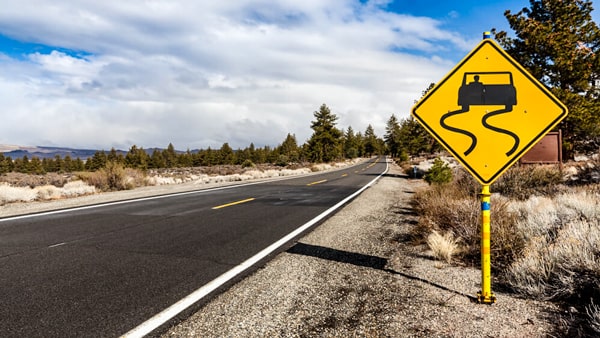
What does a Slippery When Wet warning sign tell a driver?

This sign warns drivers to  _________________.
  1. A The road can become unexpectedly slippery when wet
  2. B Driving is prohibited whenever it rains
  3. C The roadway becomes impassable because of mud
  4. D The road is equally slippery in every type of weather

Correct answer: A – The road can become unexpectedly slippery when wet

The Slippery When Wet sign warns that wet conditions may produce unexpected loss of traction. It does not prohibit travel during rain. Commercial drivers should reduce speed on wet pavement because stopping takes longer and turning without skidding becomes more difficult.

Source: Manual on Uniform Traffic Control Devices, 11th ed., Rev. 1 — § 2C.30, “Surface Condition Signs”, Vermont Commercial Driver’s License Manual — § 2.6.2, “Matching Speed to the Road Surface”

Question 6

Which driving-related abilities are affected first as alcohol begins affecting the brain?

  1. A Judgment and self-control
  2. B Kidney function
  3. C Coordination only
  4. D Muscle control only

Correct answer: A – Judgment and self-control

The first area of the brain affected by alcohol controls judgment and self-control. This is especially dangerous because impaired judgment can prevent a person from recognizing how affected they have become. As blood alcohol concentration continues to rise, vision, coordination, and muscle control also deteriorate.

Source: Vermont Commercial Driver’s License Manual — § 2.22.1, “Alcohol—Alcohol and the Brain”