


Vermont CDL Class B Practice Test (VT) 3

5 out of 5 (46 votes)
80% Passing score
20 Questions
4 Mistakes allowed
Welcome to the third Vermont CDL practice test tailored specifically for Class B applicants. With 20 meticulously crafted permit test questions and answers, this CDL practice test is designed to mirror the real DMV written test experience, helping you prepare with confidence. Our content is regularly updated to reflect the latest 2026 Vermont driving laws and regulations, ensuring that you are studying the most current and relevant information available. Whether you're accessing this Vermont permit practice test on a desktop, mobile, or through our user-friendly apps, you can practice anytime and anywhere, making your preparation convenient and efficient. This VT CDL practice test encompasses a wide range of subjects critical for your CDL Class B knowledge, including pre-trip vehicle inspection, basic vehicle control, shifting gears (with an emphasis on downshifting), tackling hills and steep downgrades, communicating with other drivers, controlling speed, and drug and alcohol awareness. We understand the importance of authentic practice, which is why our questions are crafted to closely mimic the phrasing and format of the actual Vermont DMV test for a class B license. This approach goes beyond rote memorization, fostering a deeper understanding of the material and ensuring you are well-prepared for test day. By consistently practicing with these 2026 Vermont permit test questions answers, you will develop a practical familiarity with the types of questions to expect, boosting your confidence and readiness. Achieving a passing score on this Vermont CDL class B practice test requires answering at least 16 out of 20 sample DMV questions correctly. This benchmark ensures that you have a solid grasp of the essential knowledge required for safe and responsible driving. Regularly updated and easily accessible, our permit practice test is an invaluable resource for anyone serious about obtaining their Vermont CDL Class B license. Dive into this Vermont CDL practice test today and take the next step towards mastering your CDL skills with up-to-date, relevant, and practical preparation!
FREE CDL Practice Test App
Pass your Vermont CDL General Knowledge test with the NextDoorDriving app. Real questions and answers—100% free and ad-free.
Download on the App Store

Sample Vermont CDL Test Questions - General Knowledge

Question 1

Some common over-the-counter cold medicines can cause driver drowsiness.

  1. A TRUE
  2. B FALSE

Correct answer: A – TRUE

Cold remedies, including some antihistamines, may cause drowsiness or otherwise impair safe driving. Federal regulations prohibit being on duty under the influence of a substance to a degree that makes safe vehicle operation impossible. The applicable prescription exception requires a licensed medical practitioner to advise that the substance will not affect the driver’s ability to operate safely.

Source: Vermont Commercial Driver’s License Manual — § 2.22.2, “Other Drugs”, 49 CFR § 392.4(a)(4), (c) – Drugs and other substances
Question 2

When descending a grade in a manual-transmission commercial vehicle, which practice should you avoid?

  1. A Riding the clutch to control speed
  2. B Trying to downshift after downhill speed has built up
  3. C Coasting with the clutch depressed
  4. D All of these answers are correct

Correct answer: D – All of these answers are correct

Select a low gear before beginning the downgrade rather than trying to downshift after speed increases. Riding the clutch or coasting with it depressed reduces control and can eliminate useful engine braking. Use the engine’s braking effect as the principal means of controlling downgrade speed while preserving the service brakes.

Source: Vermont Commercial Driver’s License Manual — § 2.16.2, “Select the Right Gear before Starting Down the Grade”, Vermont Commercial Driver’s License Manual — § 13.1.11(a), “Clutch Usage (for Manual Transmission)”

Question 3

Which of the following is listed as a suspension-system component?

  1. A Steering box
  2. B Tie rod
  3. C Steering column
  4. D None of the above

Correct answer: D – None of the above

The steering box, tie rods, and steering column are steering-system components rather than suspension components. Suspension items include leaf or coil springs, spring hangers, bushings, axle-mounting parts, air-ride components, and shock absorbers. Steering and suspension are inspected as separate systems.

Source: Vermont Commercial Driver’s License Manual — § 2.1.3, “What to Look For—Steering System Defects; Suspension System Defects”

Question 4

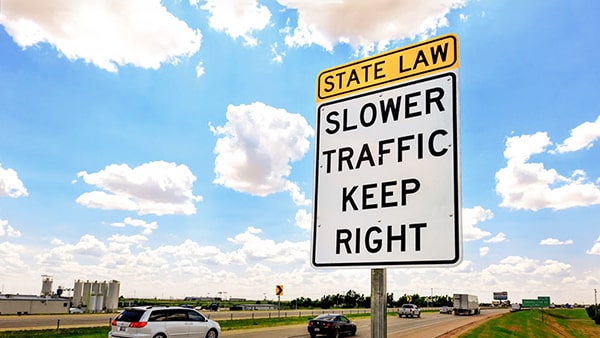
What action is directed by a SLOWER TRAFFIC KEEP RIGHT sign?

This sign indicates that drivers ___________.
  1. A Use the right-hand lane when traveling below the normal flow of traffic
  2. B Require every vehicle to remain in the right lane
  3. C Pass slower vehicles on the right
  4. D Exceed the speed limit to avoid using the right lane

Correct answer: A – Use the right-hand lane when traveling below the normal flow of traffic

The sign directs slower traffic toward the right-hand lane on a multilane roadway. It is used where slow vehicles can impede the normal flow and cause unnecessary lane changes. Vermont law also requires slow-moving vehicles to remain as close to the right side of the highway as reasonably practicable.

Source: Manual on Uniform Traffic Control Devices, 11th ed., Rev. 1 — § 2B.38, “KEEP RIGHT EXCEPT TO PASS Sign (R4-16), SLOWER TRAFFIC KEEP RIGHT Sign (R4-3), and TRUCKS USE RIGHT LANE Sign (R4-5)”, 23 V.S.A. § 1082 – Slow-moving vehicles

Question 5

A heavy commercial vehicle is approaching a curved, downhill exit ramp. When should the driver reduce to a safe speed?

  1. A Only after passing the ramp’s posted speed sign
  2. B Before entering the curved part of the ramp
  3. C After accelerating into the curve
  4. D While downshifting in the curve

Correct answer: B – Before entering the curved part of the ramp

The Vermont CDL manual instructs drivers to slow sufficiently before reaching the curved portion of an exit ramp. A ramp speed that is suitable for a passenger car may be too fast for a large or heavily loaded vehicle. Downhill curves are especially hazardous because reducing speed while turning can be difficult.

Source: Vermont Commercial Driver’s License Manual — § 2.8.2, “Hazardous Roads—Off Ramps/On Ramps”

Question 6

What is perception distance?

  1. A The distance traveled while moving your foot from the accelerator to the brake
  2. B The distance traveled from seeing a hazard until the brain recognizes it
  3. C The distance traveled after the brakes are applied
  4. D The entire distance required to stop the vehicle

Correct answer: B – The distance traveled from seeing a hazard until the brain recognizes it

Perception distance is the distance traveled from the moment the driver’s eyes see a hazard until the brain recognizes it. Reaction distance begins after recognition and continues until the driver physically applies the brakes. Braking distance is traveled after brake application, and all three combine to form total stopping distance.

Source: Vermont Commercial Driver’s License Manual — § 2.6.1, “Stopping Distance”