


Vermont CDL General Knowledge Test (VT) 5

5 out of 5 (41 votes)
80% Passing score
50 Questions
10 Mistakes allowed
Welcome to your fifth Vermont CDL General Knowledge Practice Test, designed specifically for aspiring commercial drivers. This CDL practice test offers 50 carefully curated permit test questions and answers that cover a broad spectrum of topics essential for the CDL written test in 2026. With a requirement to answer at least 40 questions correctly to pass, this test is a robust tool to gauge your preparedness. Our Vermont CDL permit practice tests stand out by incorporating visual learning aids, which can significantly enhance your understanding and retention of the material. Visual learners will benefit from images of road signs, traffic scenarios, and various driving conditions that are often included in the practice test. These aids not only make the learning process more engaging but also ensure that you are well-prepared for the visual aspects of the actual Vermont CDL general knowledge test. Unlike dubious "Vermont permit test cheat sheets" that claim to have all the answers to your permit test, our DMV practice tests are reliable, legal, and highly effective study tools. DMV Cheat sheets can be risky and costly, offering no guaranteed results and potentially leading to complications. Our CDL practice tests, on the other hand, are developed with a proven track record of helping candidates succeed. By using this Vermont CDL practice test, you can be confident that you are preparing in a comprehensive and lawful manner. Accessibility is another key feature of this 2026 Vermont CDL general knowledge practice tests. Whether you are at home, at work, or on the go, you can easily access this DMV practice test online. It is available through desktop and mobile devices, as well as mobile apps, ensuring that you can study whenever and wherever it is convenient for you. This fifth Vermont DMV general knowledge practice test for commercial drivers is not just a repetition of 2026 DMV permit test questions and answers, but a strategic tool to solidify your knowledge and build confidence. Taking the same set of sample CDL test questions multiple times allows you to identify areas where you need further study and to reinforce what you have already learned. By consistently practicing, you can approach your 2026 Vermont CDL test with confidence, knowing that you have thoroughly prepared!
FREE CDL Practice Test App
Pass your Vermont CDL General Knowledge test with the NextDoorDriving app. Real questions and answers—100% free and ad-free.
Download on the App Store

Sample Vermont CDL Test Questions - General Knowledge

Question 1

What is the main safety benefit of an antilock braking system?

  1. A It permits higher speeds and shorter following distances
  2. B It prevents every type of turning skid
  3. C It always reduces stopping distance
  4. D It helps prevent wheel lockup and maintain control during braking

Correct answer: D – It helps prevent wheel lockup and maintain control during braking

ABS detects when wheels are about to lock and adjusts braking pressure to help the driver maintain control. It may allow the driver to steer around an obstacle while braking and can reduce skids caused by overbraking. ABS does not necessarily shorten stopping distance or prevent skids caused by excessive speed in a turn.

Source: Vermont Commercial Driver’s Manual — § 2.18.4, “How ABS Helps You”
Question 2

Which procedure correctly checks a hydraulic brake system for leaks?

  1. A Assume no test is needed because hydraulic systems cannot leak
  2. B Drive slowly and check only whether the vehicle eventually stops
  3. C With the engine running and vehicle stopped, pump the pedal three times, hold firm pressure for five seconds, and check for pedal movement
  4. D Press the brake pedal and accelerator together to see whether the vehicle moves

Correct answer: C – With the engine running and vehicle stopped, pump the pedal three times, hold firm pressure for five seconds, and check for pedal movement

Start the engine and pump the hydraulic brake pedal three times. Apply firm pressure and hold the pedal for five seconds; it should remain in position. If the pedal moves while pressure is held, there may be a leak or another brake-system problem that must be repaired before driving.

Source: Vermont Commercial Driver’s Manual — § 2.1, “Test for Hydraulic Leaks”

Question 3

Why should you plan a response as soon as you recognize a roadway hazard?

  1. A To eliminate every possible emergency
  2. B To give yourself more time to choose and take action
  3. C To reduce the amount of time spent watching the road
  4. D Because every hazard will become an emergency

Correct answer: B – To give yourself more time to choose and take action

Vermont’s CDL manual teaches drivers to search for hazards early so they have time to plan an escape or other response. Consider what emergencies could develop and decide what action would be appropriate. If the situation worsens, having a plan allows you to react sooner instead of making the decision at the last moment.

Source: Vermont Commercial Driver’s Manual — § 2.8.4, “Always Have a Plan”

Question 4

Before operating a CMV after taking an over-the-counter cold medicine, what must you determine?

  1. A Whether taking half the listed dose makes it safe
  2. B Whether it could cause drowsiness or otherwise impair safe driving
  3. C Whether the trip will be completed during daylight
  4. D Whether the dispatcher approves its use

Correct answer: B – Whether it could cause drowsiness or otherwise impair safe driving

Over-the-counter medicines, including some cold remedies, can cause drowsiness or otherwise interfere with safe driving. A driver must not operate while affected by a substance to a degree that makes safe vehicle operation impossible. A smaller dose, daylight driving, or dispatcher approval does not establish that the medicine is safe for that driver.

Source: Vermont Commercial Driver’s Manual — § 2.22.2, “Other Drugs”, 49 CFR § 392.4(a)(4) — Drugs and other substances

Question 5

Why is selecting and shifting into the proper gear important?

  1. A It keeps the engine at one constant temperature
  2. B It prevents the radiator from needing coolant
  3. C It controls the amount of oil in the crankcase
  4. D It helps the driver maintain control of the vehicle

Correct answer: D – It helps the driver maintain control of the vehicle

Correct shifting helps keep the vehicle in the gear appropriate for its speed and operating conditions. If you cannot place the transmission in the correct gear while driving, you will have less control. Proper gear selection is especially important before entering curves or descending hills, where changing gears during the maneuver may be difficult or unsafe.

Source: Vermont Commercial Driver’s Manual — § 2.3, “Shifting Gears”

Question 6

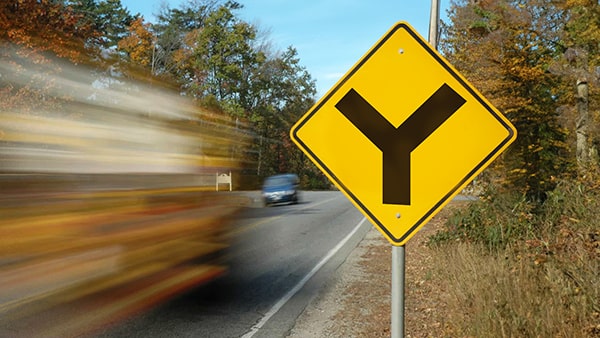
A yellow diamond-shaped sign displays a black Y-shaped symbol. What does it warn of?

This sign warns drivers to _____________.
  1. A A T-intersection ahead
  2. B A Y-intersection ahead
  3. C A road construction area ahead
  4. D A dip at the next intersection

Correct answer: B – A Y-intersection ahead

The black Y-shaped symbol identifies a Y-intersection ahead. Intersection warning signs depict the general layout of the approaching junction and warn of the possibility of turning or entering traffic. A T-intersection, roadway dip, and construction zone use different warning signs.

Source: Manual on Uniform Traffic Control Devices, 11th ed., Revision 1 — § 2C.41, “Intersection Warning Signs (W2-1 through W2-8)”