


Vermont CDL Practice Test: General Knowledge (VT) 6

5 out of 5 (39 votes)
80% Passing score
50 Questions
10 Mistakes allowed
Welcome to your sixth Vermont CDL General Knowledge Practice Test. This permit practice test is specifically designed to provide you with an authentic practice experience that closely mirrors the real DMV permit test in 2026. Our practice materials cover a broad range of subjects, including vehicle equipment, emergency prevention and handling, accident procedures, and pre-trip inspections. You will also encounter CDL test questions about hazardous materials, despite not applying for a HazMat endorsement at this stage. It's important to know certain aspects of HazMat materials as every driver needs to be aware of them for safety reasons. This Vermont CDL practice test comprises 50 sample DMV questions, and you need to correctly answer at least 40 to pass. The same set of CDL questions and answers will appear each time you take the test, allowing you to familiarize yourself with the content and improve your understanding with each attempt. This method is particularly beneficial for comprehensive learners who aim to grasp the subject matter deeply, rather than just memorizing answers. Our Vermont permit practice test is designed with your convenience in mind. You can customize your study sessions to focus on areas where you need more practice. Whether you're struggling with specific topics or just want to ensure you're thoroughly prepared, you can take the CDL practice test multiple times to improve your score. Additionally, the practice sessions can be done at your convenience, allowing you to study at a time that works best for you. To enhance your learning experience, our Vermont DMV CDL practice test also incorporates visual aids. These include images of road signs and traffic scenarios, which are particularly helpful for visual learners. By using these aids, you can better understand and remember the material, ensuring you're well-prepared for the real test day. Take advantage of this comprehensive practice tool to build your confidence and knowledge. Our Vermont CDL practice test aims to provide you with a realistic and thorough preparation experience, helping you to succeed in obtaining your CDL in 2026!
FREE CDL Practice Test App
Pass your Vermont CDL General Knowledge test with the NextDoorDriving app. Real questions and answers—100% free and ad-free.
Download on the App Store

Sample Vermont CDL Test Questions - General Knowledge

Question 1

When a CMV is stopped on a one-way or divided highway, where should the three reflective triangles be placed?

  1. A Within 10 feet of the rear, then 100 feet and 200 feet toward approaching traffic
  2. B 25 feet, 100 feet, and 250 feet toward approaching traffic
  3. C 50 feet, 100 feet, and 300 feet toward approaching traffic
  4. D 75 feet, 100 feet, and 400 feet toward approaching traffic

Correct answer: A – Within 10 feet of the rear, then 100 feet and 200 feet toward approaching traffic

On a one-way or divided highway, place one warning device at the traffic side of the CMV within 10 feet of its rear. Place the other two devices 100 feet and 200 feet toward approaching traffic, in the center of the lane or shoulder occupied by the CMV. Warning devices generally must be placed as soon as possible and within 10 minutes.

Source: Vermont Commercial Driver’s Manual — § 2.5.2, “When Parked at the Side of the Road”, 49 CFR § 392.22(b)(1), (b)(1)(v) — Emergency signals; stopped commercial motor vehicles
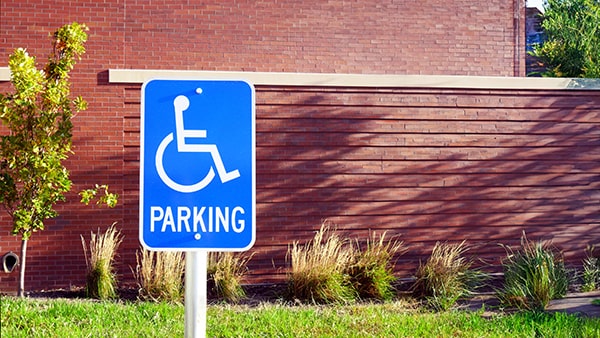
Question 2

A parking sign displays the International Symbol of Access. What does the sign indicate?

This sign indicates ___________.
  1. A Parking is reserved for eligible vehicles displaying the required disability plate or placard
  2. B Parking is prohibited for every vehicle
  3. C The space is available for unrestricted public parking
  4. D The space has only a general time limit

Correct answer: A – Parking is reserved for eligible vehicles displaying the required disability plate or placard

In Vermont, the International Symbol of Access identifies a parking space designated for eligible individuals with disabilities. It is not an unrestricted or merely time-limited parking space. A vehicle using the parking privilege must qualify under the applicable requirements and properly display an authorized disability plate or placard.

Source: 20 V.S.A. § 2904 — Parking spaces, 23 V.S.A. § 304a(a)(6), (c)–(e) — Special registration plates and placards for individuals with disabilities

Question 3

Correctly adjusted mirrors eliminate every blind spot around a school bus.

  1. A True
  2. B False

Correct answer: B – False

The statement is false. Vermont’s CDL manual identifies blind spots immediately below and in front of the outside flat mirrors and directly behind the rear bumper; the area behind the bus can be especially large. Drivers must properly adjust and systematically check all mirrors to obtain the greatest possible view of students, traffic, and objects around the bus.

Source: Vermont Commercial Driver’s Manual — § 10.1.2, “Correct Mirror Adjustment”; § 10.1.3, “Outside Left and Right Side Flat Mirrors”

Question 4

During normal braking in a CMV equipped with ABS, what technique should you use?

  1. A Use less pedal pressure solely because ABS is installed
  2. B Brake normally, using only the force needed to stop safely and remain in control
  3. C Always press the brake pedal as hard as possible
  4. D Release the accelerator and wait for ABS to apply the brakes

Correct answer: B – Brake normally, using only the force needed to stop safely and remain in control

Brake normally in a vehicle equipped with ABS, using only the force necessary to stop safely and maintain control. ABS activates when wheels are about to lock; it does not begin braking when you release the accelerator. A straight truck or combination vehicle with working ABS on every axle may receive full brake application during an emergency stop.

Source: Vermont Commercial Driver’s Manual — § 2.18.6, “Braking with ABS”

Question 5

What can happen during a rear drive-wheel braking skid while towing a trailer?

  1. A The trailer can push the towing vehicle sideways into a jackknife
  2. B The locked drive wheels gain more traction than rolling wheels
  3. C The skid cannot result in a jackknife
  4. D Only the front wheels move sideways

Correct answer: A – The trailer can push the towing vehicle sideways into a jackknife

A rear drive-wheel braking skid occurs when the rear drive wheels lock. Because locked wheels have less traction, the rear of the towing vehicle can slide sideways. When a trailer is attached, it can continue pushing the towing vehicle and cause a sudden jackknife.

Source: Vermont Commercial Driver’s Manual — § 2.19.1, “Drive-wheel Skids”

Question 6

Which preparation helps prevent distractions before you begin driving?

  1. A Eat a large meal immediately before the trip
  2. B Depend on coffee to maintain attention
  3. C Learn the vehicle’s features, adjust controls and mirrors, and program equipment before moving
  4. D Keep the phone ready so messages can be read without reaching for it

Correct answer: C – Learn the vehicle’s features, adjust controls and mirrors, and program equipment before moving

Vermont’s CDL manual recommends eliminating in-vehicle distractions before driving begins. Become familiar with the vehicle’s equipment, adjust the controls and mirrors, program radio stations or navigation, plan the route, and secure loose objects before moving. Do not type or read text messages while driving.

Source: Vermont Commercial Driver’s Manual — § 2.9.6, “Don’t Drive Distracted”