


Vermont Class A CDL Practice Test (VT) 8

5 out of 5 (34 votes)
80% Passing score
50 Questions
10 Mistakes allowed
As a driver aiming to get your Class A CDL, it's crucial to be well-prepared for the DMV written test, and our eighth Vermont CDL practice test is an excellent tool for that preparation. This practice test consists of 50 CDL test questions, designed to challenge and enhance your knowledge. To pass, you'll need to answer at least 40 questions correctly. This Vermont permit practice test is specifically tailored for Class A CDL applicants and includes a comprehensive range of subjects to ensure you're ready for any question the DMV might throw at you in 2026. Our Vermont class A CDL practice test covers essential topics like pre-trip vehicle inspections, basic vehicle control, and gear shifting, including the often-tricky downshifting. You'll also encounter DMV test questions on handling hills and steep downgrades, effective communication with other drivers, controlling speed, and understanding drug and alcohol regulations. Each question is crafted to mirror the format and content of the actual Vermont permit test in 2026, giving you a realistic preview of what to expect. One of the standout features of our Vermont CDL practice test is the variety in the questions. We draw from a large pool of questions to cover a broad spectrum of material, ensuring you get a well-rounded preparation. No matter how many times you take this VT class A CDL practice test, you'll encounter the same set of sample DMV questions, allowing you to measure your progress accurately and identify areas that need more focus. Moreover, we ensure that our Vermont permit practice test is always up-to-date with the latest regulations and requirements for 2026. This means you're studying the most current and relevant information, which is vital for your success. By regularly updating the DMV practice test, we help you stay ahead and feel confident on test day. Practicing with our Vermont CDL prep test not only boosts your knowledge but also builds your confidence, making the actual DMV permit test seem less daunting. By familiarizing yourself with the 2026 CDL test format and the types of questions, you can reduce anxiety and improve your chances of passing on the first try. So, dive into this Vermont CDL practice test and take a significant step towards earning your Class A CDL in 2026!
FREE CDL Practice Test App
Pass your Vermont CDL General Knowledge test with the NextDoorDriving app. Real questions and answers—100% free and ad-free.
Download on the App Store

Sample Vermont CDL Test Questions - General Knowledge

Question 1

What are the two functions of a combination vehicle’s emergency air line?

  1. A It supplies air to the trailer tanks
  2. B It controls the trailer emergency brakes
  3. C It performs both functions
  4. D It performs neither function

Correct answer: C – It performs both functions

The emergency or supply line carries air to the trailer’s air tanks and controls the trailer emergency brakes. If pressure is lost through this line, the trailer emergency brakes apply. Pressure loss may result from a broken hose, damaged tubing, or a trailer separating from the power unit.

Source: Vermont Commercial Driver’s Manual — § 6.2.4, “Trailer Air-lines”
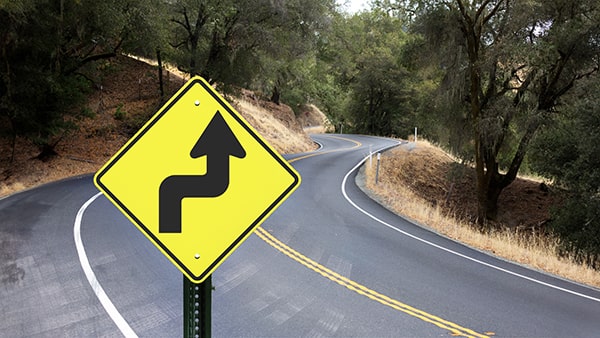
Question 2

A yellow diamond sign shows an angular arrow turning right and then left. What does it warn of?

This sign warns drivers to  _____________.
  1. A A gentle right curve followed by a left curve
  2. B One sharp right turn
  3. C One sharp left turn
  4. D A sharp right turn followed by a sharp left turn

Correct answer: D – A sharp right turn followed by a sharp left turn

This is a right reverse-turn warning sign. It is used where two roadway alignment changes in opposite directions are close together, with the first turn to the right. Approach at a speed that allows the commercial vehicle to negotiate both turns safely and remain within its lane.

Source: Manual on Uniform Traffic Control Devices, 11th ed. with Revision 1 — § 2C.07, “Horizontal Alignment Signs (W1-1 through W1-5, W1-11, and W1-15)”

Question 3

What should be the primary method of controlling speed on a long downgrade?

  1. A Brake whenever speed rises five mph above the safe speed
  2. B Use stab braking throughout the descent
  3. C Use the braking effect of the engine
  4. D Apply only the trailer brakes

Correct answer: C – Use the braking effect of the engine

Select a proper low gear before beginning the descent and use the engine’s braking effect as the principal means of controlling speed. The service brakes supplement engine braking when needed. Depending mainly on the service brakes can create excessive heat, leading to brake fade or failure.

Source: Vermont Commercial Driver’s Manual — § 2.6.6, “Speed on Downgrades”, Vermont Commercial Driver’s Manual — § 2.16.4, “Proper Braking Technique”

Question 4

How many red reflective warning triangles must a commercial motor vehicle carry?

  1. A Two
  2. B Four
  3. C One
  4. D Three

Correct answer: D – Three

Federal equipment rules require a power unit to carry three bidirectional emergency reflective triangles unless it carries an authorized alternative set of warning devices. The Vermont manual likewise lists three red reflective triangles as standard emergency equipment. These devices must be available for warning approaching traffic after an emergency stop.

Source: Vermont Commercial Driver’s Manual — § 2.1.5, “Seven-step Inspection Method—Check Emergency Equipment”, 49 CFR § 393.95(f)(2)(i) – Emergency equipment on all power units

Question 5

A commercial vehicle stops on a level, straight, undivided highway. Where should its three warning triangles be placed?

  1. A One within 10 feet on the traffic side, one about 100 feet ahead, and one about 100 feet behind
  2. B At 10, 100, and 200 feet behind the vehicle
  3. C At 100 feet ahead and at 100 and 200 feet behind
  4. D At 100, 200, and 500 feet behind the vehicle

Correct answer: A – One within 10 feet on the traffic side, one about 100 feet ahead, and one about 100 feet behind

On an undivided road carrying traffic in both directions, place one device near the vehicle on its traffic side. Place the other devices approximately 100 feet in each direction from the stopped vehicle. The Vermont manual describes this as one location marker within 10 feet and one warning device ahead and behind.

Source: Vermont Commercial Driver’s Manual — § 2.5.2, “Communicating Your Presence—When Parked at the Side of the Road”, 49 CFR § 392.22(b)(1) – Emergency signals; stopped commercial motor vehicles

Question 6

Which type of vehicle fire may require large quantities of water for cooling?

  1. A A tire fire
  2. B A gasoline fire
  3. C A diesel-fuel fire
  4. D An electrical fire

Correct answer: A – A tire fire

A burning tire must be cooled thoroughly, and a large amount of water may be required. Water should not be used on an electrical fire because of the shock hazard. It should also not be used on gasoline or similar burning liquids because it can spread the flames.

Source: Vermont Commercial Driver’s Manual — § 2.20.4, “Extinguishing Fires—Use the Right Fire Extinguisher”