


Vermont Road Signs Test

4.9 out of 5 (37 votes)
80% Passing score
10 Questions
2 Mistakes allowed
This Vermont DMV signs practice test gives you a focused way to study the road sign material that shows up on the state’s learner permit exam. And, just to be clear because this trips people up sometimes, Vermont does not run a separate road-sign-only test for a standard learner permit. Road signs are folded into the main knowledge test, along with traffic laws, signals, pavement markings, safe driving rules, and all the usual “do you actually understand what’s happening on the road?” material. The official Vermont learner permit test is taken online through myDMV, not at a DMV office. It has 20 multiple-choice questions, each with 4 answer choices, and you need 16 correct to pass. That is 80%, which sounds comfortable for about three seconds, then you remember that missing 5 questions means you are retaking it — after waiting at least 1 day, no less. So yes, the numbers are simple. The margin is still a little tighter than people like to admit. This Vermont road signs practice test stays tightly focused on the visual side of the exam: regulatory signs, warning signs, guide signs, traffic signals, work-zone signs, lane markings, pavement markings, intersection controls, and the little shape-and-color clues that matter more than they seem to at first glance. A red octagon is easy. A yellow warning sign with a symbol you half-recognize, under test pressure, with answer choices that all sound vaguely responsible? That is where practice starts earning its keep. Every question is designed to help you recognize signs quickly and connect them to real driving decisions, not just memorize a picture and hope it sticks. Vermont roads can be rural, winding, snowy, wet, dark earlier than you expected — anyway, the point is that signs are not decoration. They tell you what the road is about to do, what other drivers may do, and what the law expects you to do next. Use this free Vermont permit practice test as a targeted study tool before the real online knowledge test. Work through the questions, pay attention to the ones you miss, and come back to them until the signs feel familiar in a useful way, not just familiar because you saw them once five minutes ago.
FREE DMV Practice Test App
Study for your Vermont permit test or driver’s license with the NextDoorDriving app. 700+ DMV questions and answers, 100% free!
Download on the App Store

Sample Vermont Permit Test Questions

Question 1

What does this cross-shaped warning symbol indicate?
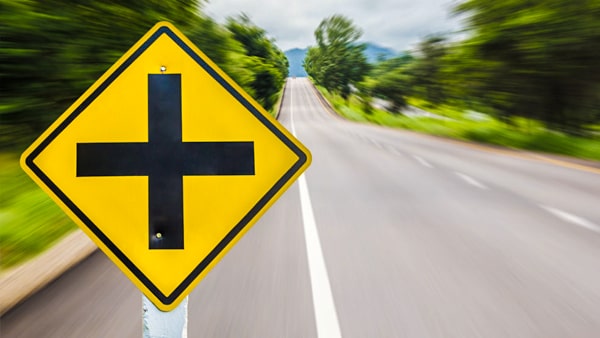
This sign means:
  1. A A church
  2. B A first-aid station
  3. C A crossroad intersection ahead
  4. D A railroad crossing

Correct answer: C – A crossroad intersection ahead

This is the Cross Road warning sign. It gives advance notice that another roadway crosses the driver’s roadway ahead and that turning or entering traffic may be present. It is an intersection warning sign rather than a service or railroad sign.

Source: 23 V.S.A. § 1025 – Standards, Manual on Uniform Traffic Control Devices for Streets and Highways, 11th Edition with Revision 1 — § 2C.41, “Intersection Warning Signs (W2-1 through W2-8)”

Question 2

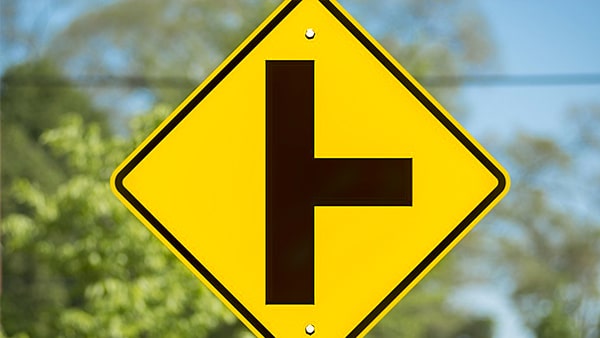
What roadway condition is shown by this warning sign?

This sign means:
  1. A All traffic must turn right
  2. B A side road enters from the right
  3. C All traffic must continue straight
  4. D Right turns are prohibited

Correct answer: B – A side road enters from the right

The Side Road warning sign indicates that another roadway enters from the side shown by the symbol. Here, the branch is on the right, indicating a side road ahead on that side. Because it is a warning sign, it does not require a right turn or prohibit one.

Source: 23 V.S.A. § 1025 – Standards, Manual on Uniform Traffic Control Devices for Streets and Highways, 11th Edition with Revision 1 — § 2C.41, “Intersection Warning Signs (W2-1 through W2-8)”
Question 3

What may a driver do when facing a steady circular green signal?

  1. A Slow and prepare to stop without entering
  2. B Stop before making any movement
  3. C Proceed if the way is clear, while yielding as required
  4. D Proceed straight but never turn right

Correct answer: C – Proceed if the way is clear, while yielding as required

Under Vermont law, traffic facing a circular green signal may proceed straight or turn unless a sign prohibits the turn. Drivers must yield to vehicles or pedestrians lawfully within the intersection or an adjacent crosswalk when the green signal appears. A green light permits movement only after these duties are satisfied.

Source: 23 V.S.A. § 1022(a)(1)(A) – Traffic-control signals

Question 4

When may a driver cross a solid yellow centerline without using the opposing lane to pass?

  1. A Whenever traffic ahead is moving slowly
  2. B Only during daylight
  3. C Whenever no vehicle is immediately visible
  4. D To turn left into an alley, private road, or driveway when safe

Correct answer: D – To turn left into an alley, private road, or driveway when safe

Vermont’s limitations on driving left of the center do not apply when making a left turn into an alley, private road, or driveway. The driver must yield to approaching traffic that presents an immediate hazard. The turn also may not be started unless it can be made with reasonable safety.

Source: 23 V.S.A. § 1035(c) – Limitations, 23 V.S.A. § 1047 – Vehicle turning left, 23 V.S.A. § 1064(b) – Signals required; general obligation to turn and move safely

Question 5

A solid yellow line is beside a broken yellow line, and the broken line is next to your lane. When may you pass?

When the road is marked with a solid yellow line and a broken yellow line on your side you may pass:
  1. A Only when responding to an emergency
  2. B Only on a controlled-access highway
  3. C When passing is otherwise legal and the opposing lane is clear
  4. D Only while traveling through an intersection

Correct answer: C – When passing is otherwise legal and the opposing lane is clear

The broken yellow line next to your lane indicates that crossing the centerline to pass is permitted with care. Vermont law also requires the left side to be clearly visible and free of oncoming traffic for enough distance to complete the maneuver safely. The passing vehicle must return to an authorized lane before coming within 200 feet of approaching traffic.

Source: 23 V.S.A. § 1025 – Standards, Manual on Uniform Traffic Control Devices for Streets and Highways, 11th Edition with Revision 1 — § 3B.01, “Yellow Center Line Pavement Markings”, 23 V.S.A. § 1035(a) – Limitations

Question 6

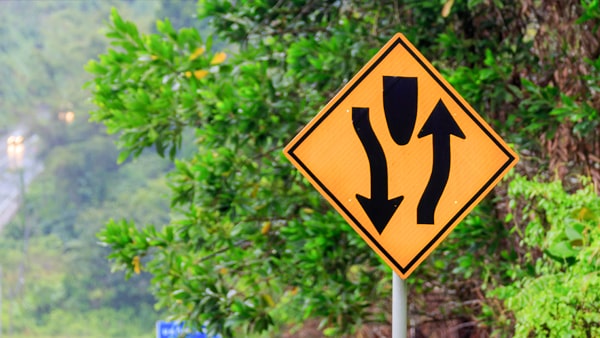
What change does this divided-highway warning sign announce?

This sign means:
  1. A A divided highway ends
  2. B A one-way street begins
  3. C A one-way street ends
  4. D A divided highway begins

Correct answer: D – A divided highway begins

The Divided Highway sign warns that opposing traffic will soon be separated by a median or another physical barrier. It is placed on the approach to the beginning of the divided section. Drivers must follow the roadway on the right side of the divider.

Source: 23 V.S.A. § 1025 – Standards, Manual on Uniform Traffic Control Devices for Streets and Highways, 11th Edition with Revision 1 — § 2C.20, “Divided Highway Sign (W6-1)”