


Virginia CDL Class B Practice Test (VA) 3

4.9 out of 5 (90 votes)
80% Passing score
20 Questions
4 Mistakes allowed
Get ready to ace your CDL Class B test with our comprehensive Virginia CDL Class B Practice Test. This is the third in our series of DMV practice tests, designed to provide you with a robust preparation experience. Our VA permit practice test features 20 carefully curated questions, covering an extensive range of topics critical for CDL Class B applicants. You'll encounter questions on pre-trip vehicle inspections, basic vehicle control, and the intricacies of shifting gears, including downshifting. Additionally, the DMV practice test tackles essential subjects like handling hills and steep downgrades, effective communication with other drivers, speed control, and drug and alcohol awareness. Our Virginia CDL class B practice test stands out because it is regularly updated to reflect the latest driving laws and regulations in Virginia, ensuring that you are studying the most current information available. This 2026 update guarantees that the content is both relevant and reliable. As you work through your Virginia CDL practice test, you'll receive immediate feedback on each question. This feature not only lets you know if you answered correctly but also provides detailed explanations to help you understand why an answer is correct or incorrect. This method of learning through feedback ensures that you can improve your knowledge and comprehension effectively. Upon completing this Virginia class B DMV practice test, you'll receive a comprehensive summary of your performance. This summary highlights the questions you got wrong and provides the correct answers, giving you a clear understanding of areas where you need improvement. This feedback loop is invaluable for identifying and targeting weak spots in your knowledge, ensuring you're thoroughly prepared for the actual Virginia CDL permit test. Whether you are taking this Virginia DMV practice test for the first time or revisiting it to gauge your progress, the same set of questions will appear, allowing you to track your improvement over time. Our goal is to provide you with the tools and confidence needed to pass your Virginia CDL Class B test in 2026 with flying colors!
FREE CDL Practice Test App
Pass your Virginia CDL General Knowledge test with the NextDoorDriving app. Real questions and answers—100% free and ad-free.
Download on the App Store

Sample Virginia CDL Test Questions - General Knowledge

Question 1

In Virginia, a yellow BUMP warning sign identifies what roadway condition ahead?

This sign warns drivers to _____________.
  1. A. A long, low area in the pavement
  2. B. A sharp rise in the roadway profile
  3. C. A section where drivers should increase speed
  4. D. A depression marked by a DIP sign

Correct answer: B. – A sharp rise in the roadway profile

A BUMP sign warns of a sharp rise in the roadway profile. A DIP sign is used for a depression, making the two signs distinct even though both concern vertical changes in the road. The sign identifies a condition that may require a driver to adjust speed and vehicle control. It does not direct a driver to accelerate.

Source: 24VAC30-315-10 – General provisions, Manual on Uniform Traffic Control Devices for Streets and Highways, 11th ed. — § 2C.26, “BUMP and DIP Signs (W8-1 and W8-2)”
Question 2

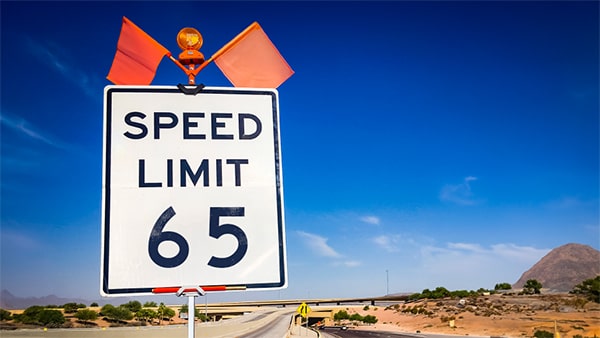
A Virginia SPEED LIMIT 65 sign with no time restriction means:

This sign instructs drivers to _____________.
  1. A. The limit is 65 mph during daylight only
  2. B. Traffic must travel at least 65 mph
  3. C. Drivers may not exceed 65 mph during either day or night
  4. D. The limit applies only after dark

Correct answer: C. – Drivers may not exceed 65 mph during either day or night

A posted 65 mph speed limit is the maximum permitted speed unless another sign establishes a different limit or condition. Virginia law allows separate daytime and nighttime limits only when those limits are properly established and displayed by signs. A single SPEED LIMIT 65 sign does not require drivers to maintain 65 mph. Road, weather, or traffic conditions may require a lower speed.

Source: Va. Code § 46.2-878 – Authority to change speed limits

Question 3

On dry pavement with good visibility, how much following time should a 40-foot commercial vehicle maintain at 45 mph?

  1. A. 2 seconds
  2. B. 3 seconds
  3. C. 4 seconds
  4. D. 5 seconds

Correct answer: D. – 5 seconds

A recommended following-distance rule is one second for each 10 feet of vehicle length at speeds below 40 mph. A 40-foot vehicle starts with four seconds. Because the speed is above 40 mph, one additional second is needed, producing a five-second interval. Slippery roads or other adverse conditions require substantially more space.

Source: Virginia Commercial Driver’s License Manual — Section 2, § 2.7.1, “Space Ahead”

Question 4

Under Virginia law, how many red reflectorized triangular warning devices must be placed for a stopped commercial motor vehicle?

  1. A. 1
  2. B. 2
  3. C. 3
  4. D. 4

Correct answer: C. – 3

Three red reflectorized triangular warning devices must be placed for a qualifying stopped commercial motor vehicle. The vehicle’s hazard flashers must be activated immediately, and the triangles must be placed as soon as possible, but within 10 minutes. Their required positions provide warning near the vehicle and in the directions from which traffic approaches.

Source: Virginia Commercial Driver’s License Manual — Section 2, § 2.1.3, “Emergency Equipment”, Va. Code § 46.2-111.A – Flares and other signals relating to stopped commercial motor vehicles

Question 5

If a commercial vehicle’s speed is doubled, approximately what happens to its braking distance?

  1. A. It remains about the same
  2. B. It becomes about twice as long
  3. C. It becomes about four times as long
  4. D. It becomes about eight times as long

Correct answer: C. – It becomes about four times as long

Doubling speed increases braking distance to approximately four times its previous length. For example, the manual compares an increase from 20 mph to 40 mph and explains that both braking distance and impact force become about four times greater. This relationship is one reason even a moderate increase in speed can sharply reduce the distance available to stop safely.

Source: Virginia Commercial Driver’s License Manual — Section 2, “The Effect of Speed on Stopping Distance”

Question 6

At night, a commercial driver should always use low beams, even when high beams are safe and lawful.

  1. A. True
  2. B. False

Correct answer: B. – False

The Virginia CDL manual advises using high beams when it is safe and legal because always using low beams reduces how far ahead you can see. State law requires low beams on sufficiently lighted roads, within 500 feet of an oncoming vehicle, and when approaching from behind or following within 200 feet. Outside those situations, high beams can improve nighttime visibility when they do not interfere with other traffic.

Source: Virginia Commercial Driver’s License Manual — Section 2, “Use High Beams When You Can”, Va. Code § 46.2-1034 – When dimming headlights required