Virginia DMV Practice Test 2

4.8 out of 5 (894 votes)
80% Passing score
20 Questions
4 Mistakes allowed
This Virginia DMV practice test is meant to do more than run you through a quick set of questions. It gives you 20 multiple-choice questions modeled around the VA DMV written test, with hints when you are close but not quite there, and explanations when you miss something. That part matters more than people sometimes admit, because a wrong answer on seat belt rules, signs, right-of-way, or basic road law is usually not about being careless. A lot of the time, it is just the wording, the small exception, the one detail you skimmed because it seemed obvious enough. Virginia’s licensing process has a few of those details. If you are under 18, you can apply for a learner’s permit at 15 years and 6 months, but you will need the required documents, fees, a vision screening, the two-part knowledge exam, and parent or guardian consent unless you are emancipated. If you are 18 or older and this is your first license, you still need the knowledge exam and vision screening, and if you have never held a license before, Virginia may require an approved driver education course or at least 60 days with a learner’s permit before the road skills test. Not complicated, exactly, but it is a process with steps, and missing one can slow things down. The actual Virginia knowledge exam is multiple choice and taken on a computer at DMV customer service centers, with some school-based testing available through participating programs. Oral exams are available by request, and Virginia offers the test in many languages, including English, Spanish, Arabic, Korean, Vietnamese, American Sign Language, and others. Audio support and disability accommodations are also available, which is worth knowing before you are standing at the counter trying to figure it out in real time. Retake rules are where preparation starts to feel practical instead of theoretical. Under-18 applicants who fail the knowledge exam must wait a full 15 days before testing again. Adults may retest once per business day, but after three failed attempts, classroom driver education is required before a fourth try. So this VA DMV permit practice test is not just a warm-up. It is a way to catch weak spots early, tighten up the rules you half-remember, and walk into the DMV with fewer surprises.
FREE DMV Practice Test App
Study for your Virginia permit test or driver’s license with the NextDoorDriving app. 700+ DMV questions and answers, 100% free!
Download on the App Store

Sample Virginia Permit Test Questions

Question 1

A driver extends the left hand and arm upward. What maneuver is being signaled?

  1. A A left turn
  2. B A right turn
  3. C Slowing or stopping
  4. D Continuing straight

Correct answer: B – A right turn

An upward left hand and arm signal indicates a right turn or movement to the right. A horizontal left arm signals a left turn, while a downward left arm signals slowing or stopping. Certain riders, including bicyclists, may alternatively signal a right turn by extending the right arm horizontally.

Source: Va. Code § 46.2-849 — How Signals Given, Virginia Driver’s Manual — § 3, “Hand Signals”

Question 2

Double solid yellow centerlines must not be crossed for which maneuver?

  1. A Turning left onto another road
  2. B Turning left into a private driveway
  3. C Passing another motor vehicle
  4. D Safely passing a bicyclist when the opposite lane is clear

Correct answer: C – Passing another motor vehicle

Double solid yellow lines separate opposing traffic and prohibit crossing to pass another motor vehicle. Virginia permits crossing them to turn left. The law also provides a limited exception for safely passing a pedestrian or human-powered device, including a bicycle, when the maneuver can be made safely.

Source: Va. Code § 46.2-804 — Special Regulations Applicable on Highways Laned for Traffic; Penalty

Question 3

Which group lists maneuvers for which a Virginia driver should use a turn signal?

  1. A Turns only
  2. B Lane changes only
  3. C Entering or exiting a highway only
  4. D Turns, lane changes, and entering or exiting a highway

Correct answer: D – Turns, lane changes, and entering or exiting a highway

Use the proper signal before turning, changing lanes, or entering or exiting a highway. A signal communicates your intended movement to nearby road users but does not guarantee that the way is clear. Check your mirrors, surrounding traffic, and blind spots before beginning the maneuver.

Source: Va. Code § 46.2-848 — Signals Required on Backing, Stopping, or Turning, Virginia Driver’s Manual — § 3, “Turn Signals”

Question 4

Who must make sure a medication will not impair you before you drive?

Who is responsible for knowing how your medications affect your driving?
  1. A The driver taking the medication
  2. B The prescribing doctor
  3. C The dispensing pharmacist
  4. D A DMV employee

Correct answer: A – The driver taking the medication

Before driving, read medication labels and look for warnings about drowsiness, dizziness, reduced alertness, or slower reactions. Prescription and over-the-counter medicines can both affect driving ability. If you are uncertain about a drug’s effects, ask a doctor or pharmacist for advice before getting behind the wheel.

Source: Virginia Driver’s Manual — § 3, “Drowsy Driving” and “Drunk and Drugged Driving”

Question 5

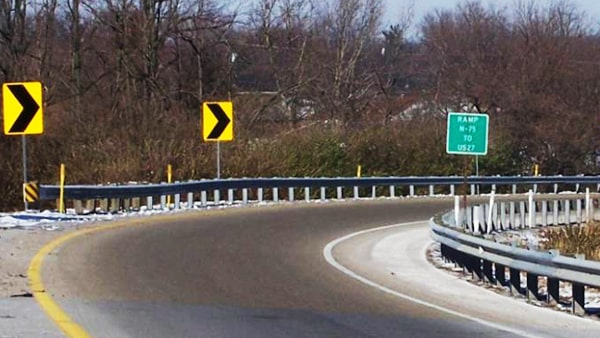
An exit ramp curves downhill. When should you reduce to a safe ramp speed?

If you exit a freeway with a ramp that curves downhill, you should:
  1. A Only after reaching the freeway’s posted speed
  2. B After you are well into the curve
  3. C Before entering the curve
  4. D After accelerating into the curve

Correct answer: C – Before entering the curve

An advisory-speed sign identifies the maximum safe speed for a highway exit, and curve warnings tell drivers to slow down for better control. Reduce your speed while approaching the curve rather than accelerating or waiting until you are deep into it. Continue at a controlled speed appropriate for the ramp and roadway conditions.

Source: Virginia Driver’s Manual — § 2, “Advisory Speed” and “Winding Road”, Virginia Driver’s Manual — § 3, “Over-Correcting”

Question 6

At an uncontrolled intersection, what should you do instead of automatically waving every other driver through?

  1. A Always give priority to the driver on your left
  2. B Follow the right-of-way order and proceed when it is your turn and safe
  3. C Remain stopped until no other vehicle is visible

Correct answer: B – Follow the right-of-way order and proceed when it is your turn and safe

The vehicle arriving first at an uncontrolled intersection normally proceeds first. If vehicles arrive at the same time, the driver on the left yields to the driver on the right. Follow that order while checking that the intersection is clear rather than creating a different sequence by automatically waving everyone else ahead.

Source: Virginia Driver’s Manual — § 3, “Yielding the Right-of-Way”