


Virginia DMV Practice Test 5

4.9 out of 5 (417 votes)
80% Passing score
20 Questions
4 Mistakes allowed
This fifth Virginia DMV permit practice test gives you 20 questions centered on DUI laws, blood alcohol content (BAC), alcohol impairment, and the penalties that follow impaired driving. That is a fairly specific slice of the Virginia DMV test, but it is an important one, because alcohol-related questions are not there as filler. They test whether you understand how Virginia treats impaired driving, how BAC limits work, and why “I thought I was fine to drive” is not much of a defense once the law gets involved. The practice test is untimed, which is more useful than it sounds. You are not being pushed through the questions just to produce a score and move on. You can sit with the wording, look at the answer choices, and actually learn from the explanations. Some questions include images and visual cues, too, which helps when the topic shifts from plain legal language into real driving judgment — road situations, signs, and those little details that are easy to skim past when you are only reading the manual. There is also the bigger licensing process to keep in mind, especially for adults. In Virginia, a resident age 18 or older who has never held a driver’s license from any state, U.S. territory, or foreign country generally has two options. One is the driver education route: complete an approved driver education program, pass the knowledge exam, apply for and receive a learner’s permit, and complete the end-of-course skills exam. Doing that can waive the required 60-day permit holding period and the DMV-administered road skills test. The other option is more direct, but slower: hold a Virginia learner’s permit for at least 60 days, complete the Behind-the-Wheel Checklist, and then take the road skills test at the DMV. And, because licensing always comes with paperwork — no way around that part — adult applicants also need documents proving identity, legal presence, Virginia residency, and a Social Security number if one has been issued. Updated for 2026, this VA DMV permit practice test keeps the focus where it belongs: current Virginia driving laws, practical permit test preparation, and the kind of DUI knowledge that matters long after the test is over.
FREE DMV Practice Test App
Study for your Virginia permit test or driver’s license with the NextDoorDriving app. 700+ DMV questions and answers, 100% free!
Download on the App Store

Sample Virginia Permit Test Questions

Question 1

In Virginia, which statement about medication and driving is correct?

Which of these statements is true about driving and taking drugs?
  1. A Only illegal drugs can interfere with safe driving
  2. B Over-the-counter medication can impair driving
  3. C Prescription medicine is safe for driving whenever you feel awake
  4. D Every medicine affects all drivers in the same way

Correct answer: B – Over-the-counter medication can impair driving

Prescription and over-the-counter medications can cause drowsiness, dizziness, reduced alertness, or slower reactions. Read the warning label and consult a doctor or pharmacist if you are uncertain about a drug's effects. Driving under the influence of any drug to a degree that impairs safe operation violates § 18.2-266; a first offense is a Class 1 misdemeanor with a mandatory minimum $250 fine.

Source: Va. Code § 18.2-266 – Driving motor vehicle, engine, etc., while intoxicated, etc., Va. Code § 18.2-270(A) – Penalty for driving while intoxicated; subsequent offense; prior conviction, Virginia Driver’s Manual — Section 3, “Drunk and Drugged Driving”
Question 2

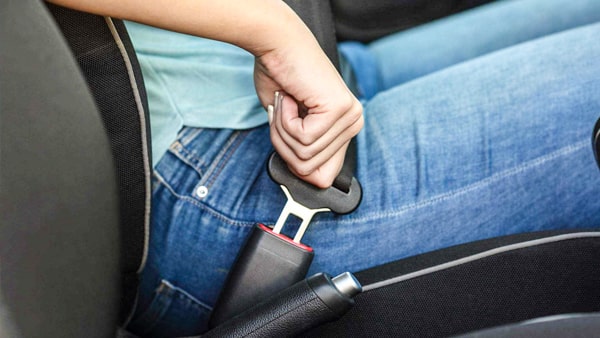
How should a combination lap-and-shoulder safety belt be used?

  1. A Use only the lap portion during low-speed trips
  2. B Wear both portions snugly in their proper positions
  3. C Place the shoulder portion behind your back
  4. D Keep both portions loose for easier movement

Correct answer: B – Wear both portions snugly in their proper positions

Wear the lap portion low across your lap and against your thighs. The shoulder portion should cross your chest and shoulder, not pass under your arm or behind your back. Both portions should fit snugly so the complete restraint can protect you as designed during a crash.

Source: Virginia Driver’s Manual — Section 4, “Seat Belts”

Question 3

In Virginia’s driver’s manual, a yellow-painted curb used as a parking restriction indicates:

  1. A Parking is prohibited in that area
  2. B Parking is limited to commercial vehicles
  3. C The space is reserved for persons with disabilities

Correct answer: A – Parking is prohibited in that area

The manual lists areas marked by yellow-painted curbs among the places where parking is prohibited. A yellow curb does not by itself designate commercial loading or accessible parking. Drivers should also observe nearby signs because they may provide additional parking restrictions or instructions.

Source: Virginia Driver’s Manual — Section 3, “Parking”

Question 4

Seat belts provide the greatest protection when they are worn by:

Seat belts can be most effective as injury preventive devices when they are worn by:
  1. A Only the driver
  2. B Passengers only during long trips
  3. C Everyone, but only on expressways
  4. D The driver and all passengers on every trip

Correct answer: D – The driver and all passengers on every trip

Every occupant should be properly restrained whenever the vehicle is used. Safety belts increase the chances of surviving a crash and avoiding serious injury, regardless of trip length or type of road. Lap and shoulder portions should be snug and positioned correctly rather than placed under an arm or behind the back.

Source: Virginia Driver’s Manual — Section 4, “Seat Belts”

Question 5

Under Virginia’s regulatory definition, a momentary halt is not considered “stopping” when it is necessary to:

  1. A Unload packages quickly
  2. B Avoid a traffic conflict or obey an officer or traffic-control device
  3. C Let a passenger out
  4. D Wait for fewer than five minutes

Correct answer: B – Avoid a traffic conflict or obey an officer or traffic-control device

The regulatory definition of stopping excludes a halt required to avoid conflict with other traffic or to comply with a police officer or official traffic-control device. Drivers must obey lawfully erected traffic-control devices, including stopping restrictions. Loading packages, discharging passengers, or stopping briefly does not fall within the stated exception merely because the halt is short.

Source: Va. Code § 46.2-830 – Uniform traffic control devices on highways; drivers to obey traffic control devices; enforcement of section, 24VAC30-640-10 – Definitions

Question 6

Under Virginia turning rules, where should you enter a one-way street when turning left from a two-way street, unless traffic-control devices direct otherwise?

  1. A The right lane
  2. B The center of the roadway
  3. C The left lane
  4. D Whichever lane has the least traffic

Correct answer: C – The left lane

Approach the turn from the lane nearest the center line of the two-way street. After entering the intersection, complete the turn as nearly as practicable in the left lane lawfully available on the one-way street. Follow pavement markings or other traffic-control devices if they direct a different turning path.

Source: Va. Code § 46.2-846(A)(2)–(3), (B) – Required position and method of turning at intersections; local regulations