


Virginia DMV Permit Practice Test 7

4.9 out of 5 (281 votes)
80% Passing score
20 Questions
4 Mistakes allowed
This seventh Virginia DMV practice test is built for the part of studying where you stop casually recognizing the material and start proving you can actually use it. It gives you 20 questions drawn from the same general world as the real VA DMV knowledge test: road signs, pavement markings, traffic laws, safe driving choices, impaired-driving rules, sharing the road, and the everyday legal responsibilities that come with holding a learner’s permit. That includes things like proof of insurance, which is easy to treat as background information until it shows up as a real obligation. Virginia’s actual knowledge exam is more specific than many new drivers expect. It is based on the Virginia Driver’s Manual and is split into two parts: 10 road sign questions first, followed by 30 general knowledge questions. The sign section is the unforgiving part, honestly. You must answer all 10 sign questions correctly before you even move on to the rest of the exam. After that, you need 24 correct answers out of 30 on the general knowledge section, which comes out to 80%. So, no, the test is not really one big 40-question score where a few missed signs can be balanced out somewhere else. This practice DMV test uses a 16-out-of-20 passing score, matching that 80% benchmark in a smaller format. It is not trying to replace the Virginia Driver’s Manual, and it should not be treated like a shortcut around reading it. Still, it does something the manual cannot always do cleanly: it shows you where your understanding gets thin, especially when a rule is tucked inside a real driving situation instead of sitting there as a neat paragraph. Retakes are another reason to take the practice seriously. Applicants under 18 must wait a full 15 days after failing the knowledge exam, adults can test no more than once per business day, and after three failures, applicants have to complete the required classroom driver training before a fourth attempt. That is a lot of delay for material that can be reviewed ahead of time. Use this VA DMV practice test with the manual, road sign charts, flashcards, or a driver education course. Since it is online and available whenever you have time, it works well for repeated review—the kind of steady, slightly boring practice that usually makes the real Virginia permit test feel a lot more manageable.
FREE DMV Practice Test App
Study for your Virginia permit test or driver’s license with the NextDoorDriving app. 700+ DMV questions and answers, 100% free!
Download on the App Store

Sample Virginia Permit Test Questions

Question 1

Why should you maintain open space around your vehicle?
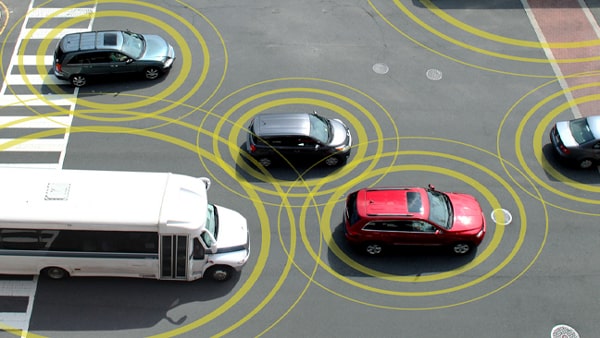
What is the benefit of a "space cushion" around your vehicle?
  1. A It prevents other drivers from entering your lane
  2. B It is necessary only when driving outside cities
  3. C It provides distance to react to an emergency
  4. D It allows you to ignore vehicles behind you

Correct answer: C – It provides distance to react to an emergency

A space cushion provides distance for braking or steering when a hazard develops. Maintain room ahead and behind, stay near the middle of your lane, and use an appropriate time interval behind the vehicle ahead. Increase that following interval when weather, traffic, pavement, or vehicle conditions make stopping more difficult.

Source: Virginia Driver’s Manual — § 3, “Maintaining a Space Cushion” ([dmv.virginia.gov](https://www.dmv.virginia.gov/sites/default/files/forms/dmv39.pdf))
Question 2

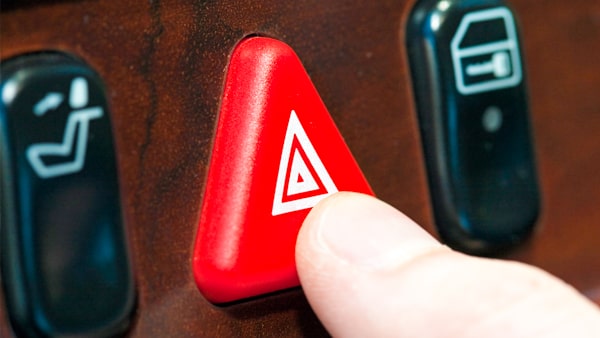
When must you activate your vehicle’s emergency flashers?

You should always use your emergency flashers when:
  1. A When double-parking in a travel lane
  2. B Whenever legally parked during fog
  3. C When a mechanical breakdown leaves the vehicle stopped on the roadway
  4. D When continuing to drive while tired

Correct answer: C – When a mechanical breakdown leaves the vehicle stopped on the roadway

Virginia law requires a vehicle’s emergency flashing lights to be turned on after an emergency, crash, or mechanical breakdown when the lights are available and working. If the vehicle can be moved safely and no one is injured or killed, the driver must move it from the roadway. It should be moved to the shoulder as soon as possible.

Source: Va. Code § 46.2-888 – Stopping on highways; removing motor vehicle from roadway ([law.lis.virginia.gov](https://law.lis.virginia.gov/vacodefull/title46.2/chapter8/?utm_source=openai))

Question 3

If the accelerator remains stuck while your vehicle is moving, what should you do to regain speed control?

  1. A Shift into Neutral and apply the service brakes
  2. B Pull the parking brake fully and immediately
  3. C Reach down and pull the pedal up by hand
  4. D Pump the brakes as quickly as possible

Correct answer: A – Shift into Neutral and apply the service brakes

Move the transmission into Neutral and use the regular brakes to slow the vehicle while maintaining steering control. Look for a safe place away from traffic and stop before turning off the ignition. Do not reach toward the pedal while moving, and do not depend on abruptly applying the parking brake to control the vehicle.

Source: Virginia Commercial Driver’s License Manual — § 2.3, “Shifting Gears” ([dmv.virginia.gov](https://www.dmv.virginia.gov/sites/default/files/forms/dmv60a.pdf)), Virginia Driver’s Manual — § 3, “Stopping” ([dmv.virginia.gov](https://www.dmv.virginia.gov/sites/default/files/forms/dmv39.pdf))

Question 4

Which combination of factors helps determine a person’s blood alcohol concentration?

  1. A Only the amount of alcohol consumed
  2. B Only the person’s body weight
  3. C Only how quickly the drinks are consumed
  4. D The amount consumed, drinking rate, and body weight

Correct answer: D – The amount consumed, drinking rate, and body weight

Blood alcohol concentration is affected by how much alcohol a person consumes, how quickly it is consumed, and the person’s body weight. Drinking faster allows alcohol to build up because the body processes it at a limited rate. A smaller person generally reaches the same BAC after consuming less alcohol than a larger person.

Source: Virginia Commercial Driver’s License Manual — § 2.22.1, “Alcohol and Driving” ([dmv.virginia.gov](https://www.dmv.virginia.gov/sites/default/files/forms/dmv60a.pdf))

Question 5

Which statement about large trucks, buses, and recreational vehicles is correct?

  1. A They generally require more distance to stop
  2. B Air brakes allow them to stop faster than cars
  3. C They can turn more sharply than passenger vehicles
  4. D Their drivers have no significant blind spots

Correct answer: A – They generally require more distance to stop

Trucks, tractor-trailers, buses, and recreational vehicles are longer, wider, and higher than most passenger vehicles. They accelerate slowly and require greater stopping and turning distances. They also have large blind areas, called No-Zones, along their sides and to the front and rear.

Source: Virginia Driver’s Manual — § 3, “Trucks, Tractor-Trailers, Buses and RVs” ([dmv.virginia.gov](https://www.dmv.virginia.gov/sites/default/files/forms/dmv39.pdf))

Question 6

When is it appropriate to use high-beam headlights at night?

  1. A In any well-lighted area
  2. B When following another vehicle within 200 feet
  3. C On a dark roadway when nearby traffic does not require you to dim them
  4. D At all times while traveling on a highway

Correct answer: C – On a dark roadway when nearby traffic does not require you to dim them

Virginia requires low beams on a roadway lighted well enough to reveal objects 350 feet ahead. You must also dim high beams for an oncoming vehicle within 500 feet and when approaching from behind or following another vehicle within 200 feet. High beams are appropriate on dark roads when none of these dimming conditions applies.

Source: Va. Code § 46.2-1034 – When dimming headlights required ([law.lis.virginia.gov](https://law.lis.virginia.gov/vacode/title46.2/chapter10/section46.2-1034/?utm_source=openai))