


Virginia Drivers Ed Practice Test 8

4.9 out of 5 (257 votes)
80% Passing score
20 Questions
4 Mistakes allowed
This Virginia permit practice test gives you 20 multiple-choice questions focused on intersections, which is a smart place to spend extra time because a lot of permit-test mistakes come from small misunderstandings there. Four-way stops, crosswalks, right-of-way, when to yield, when not to roll through a stop because “it was basically clear”—that whole cluster of rules matters on the VA DMV written permit test, and it matters even more once you are driving with other people making their own questionable little decisions around you. The test is written to feel close to the style and difficulty of the real Virginia DMV knowledge test, although the actual DMV questions are not publicly released. So the point is not to memorize a secret answer key. It is to practice the kind of thinking the test expects: reading the full situation, noticing who arrived first, understanding what Virginia law expects near pedestrians and intersections, and not letting familiar-looking questions trick you into answering too fast. A little boring? Maybe. But this is exactly the material that separates “I skimmed the manual” from “I actually know what I’m supposed to do.” Virginia’s licensing process adds some structure around all of this. You can apply for a learner’s permit at 15 years and 6 months after passing the vision screening and the two-part knowledge exam. If you are under 18, you will need to hold that permit for at least 9 months, complete a state-approved driver education program, and log 45 hours of supervised driving practice, including 15 hours after sunset. The earliest license age is 16 years and 3 months, assuming the rest of the requirements are handled properly. Driver education in Virginia also includes classroom work, driving sessions, observation sessions, and a road skills exam. Teens have the added 90-minute parent/teen component, and while online classroom driver education is available, it does not erase the in-person final exam or behind-the-wheel training requirements. That is the part people sometimes blur together, unfortunately. Use this free Virginia drivers ed practice test as a steady review tool alongside your course and the Virginia Driver’s Manual. It keeps the intersection rules fresh, exposes weak spots without much drama, and gives you a cleaner sense of what you know before the official VA DMV permit test is in front of you.
FREE DMV Practice Test App
Study for your Virginia permit test or driver’s license with the NextDoorDriving app. 700+ DMV questions and answers, 100% free!
Download on the App Store

Sample Virginia Permit Test Questions

Question 1

A yellow diamond-shaped sign displaying a black T symbol warns of what?
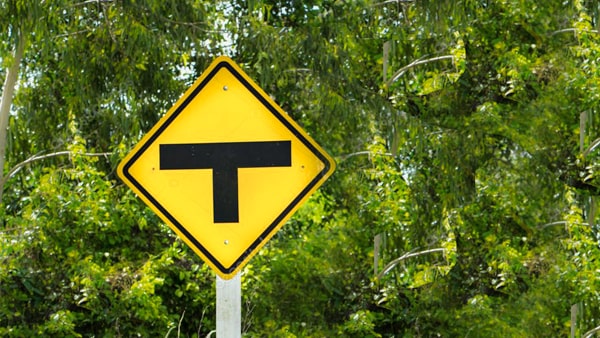
This sign shows one type of:
  1. A A mandatory right turn
  2. B A T intersection
  3. C A lane change
  4. D A series of road curves

Correct answer: B – A T intersection

The T-intersection warning sign indicates that the roadway on which you are traveling ends ahead at another road. Prepare to turn either right or left and signal before making the turn. The sign warns of the roadway layout; any stop or yield requirement will be shown by a separate traffic-control device.

Source: Virginia Driver’s Manual — § 2, “T Intersection”
Question 2

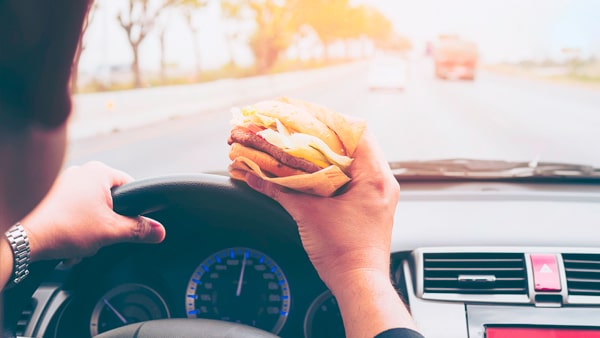
Eating while driving is unsafe because it can:

Drivers who eat and drink while driving:
  1. A Eliminate driving errors
  2. B Improve speed control
  3. C Make a driver more attentive
  4. D Take attention away from controlling the vehicle

Correct answer: D – Take attention away from controlling the vehicle

The driver’s manual identifies eating as a distraction that can prevent a driver from focusing on the driving task. Safe driving requires keeping your eyes on the road and your hands on the wheel. If an activity will distract you, pull over and stop in a safe location before doing it.

Source: Virginia Driver’s Manual — § 3, “Distracted Driving”

Question 3

As little as how many inches of water at a low-water crossing may cause a driver to lose control?

  1. A Two inches
  2. B Four inches
  3. C Six inches
  4. D Eight inches

Correct answer: C – Six inches

As little as six inches of water may cause a driver to lose control of a vehicle. Floodwater can conceal a damaged or washed-out roadway, and deeper flowing water can carry vehicles away. Do not attempt to drive through flowing water at a flooded crossing.

Source: Virginia Department of Education Curriculum and Administrative Guide for Driver Education — Module 8, Topic 2, Lesson 1, “Low Water Crossings”

Question 4

Which statement best describes the protection provided by seat belts?

  1. A They help only at speeds above 40 mph
  2. B They help only during low-speed crashes
  3. C They are useful only when driving in a city
  4. D They improve the chances of surviving and avoiding serious injury

Correct answer: D – They improve the chances of surviving and avoiding serious injury

Seat belts can double an occupant’s chances of surviving a crash and more than double the chances of avoiding serious injury. They should be worn properly, with the lap belt low against the thighs and the shoulder belt across the chest. Their protective value is not restricted to a particular road, location, or speed range.

Source: Virginia Driver’s Manual — § 4, “Seat Belts”

Question 5

At a stop sign, where must you stop when there is no marked stop line but a crosswalk is present?

  1. A At the corner after entering the crosswalk
  2. B Before entering the crosswalk
  3. C Just beyond the intersection corner
  4. D At least 15 feet from the corner

Correct answer: B – Before entering the crosswalk

Virginia law requires a driver at a stop sign to stop at the clearly marked stop line. If there is no stop line, the driver must stop before entering the crosswalk on the near side of the intersection. If neither marking exists, stop at the nearest point that provides a view of approaching traffic before entering the intersecting roadway.

Source: Va. Code § 46.2-821 — Vehicles before entering certain highways shall stop or yield right-of-way

Question 6

When approaching a highway work zone, you should:

  1. A Follow temporary controls and keep your attention on the roadway
  2. B Brake abruptly just before entering the work area
  3. C Slow down mainly to watch the construction activity
  4. D Sound the horn to alert workers

Correct answer: A – Follow temporary controls and keep your attention on the roadway

Orange identifies a work zone and warns drivers to slow down and remain alert. Obey posted speed limits, temporary signs, message boards, and directions from flaggers. Keep your vehicle within the guided travel lane and avoid letting the construction activity distract you from driving.

Source: Virginia Driver’s Manual — § 2, “Road Construction Ahead—Detour”, Virginia Driver’s Manual — § 2, “Flaggers”, Virginia Driver’s Manual — § 3, “Distracted Driving”