


Virginia DMV Sign Test 4

4.8 out of 5 (336 votes)
80% Passing score
20 Questions
4 Mistakes allowed
Virginia’s DMV knowledge exam gives road signs their own separate hurdle, and that matters more than some applicants realize. The full learner’s permit knowledge test has 2 parts: 10 road sign questions first, followed by 30 general knowledge questions. Before you can even get to the laws, safe driving rules, pavement markings, impaired-driving topics, and all the other material from the Virginia Driver’s Manual, you have to clear the signs section with a perfect score. All 10 correct. No cushion there. That is the main reason this Virginia road signs practice test deserves its own attention. It is not just extra studying, or a quick warm-up before the “real” test. In Virginia, signs are treated as a gatekeeping skill, which is fair enough, although it does make the first section feel a little sharper-edged than people expect. This 20-question DMV sign test gives you more room to practice the details: colors, shapes, warnings, regulatory signs, guide signs, and the kind of sign recognition you need when the road changes quickly from city traffic to a rural stretch or a mountain curve. The official exam is based on the Virginia Driver’s Manual. On test day, you must answer every road sign question correctly, then answer at least 24 of the 30 general knowledge questions correctly to pass that second section. This VA DMV practice test uses a 20-question multiple-choice format, so you can repeat the material without feeling like you are just memorizing 10 items and hoping the DMV asks them the same way. It is especially useful for first-time permit applicants, but not only for them. Drivers brushing up for renewal, new residents getting used to Virginia rules, and adults applying for a license after years away from testing can all benefit from slowing down and studying signs separately. Applicants under 18 may apply for a learner’s permit at 15 years and 6 months, with the required consent unless they are emancipated. Retake rules are different for teens and adults, and after 3 failed attempts, anyone has to complete the required classroom training before trying again. So the practical advice is pretty simple, even if the testing setup has a few extra layers: treat the Virginia road sign test like its own exam. Because, in the part that counts first, it basically is.
FREE DMV Practice Test App
Study for your Virginia permit test or driver’s license with the NextDoorDriving app. 700+ DMV questions and answers, 100% free!
Download on the App Store

Sample Virginia Permit Test Questions

Question 1

What movement does the regulatory sign shown prohibit?
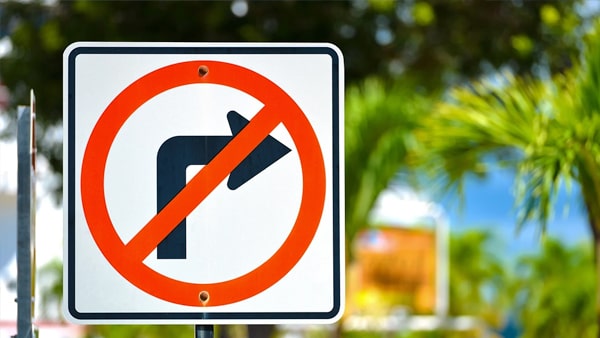
This sign means:
  1. A. Making a U-turn
  2. B. Turning left
  3. C. Turning right
  4. D. Making any turn

Correct answer: C. – Turning right

The sign is a No Right Turn sign. A red circle and diagonal slash indicate that the movement represented by the symbol is prohibited. Drivers must obey the restriction and must not make a right turn at the location where the sign applies.

Source: Va. Code § 46.2-830 – Uniform traffic control devices on highways; drivers to obey traffic control devices; enforcement of section, Virginia Driver’s Manual — Section 2, “No Right Turn”
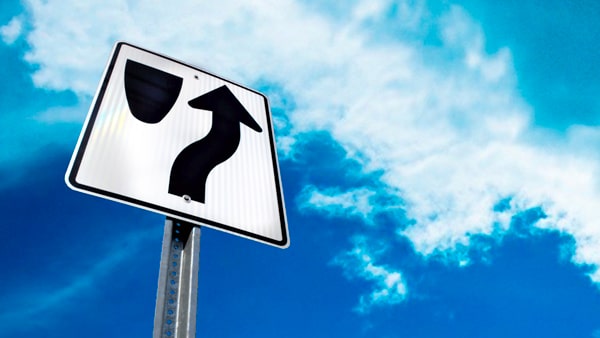

Question 2

What does the white KEEP RIGHT sign direct a driver to do?

This white sign means:
  1. A. Pass to the right of the traffic island, median, or barrier
  2. B. Yield before making a right turn
  3. C. Move right only when driving below the speed limit
  4. D. Turn right at the next intersection

Correct answer: A. – Pass to the right of the traffic island, median, or barrier

A Keep Right sign marks an island, median, barrier, or similar obstruction ahead. Follow the arrow and travel on the indicated side of the obstruction. The sign does not necessarily require a turn at an intersection or apply only to slower vehicles.

Source: Virginia Driver’s Manual — Section 2, “Keep Right”

Question 3

A yellow diamond warning sign shows one vertical arrow pointing up and another pointing down. Which sign is this?

  1. A. Lane Ends
  2. B. Divided Highway Ends
  3. C. Two-Way Traffic
  4. D. Turn Left or Right

Correct answer: C. – Two-Way Traffic

The Two-Way Traffic sign warns that vehicles are moving in opposite directions on the roadway ahead. In a work zone where one roadway of a normally divided highway is closed, the sign is used at the beginning of the two-way section and may be repeated to remind drivers about opposing traffic.

Source: 24VAC30-315-10 – General provisions, Virginia Work Area Protection Manual — Ch. 6H, “Two-Way Traffic Sign (W6-3)”

Question 4

A broken yellow line is next to your lane, with a solid yellow line beside it. When may you pass?

When the road is marked with a solid yellow line and a broken yellow line on your side you may pass:
  1. A. Only when responding to an emergency
  2. B. Only on a controlled-access highway
  3. C. When the roadway ahead is visible and free of oncoming traffic for a safe distance
  4. D. Only while traveling through an intersection

Correct answer: C. – When the roadway ahead is visible and free of oncoming traffic for a safe distance

In Virginia, a solid-and-broken yellow pair allows passing from the side next to the broken line. The left side of the roadway must be clearly visible and free of oncoming traffic far enough ahead to complete the maneuver safely. Drivers on the solid-line side generally may not cross to pass another motor vehicle.

Source: Va. Code § 46.2-804(5) – Special regulations applicable on highways laned for traffic; penalty, Va. Code § 46.2-843 – Limitations on overtaking and passing, Virginia Driver’s Manual — Section 2, “Pavement Markings”

Question 5

In Virginia, what should a driver understand before parking beside a painted curb?

  1. A. Every painted curb is reserved for emergency vehicles
  2. B. Green always permits passenger loading only
  3. C. Local signs and rules must be checked for the exact restriction
  4. D. Curb colors never regulate stopping or parking

Correct answer: C. – Local signs and rules must be checked for the exact restriction

The driver’s manual directs motorists to check the locality for the specific meaning of a painted curb. It gives general examples, including white for brief passenger pickup or drop-off, yellow for loading or unloading while remaining with the vehicle, and red for no stopping, standing, or parking. Local governments are authorized to regulate parking, stopping, and standing.

Source: Va. Code § 46.2-1220 – Parking, stopping, and standing regulations in counties, cities, or towns; parking meters; presumption as to violation of ordinances; penalty, Virginia Driver’s Manual — Section 2, “Painted Curbs”

Question 6

At a stop-sign intersection with both a stop line and a crosswalk, where must you first stop?

  1. A. Where cross traffic is easiest to see
  2. B. After entering the crosswalk
  3. C. At the stop line before the crosswalk
  4. D. Five feet before the stop sign

Correct answer: C. – At the stop line before the crosswalk

When a clearly marked stop line is present, stop at that line before entering the intersection. If there is no stop line, stop before entering the near-side crosswalk. If neither marking exists, stop at the point nearest the intersecting roadway where you can see approaching traffic, then yield before proceeding.

Source: Va. Code § 46.2-821 – Vehicles before entering certain highways shall stop or yield right-of-way, Virginia Driver’s Manual — Section 2, “Octagon (Stop)”