


Virginia Road Signs Test Simulator

4.9 out of 5 (326 votes)
80% Passing score
25 Questions
5 Mistakes allowed
Virginia road signs deserve serious attention before you sit for the DMV knowledge exam, because that first section gives you no room to ease into things. The official Virginia permit test starts with 10 road sign questions, and all 10 have to be answered correctly before you can continue to the 30-question general knowledge section. After that, you still need 24 correct answers on the second part. So, yes, the road sign portion is short, but short is not the same as forgiving. This Virginia DMV practice test is built around that reality. It gives you 20 focused road sign questions in each session, with a passing score of 16 correct answers, so you get more practice than the official sign section provides while still keeping the session manageable. The questions are drawn from material in the Virginia Driver’s Manual, which is the same source the DMV uses for the real knowledge exam. That matters. You are not just clicking through random sign trivia; you are working with the kind of sign recognition Virginia expects you to know. And because the test reshuffles from a larger pool of questions, retaking it does not feel like running the same little loop over and over. Some signs are obvious when you see them in isolation, then suddenly less obvious when the answer choices are close together or when two warning signs look almost, but not quite, interchangeable. That is usually where people find out whether they actually know the sign or just remember seeing it somewhere before. This free drivers license test online is useful for first-time teen drivers, adult applicants, renewal practice, or anyone brushing up before a VA DMV test for permit. Virginia applicants can start the learner’s permit process at 15 years and 6 months, and adults who are licensing for the first time still need to understand the same signs, markings, and rules unless they qualify for a waiver. Retake rules are not exactly generous, either: applicants under 18 must wait 15 full days after failing the knowledge exam, adults may test once per business day, and after three failures, driver education is required before another attempt. Use the practice test more than once. That sounds plain, maybe too plain, but it is the part that helps. The goal is to recognize road signs quickly, accurately, and without turning every question into a debate with yourself.
FREE DMV Practice Test App
Study for your Virginia permit test or driver’s license with the NextDoorDriving app. 700+ DMV questions and answers, 100% free!
Download on the App Store

Sample Virginia Permit Test Questions

Question 1

On a two-way road marked by one solid and one broken yellow line, which line must be next to your lane before you may cross to pass?

You may cross a double line to pass another vehicle if the line on your side is:
  1. A. The solid yellow line
  2. B. Two solid yellow lines
  3. C. The broken yellow line
  4. D. A solid white line

Correct answer: C. – The broken yellow line

A driver may cross from the side next to the broken yellow line to pass, subject to all other passing rules. The opposing lane must be clearly visible and free of oncoming traffic for enough distance to complete the maneuver safely. A driver next to the solid yellow line generally may not cross it to pass another motor vehicle.

Source: Va. Code § 46.2-804(5) – Special regulations applicable on highways laned for traffic; penalty, Va. Code § 46.2-843 – Limitations on overtaking and passing, Virginia Driver’s Manual — Section 2, “Pavement Markings”
Question 2

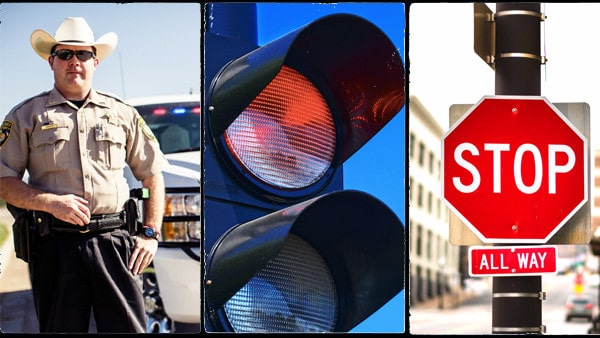
A stop-sign intersection has a marked crosswalk but no stop line. Where must you stop?

  1. A. Before entering the crosswalk
  2. B. Fifty feet before the intersection
  3. C. Where a stop line might normally be painted
  4. D. With the front wheels inside the crosswalk

Correct answer: A. – Before entering the crosswalk

Virginia law requires a driver to stop at the clearly marked stop line when one exists. If there is no stop line, the driver must stop before entering the crosswalk on the near side of the intersection. After stopping, the driver must yield to vehicles approaching on the intersecting highway before proceeding.

Source: Va. Code § 46.2-821 – Vehicles before entering certain highways shall stop or yield right-of-way, Virginia Driver’s Manual — Section 2, “Octagon (Stop)”

Question 3

At a Virginia intersection, what does a flashing circular yellow signal require?

  1. A. Merge with traffic entering from the side
  2. B. Slow down and proceed with caution
  3. C. Stop and wait for a steady green light
  4. D. Come to a complete stop before proceeding

Correct answer: B. – Slow down and proceed with caution

A flashing yellow signal allows traffic to continue with reasonable care. Slow down, watch the intersection, and yield to pedestrians or vehicles lawfully within it. Unlike a flashing red signal, it does not require a complete stop when the way is clear.

Source: Va. Code § 46.2-833 — Traffic Lights; Penalty, Virginia Driver’s Manual — § 2, “Traffic Signals—Flashing Yellow Light”

Question 4

For which purpose may a driver cross double solid yellow centerlines?

  1. A. To pass a slower motor vehicle
  2. B. To pass during daylight hours only
  3. C. To avoid waiting in traffic
  4. D. To make a left turn

Correct answer: D. – To make a left turn

Virginia’s centerline rule generally prohibits driving to the left of double solid yellow lines, but it permits crossing them to turn left. Another limited exception allows a safe pass around a pedestrian or human-powered device, including a bicycle. The lines may not be crossed simply to pass another motor vehicle.

Source: Va. Code § 46.2-804 — Special Regulations Applicable on Highways Laned for Traffic; Penalty

Question 5

In Virginia, whose direction controls if it conflicts with a traffic signal?

Which of the following must you obey over the other three?
  1. A. The steady red signal
  2. B. The law-enforcement officer directing traffic
  3. C. The stop sign beside the intersection
  4. D. The flashing red signal

Correct answer: B. – The law-enforcement officer directing traffic

A law-enforcement officer may control traffic at an intersection whether it is controlled by signals, other devices, or no devices. Drivers must follow the officer’s directions even when those directions differ from a sign or signal. For example, stop if the officer orders you to stop while your signal is green.

Source: Va. Code § 46.2-834 — Signals by Law-Enforcement Officers, Crossing Guards, and Flaggers, Virginia Driver’s Manual — § 2, “Signals, Signs and Pavement Markings”

Question 6

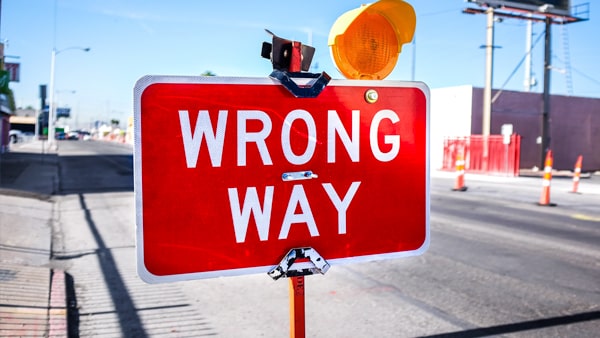
A red rectangular WRONG WAY sign tells you that:

This red and white sign means:
  1. A. You may enter after yielding to traffic
  2. B. The entire roadway is closed in both directions
  3. C. U-turns are prohibited at the next intersection
  4. D. Traffic is not permitted to travel in your direction

Correct answer: D. – Traffic is not permitted to travel in your direction

A WRONG WAY sign means your vehicle is traveling in a prohibited direction and may face oncoming traffic. Immediately slow down, pull over, and cautiously turn around when it is safe. A DO NOT ENTER sign may be posted nearby to prevent drivers from entering the roadway in that direction.

Source: Virginia Driver’s Manual — § 2, “Do Not Enter—Wrong Way”