


Washington CDL General Knowledge Practice Test (WA) 2

4.8 out of 5 (62 votes)
80% Passing score
20 Questions
4 Mistakes allowed
This is your second DMV practice test, the perfect starting point to hone your knowledge for the Washington CDL General Knowledge Test. This CDL practice test comprises 20 questions, and you must answer at least 16 correctly to pass. Designed with real 2026 knowledge test answers and helpful study aids, this DOL practice test is an excellent tool to guide you through challenging questions. The Washington DOL practice test features multiple-choice questions that closely mimic the format and content of the actual DMV knowledge test. This similarity ensures that you will become familiar with the types of questions you will encounter on test day. Whether you are pursuing a Class A or Class B driver's license, the general knowledge test is mandatory, and this Washington permit practice test will help you prepare thoroughly. Covering a broad range of subjects, this CDL general knowledge practice test includes questions on pre-trip vehicle inspection, basic vehicle control, shifting gears, and more. It also addresses essential topics like tackling hills, steep downgrades, communicating with other drivers, controlling speed, and drug and alcohol awareness. The diverse subject matter ensures you are well-prepared for the many facets of commercial driving. Our Washington CDL general knowledge test practice is accessible online via mobile, desktop, and mobile apps, making them convenient for on-the-go study sessions. You can customize your practice to focus on areas where you need the most improvement, retake tests multiple times to enhance your score, and study at times that best fit your schedule. By taking this second driving practice test, you are taking a crucial step toward passing the Washington CDL General Knowledge Test. The same set of permit test questions will appear no matter how many times you take the test, allowing you to solidify your knowledge and increase your confidence. Dive into your Washington state driving test practice and get one step closer to obtaining your CDL in 2026!
FREE CDL Practice Test App
Pass your Washington CDL General Knowledge test with the NextDoorDriving app. Real questions and answers—100% free and ad-free.
Download on the App Store

Sample Washington CDL Test Questions - General Knowledge

Question 1

Which gauge should gradually rise toward its normal operating range after the engine is started?

  1. A The exhaust manifold indicator
  2. B The coolant-temperature gauge
  3. C The air-pressure gauge after 10 to 15 minutes
  4. D The oil-pressure gauge after 4 to 5 minutes

Correct answer: B – The coolant-temperature gauge

The coolant-temperature gauge should begin a gradual rise toward the normal operating range as the engine warms. Oil pressure should reach normal within seconds after startup. In an air-brake vehicle, air pressure should also build according to the vehicle's specified pressure and time requirements rather than taking 10 to 15 minutes.

Source: Washington State Commercial Driver Guide — § 2.1.5, “7-Step Inspection Method—Look at the Gauges”
Question 2

Which statement describes a safe practice when backing a commercial vehicle?

  1. A If a trailer drifts, turn the top of the wheel away from the drift
  2. B Avoid backing whenever a forward maneuver is available
  3. C A helper should guide the driver primarily with shouted instructions
  4. D Backing is safer than moving forward

Correct answer: B – Avoid backing whenever a forward maneuver is available

Washington's Commercial Driver Guide advises drivers to avoid backing whenever possible and to park where they can pull forward when leaving. When backing is necessary, inspect the path, move slowly, use both mirrors, and use a helper when available. The driver and helper should agree on clear hand signals, especially a stop signal.

Source: Washington State Commercial Driver Guide — § 2.2.4, “Backing Safely”

Question 3

What is a hazardous materials placard?

  1. A A carrier-identification sticker
  2. B A triangular label placed on individual packages
  3. C A sign showing that a vehicle is carrying an oversize load
  4. D A sign displayed outside a vehicle to identify the cargo's hazard class

Correct answer: D – A sign displayed outside a vehicle to identify the cargo's hazard class

Federal hazardous materials rules use placards to communicate the hazards presented by regulated cargo. A placard is displayed on the outside of a transport vehicle or bulk packaging and identifies the applicable hazard class. Placards are square-on-point, giving them a diamond-shaped appearance; they are not wide-load signs or ordinary carrier stickers.

Source: Washington State Commercial Driver Guide — § 9.3.3, “Placards”, 49 CFR § 172.504 — General Placarding Requirements, 49 CFR § 172.519 — General Specifications for Placards

Question 4

In a vehicle without ABS, what is the main danger of locking the wheels during emergency braking?

  1. A The steering-axle brakes automatically disconnect
  2. B The rear wheels gain additional traction
  3. C The transmission cannot be downshifted
  4. D Skidding wheels prevent the driver from maintaining normal control

Correct answer: D – Skidding wheels prevent the driver from maintaining normal control

Emergency braking should not keep the wheels locked. Locked steering wheels eliminate steering control, while other locked wheels can cause the vehicle to skid, jackknife, or spin. Controlled braking applies maximum pressure without locking the wheels; with stab braking, the brakes are released when the wheels lock and reapplied after they begin rolling again.

Source: Washington State Commercial Driver Guide — § 2.17.2, “How to Stop Quickly and Safely”

Question 5

What condition should be checked at wheel bearing seals during an inspection?

  1. A Excessive tightness
  2. B Leakage
  3. C Coolant level
  4. D Electrical continuity

Correct answer: B – Leakage

Washington's vehicle-inspection guidance requires checking that wheel bearing seals are not leaking. A leaking seal can allow lubricant to escape from the hub. The inspection concerns visible leakage rather than coolant level, electrical operation, or a general statement that the component appears safe.

Source: Washington State Commercial Driver Guide — § 2.1.3, “What to Look For”

Question 6

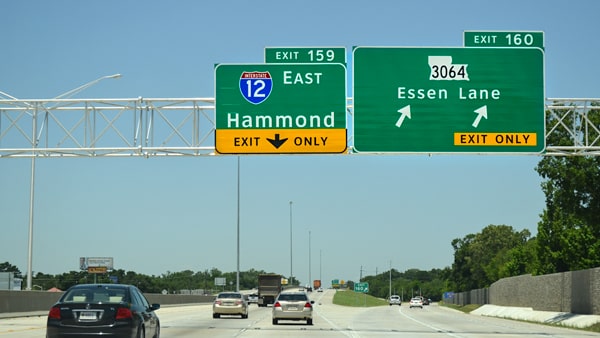
Which class of signs provides route, destination, distance, service, and directional information?

____________ signs inform drivers of basic highway information.
  1. A Parking signs
  2. B Guide signs
  3. C Regulatory signs
  4. D Warning signs

Correct answer: B – Guide signs

Guide signs provide navigation and other useful roadway information. They can show route designations, destinations, directions, distances, services, and points of interest. Regulatory signs give notice of traffic laws, while warning signs call attention to conditions that may not be readily apparent.

Source: Manual on Uniform Traffic Control Devices for Streets and Highways, 11th Edition with Revision 1 — § 2A.03, “Classification of Signs”