


Washington CDL Class B Practice Test (WA) 3

4.9 out of 5 (51 votes)
80% Passing score
20 Questions
4 Mistakes allowed
If you're gearing up to secure your Class B CDL in Washington, this is your third driving practice test designed to help you succeed. Our comprehensive Washington CDL practice test consists of 20 meticulously crafted questions, and to pass, you'll need to correctly answer at least 16. This DOL practice test is specifically tailored for Class B CDL applicants and serves as an essential tool in your preparation arsenal. The questions span a broad array of subjects, ensuring that you get a well-rounded review of the material. This Washington CDL class B practice test includes vital topics such as pre-trip vehicle inspections, which are crucial for ensuring your vehicle's readiness for the road. You'll find driving test questions on basic vehicle control, a fundamental skill for any CDL driver, and detailed inquiries into shifting gears, including the often-tricky downshifting process. Navigating hills and steep downgrades is another area covered, providing you with the knowledge to handle these challenging driving conditions safely. Communication with other drivers is a critical aspect of road safety, and this Washington knowledge test practice addresses how to effectively convey your intentions and understand those of others on the road. Speed control is another key component, helping you to maintain safe speeds in various driving conditions. Additionally, this class B CDL practice test includes DOL questions on drug and alcohol awareness, highlighting the importance of staying alert and sober while driving. One of the standout features of our Washington DOL practice test is the variety of questions. This ensures that you are thoroughly prepared for the DMV knowledge test by exposing you to a wide range of scenarios and information. Our CDL practice test is regularly updated to reflect the most current laws and best practices, so you can be confident that you are studying the most relevant material for 2026. By focusing on these essential areas, our Washington CDL class B practice test not only prepares you for the CDL test but also equips you with the knowledge needed for safe and responsible driving. Whether it's handling cargo safely or responding to emergency situations, you'll be well-prepared to hit the road with confidence!
FREE CDL Practice Test App
Pass your Washington CDL General Knowledge test with the NextDoorDriving app. Real questions and answers—100% free and ad-free.
Download on the App Store

Sample Washington CDL Test Questions - General Knowledge

Question 1

What does a Winding Road warning sign indicate?
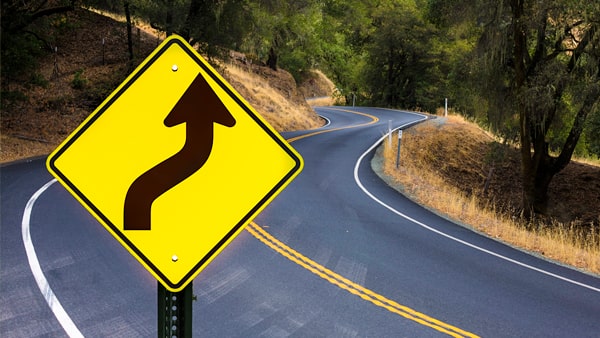
This sign warns drivers to ____________.
  1. A A series of roadway alignment changes is ahead
  2. B A road-construction area is ahead
  3. C Exactly two curves in opposite directions are ahead
  4. D Two sharp turns are ahead

Correct answer: A – A series of roadway alignment changes is ahead

The Winding Road sign warns of a series of curves or turns ahead rather than one isolated curve. It may be used where there are three or more changes in roadway alignment separated by relatively short straight sections. A Reverse Curve sign is used for two qualifying changes in opposite directions.

Source: Manual on Uniform Traffic Control Devices for Streets and Highways, 11th Edition with Revision 1 — § 2C.07, “Horizontal Alignment Signs (W1-1 through W1-5, W1-11, and W1-15)”
Question 2

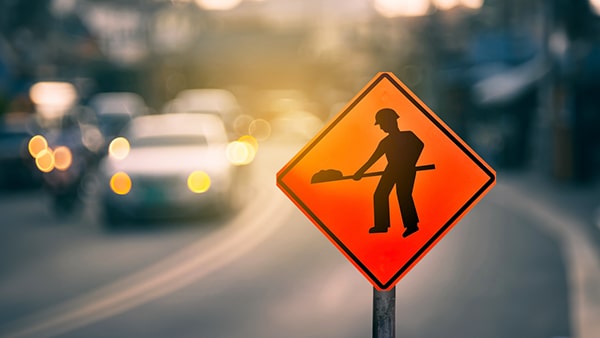
What does a ROAD WORK AHEAD sign warn drivers about?

This sign warns drivers to  _____________.
  1. A A flagger who always requires a complete stop
  2. B A closed roadway that requires drivers to turn around
  3. C Possible obstructions or restrictions near an upcoming work area
  4. D A mandatory detour onto another roadway

Correct answer: C – Possible obstructions or restrictions near an upcoming work area

A ROAD WORK AHEAD sign provides a general warning that obstructions or restrictions may be present near an upcoming work space. It can also be placed before a detour associated with the work. The sign does not by itself state that the road is closed, that a detour is mandatory, or that every driver must stop for a flagger.

Source: Manual on Uniform Traffic Control Devices for Streets and Highways, 11th Edition with Revision 1 — § 6H.03, “ROAD (STREET) WORK Sign (W20-1)”

Question 3

Which description best defines black ice?

  1. A A thin, clear ice layer through which the roadway remains visible
  2. B Ice that has almost completely melted
  3. C Ice found only along the roadway shoulder
  4. D Ice that does not affect vehicle traction

Correct answer: A – A thin, clear ice layer through which the roadway remains visible

The Washington guide describes black ice as a thin layer clear enough for the road beneath it to remain visible. Because the pavement can look wet rather than frozen, the hazard may be difficult to recognize. When the temperature is below freezing and the road appears wet, drivers should watch for black ice and reduced traction.

Source: Washington State Commercial Driver Guide — § 2.6.2, “Matching Speed to the Road Surface—Identifying Slippery Surfaces”

Question 4

To reduce a vehicle's center of gravity, heavier cargo should be placed beneath lighter cargo.

  1. A True
  2. B False

Correct answer: A – True

Placing the heaviest cargo below lighter items keeps the load's center of gravity as low as possible. Heavy cargo stacked high makes the vehicle top-heavy and more likely to roll over during a curve or sudden steering maneuver. Proper securement is still necessary to prevent the load from shifting even when the weight is arranged correctly.

Source: Washington State Commercial Driver Guide — § 3.2.3, “Don't Be Top-Heavy”

Question 5

What instruction is given by a DO NOT PASS sign?

This sign indicates that the driver should _____________.
  1. A Pass only when operating behind schedule
  2. B Do not overtake another vehicle in the posted no-passing area
  3. C Prepare to stop at the next intersection
  4. D Complete any pass as quickly as possible

Correct answer: B – Do not overtake another vehicle in the posted no-passing area

A DO NOT PASS sign emphasizes that passing is restricted in the area where it is posted. It may appear at the beginning of and within a zone where sight distance is limited or other conditions make overtaking inappropriate. It does not authorize passing based on urgency or merely advise the driver to complete a pass quickly.

Source: Manual on Uniform Traffic Control Devices for Streets and Highways, 11th Edition with Revision 1 — § 2B.36, “DO NOT PASS Sign (R4-1)”

Question 6

Ignoring the additional lag present in air-brake systems, total stopping distance consists of which three parts?

  1. A Perception distance, reaction distance, and braking distance
  2. B Observation distance, reaction distance, and slowing distance
  3. C Perception distance, response distance, and reaction distance
  4. D Road-condition distance, speed distance, and perception distance

Correct answer: A – Perception distance, reaction distance, and braking distance

The general stopping-distance formula adds perception distance, reaction distance, and braking distance. Perception distance is traveled while recognizing the hazard, reaction distance is traveled before brake application begins, and braking distance is traveled while the brakes stop the vehicle. An air-brake vehicle has an additional brake-lag distance because air takes time to reach the brakes.

Source: Washington State Commercial Driver Guide — § 2.6.1, “Stopping Distance”, Washington State Commercial Driver Guide — § 5.4.4, “Stopping Distance”