Washington DMV Knowledge Test Practice 4

4.8 out of 5 (1817 votes)
80% Passing score
20 Questions
4 Mistakes allowed
This Washington DOL knowledge practice test is built for drivers who want more than a quick skim before exam day. It gives you 20 multiple-choice questions drawn from a larger question pool, with this set placing extra attention on child safety seats, passenger protection, and the kinds of details that can trip people up when they think they already know the rule. To pass this practice round, you’ll need at least 16 correct answers, which is a useful benchmark before you sit for the real Washington knowledge test. The test works best when you treat it like part of the whole licensing process, not just a separate quiz floating off by itself. Washington drivers also have to deal with the practical side of getting licensed: proving identity, providing a Social Security number if they have one, getting a photo taken, passing vision screening when required, and paying the appropriate fees. For a standard driver license, instruction permit, or ID card, the DOL accepts several proof-of-identity combinations, including one stand-alone document, two A-list documents, one A-list document plus two B-list documents, or four B-list documents, as long as one establishes name and date of birth. A valid U.S. passport, passport card, state driver license or ID card, Certificate of Citizenship or Naturalization, USCIS ID, or U.S. armed services ID can all fall into that stand-alone category. That paperwork piece matters because Washington does not accept copied, scanned, or photographed identity documents. You need the real documents, which is one of those small administrative details that can turn a planned licensing visit into a second trip. Teen applicants have a few more moving parts, too. A 16- or 17-year-old applying in person generally needs a parent present or a notarized Parental Authorization Affidavit, plus proof of identity, a Social Security number or declaration, a vision screening, photo, and fees. Their driver training school must also submit course completion and exam scores, with scores entered within 24 hours after each passed exam. As you move through this Washington DMV knowledge test practice, you can use hints when a question feels too narrow or technical, and incorrect answers come with explanations so the mistake actually teaches you something. Retake the DOL knowledge test online as often as needed, especially if you are preparing for your first permit, checking your understanding of child passenger safety, or just trying to walk into the licensing process with fewer surprises.
FREE DMV Practice Test App
Study for your Washington permit test or driver’s license with the NextDoorDriving app. 700+ DMV questions and answers, 100% free!
Download on the App Store

Sample Washington Permit Test Questions

Question 1

In Washington, when may a vehicle displaying disability license plates use a reserved accessible parking space?

  1. A. Whenever the vehicle has the plates, regardless of its occupants
  2. B. Only when the person with the disability is driving
  3. C. When the parking-privilege holder is driving or being transported
  4. D. Whenever a relative of the privilege holder uses the vehicle

Correct answer: C. – When the parking-privilege holder is driving or being transported

The plates or placard may be used when the person holding the parking privilege is operating the vehicle or being transported in it. Using another holder’s credential while that person is absent is unauthorized, even with permission. Unauthorized use is a $250 parking infraction plus a $200 assessment, for a total of $450.

Source: RCW 46.19.050(2), (4) – Restrictions—Prohibitions—Violations—Penalties., RCW 46.19.030(2), (6) – Display and design of placards, license plates, and year tabs.
Question 2

On a Washington highway divided into separate roadways, must an opposing driver stop for a school bus displaying its red signals?

If a school bus stops to unload children on a divided highway with a dividing barrier, vehicles traveling in the opposite direction are:
  1. A. Yes, until the bus withdraws its signals
  2. B. Yes, but the driver may proceed after stopping
  3. C. Only after pulling onto the shoulder
  4. D. No, when traveling on the separate opposing roadway

Correct answer: D. – No, when traveling on the separate opposing roadway

A driver meeting a stopped school bus from the opposite direction does not have to stop when the highway is divided into separate roadways. Drivers traveling in the same direction as the bus must stop when its required visual signals are operating. The law also provides an opposing-traffic exception on highways with three or more marked traffic lanes.

Source: RCW 46.61.370(1)–(3) – Overtaking or meeting school bus, exceptions—Duties of bus driver—Penalty—Safety cameras., Washington State Driver Guide — Ch. 4, § 4.2, “On a multilane road”

Question 3

A driver behind sounds the horn and starts passing you on the left. What should you do?

The car behind you begins to pass you. You should:
  1. A. Maintain your position and increase speed slightly
  2. B. Stop immediately in your traffic lane
  3. C. Give way to the right and do not increase speed
  4. D. Sound your horn continuously until the pass is complete

Correct answer: C. – Give way to the right and do not increase speed

Washington law requires overtaken traffic to give way to the right after an audible passing signal and not increase speed until completely passed. Remain predictable and avoid moving left into the passing vehicle’s path. The passing driver remains responsible for using a safe distance and returning to the right only after safely clearing your vehicle.

Source: RCW 46.61.110(1)(a), (3) – Overtaking on the left—Fine.

Question 4

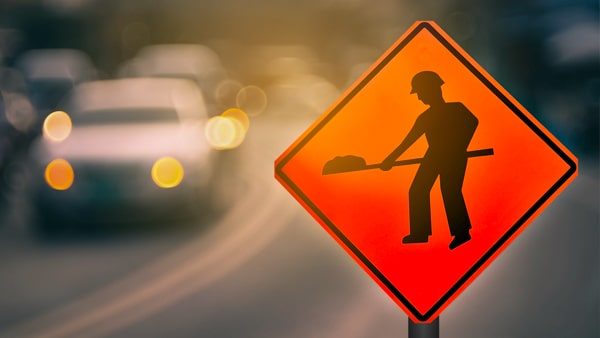
An orange diamond sign showing a worker with a shovel warns that:

This sign means that:
  1. A. A volunteer cleanup group is beside the highway
  2. B. Workers may be on or near the roadway ahead
  3. C. A recreation area is under construction
  4. D. A pedestrian crossing is immediately ahead

Correct answer: B. – Workers may be on or near the roadway ahead

The worker symbol warns that road personnel may be working on or close to the roadway. Washington’s driver guide identifies orange as the color for construction and maintenance warnings. Watch for workers, equipment, cones, and changing traffic patterns; reduce speed, increase following distance, and be prepared to stop as you travel through the work zone.

Source: WSDOT Sign Fabrication Manual M 55-05 — W21-1, “Workers Symbol”, Washington State Driver Guide — Ch. 4, § 4.12, “Work zone signs”

Question 5

Why should you maintain open space around your vehicle whenever practical?

Should you try to keep a "space cushion" around your vehicle whenever possible?
  1. A. It gives you time and room to respond to a developing hazard
  2. B. It prevents other drivers from changing lanes
  3. C. It is necessary only when traveling on city streets
  4. D. It allows you to ignore traffic in your mirrors

Correct answer: A. – It gives you time and room to respond to a developing hazard

Space around your vehicle gives you additional time to identify a problem and choose a safe response. It may also provide room for an alternate path if a vehicle stops, changes lanes, or enters your path. Continue evaluating the space ahead, behind, and beside you because traffic conditions change constantly.

Source: Washington State Driver Guide — Ch. 5, § 5.2, “Space”

Question 6

Which statement is correct when a vehicle has a lap-and-shoulder safety belt?

  1. A. The shoulder portion is unnecessary at low speeds
  2. B. Both portions should be worn and positioned correctly
  3. C. The lap portion should be placed across the stomach
  4. D. The shoulder portion should be placed behind the back

Correct answer: B. – Both portions should be worn and positioned correctly

Wear both portions of a lap-and-shoulder belt in their intended positions. The lap belt should fit snugly across the hips below the stomach, while the shoulder belt should cross the shoulder and middle of the chest. Do not place the shoulder belt behind your back or under your arm. Properly fastening the belt substantially reduces the risk of fatal injury.

Source: RCW 46.61.688(3) – Safety belts, use required—Penalties—Exemptions., Washington State Driver Guide — Ch. 2, § 2.6, “Seat belts and occupant protection”