


Washington Driving Test Practice 7

4.8 out of 5 (1010 votes)
80% Passing score
20 Questions
4 Mistakes allowed
This Washington practice test is the seventh test in the Washington DOL practice series, and it focuses on the kind of knowledge that tends to sit somewhere between “basic driving rule” and “wait, I was supposed to know that too?” The test includes 20 multiple-choice questions, with attention on Washington’s requirement that drivers carry proof of insurance. It is a plain responsibility, sure, but it is also one of those details that follows you after the knowledge test is over and you are actually on the road. The format is simple enough: take the test online from a computer, phone, tablet, or app, and work through the questions at your own pace. But the value is not just in clicking through answers. A good Washington DOL practice test should help you notice the rules, terms, and licensing details that are easy to blur together when you are studying from the manual alone. If a question slows you down, the built-in hints give you a little direction without handing you the answer outright. If you miss one, the explanation matters more than the score, honestly, because that is where the rule usually sticks. Washington’s licensing process also has its own little administrative layer, and that is worth knowing before you are halfway into an appointment or driver training requirement. Applicants who pre-apply online receive a Washington driver license, ID, or permit number beginning with “WDL,” which can be used for scheduling or for providing information to a driver training school. Teen drivers have extra steps as well. A 16- or 17-year-old applying in person needs a parent or guardian present, or a notarized Parental Authorization Affidavit, and driver training schools report completion status and passing exam scores to the DOL. There are a few special cases tucked into Washington licensing, too. Agricultural permits may allow drivers under 18 to drive within a specific area for farm work, though that permit does not replace the instruction permit or cancel the usual first-license requirements. And then there is the REAL ID issue, which people sometimes mix up. A standard Washington driver license is not REAL ID-compliant. An enhanced driver license, or EDL, meets REAL ID standards and can also be used for land and sea re-entry into the United States from places such as Canada, Mexico, Bermuda, and the Caribbean. So this WA driving test practice is not a shortcut, and it should not feel like one. It is a steady way to prepare for the Washington drivers permit test while also getting a better grip on the licensing details that Washington expects new drivers to understand.
FREE DMV Practice Test App
Study for your Washington permit test or driver’s license with the NextDoorDriving app. 700+ DMV questions and answers, 100% free!
Download on the App Store

Sample Washington Permit Test Questions

Question 1

Which lane should you use to turn left from a one-way street onto another one-way street?

  1. A. The available lane nearest the left edge
  2. B. Any through lane
  3. C. The lane nearest the right edge
  4. D. The center lane, regardless of the markings

Correct answer: A. – The available lane nearest the left edge

In Washington, a driver turning left must approach from the extreme left-hand lane lawfully available. Whenever practicable, the vehicle must also leave the intersection in the extreme left-hand lane available on the street being entered. Follow any traffic-control devices that direct a different turning path.

Source: RCW 46.61.290(2), (4) – Required position and method of turning at intersections.
Question 2

At an unmarked crosswalk, a pedestrian is crossing within your half of the roadway. What must you do?

  1. A. Continue because no crosswalk lines are painted
  2. B. Slow down and pass in front of the pedestrian
  3. C. Stop and remain stopped to allow the pedestrian to cross
  4. D. Sound your horn and continue

Correct answer: C. – Stop and remain stopped to allow the pedestrian to cross

Washington requires an approaching driver to stop and remain stopped when a pedestrian in a marked or unmarked crosswalk is upon, or within one lane of, the driver’s half of the roadway. A pedestrian may not suddenly enter the path of a vehicle when it is impossible for the driver to stop. Here, the driver must stop.

Source: RCW 46.61.235(1)–(2) – Crosswalks.

Question 3

A signal displays a green arrow with a red circular light. What may you do?

  1. A. Proceed only straight ahead
  2. B. Proceed only in the direction shown by the green arrow
  3. C. Wait for the circular light to turn green
  4. D. Proceed in any direction after stopping

Correct answer: B. – Proceed only in the direction shown by the green arrow

In Washington, a green arrow permits a driver to enter the intersection only for the movement shown by the arrow. The red circular light continues to control movements not authorized by the arrow. Before proceeding, the driver must allow vehicles lawfully in the intersection to finish and must stop for pedestrians as required.

Source: RCW 46.61.055(1)(b) – Traffic control signal legend.

Question 4

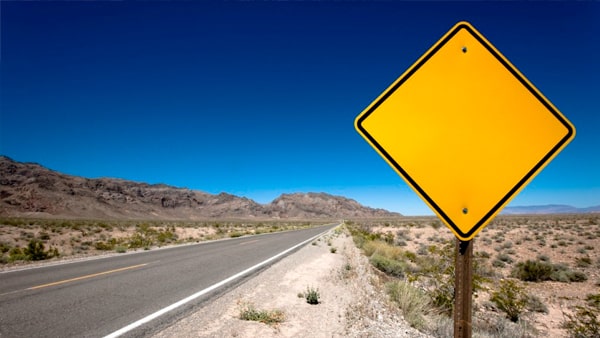
What does a black-on-yellow diamond-shaped sign generally indicate?

A yellow and black diamond-shaped sign:
  1. A. A general or unexpected roadway condition ahead
  2. B. Directions and distances to destinations
  3. C. A traffic regulation that must be obeyed
  4. D. A construction or maintenance area

Correct answer: A. – A general or unexpected roadway condition ahead

Yellow signs warn about general or unexpected roadway conditions, while orange signs identify construction and maintenance warnings. A black-on-yellow diamond sign alerts you to a possible hazard or change ahead. Watch for the condition shown by its words or symbol and adjust your driving as necessary.

Source: Washington State Driver Guide — § 4.12, “Signs”

Question 5

When conditions do not require a reduced speed, may you drive so slowly that you impede normal traffic?

  1. A. Yes, because a lower speed is always safer
  2. B. No, unnecessarily slow driving can obstruct normal traffic
  3. C. Yes, whenever you remain below the speed limit
  4. D. Yes, as long as you remain in the right lane

Correct answer: B. – No, unnecessarily slow driving can obstruct normal traffic

Washington prohibits driving so slowly that you impede the normal and reasonable movement of traffic. An exception applies when reduced speed is necessary for safe operation or compliance with the law. Poor visibility, road conditions, traffic, or another hazard may require slowing down, but an unnecessarily low speed can obstruct traffic.

Source: RCW 46.61.425(1) – Minimum speed regulation—Passing slow moving vehicle.

Question 6

On a two-lane road, a curve blocks your view of the oncoming lane. What should you do about passing the vehicle ahead?

  1. A. Wait and do not pass
  2. B. Signal for at least five seconds, then pass
  3. C. Accelerate rapidly through the curve
  4. D. Sound your horn before entering the oncoming lane

Correct answer: A. – Wait and do not pass

Washington prohibits driving left of center at a curve when the obstructed view could create a hazard from approaching traffic. A passing driver must also have a clearly visible oncoming lane that is open for enough distance to complete the maneuver safely. If the curve blocks your view, do not begin the pass.

Source: RCW 46.61.125(1)(a) – Further limitations on driving to left of center of roadway., RCW 46.61.120 – Limitations on overtaking on the left.