Washington Driving Test Practice 9

4.8 out of 5 (905 votes)
80% Passing score
20 Questions
4 Mistakes allowed
This ninth Washington DMV practice test focuses on one specific part of the WA DOL knowledge test: school bus laws. You will need to know when to stop, which lanes are affected, what flashing lights mean, and how to handle those moments when children may be getting on or off the bus. It is a focused practice driving test, yes, but the topic carries more weight than people sometimes give it. School bus questions are really questions about stopping, right-of-way, pedestrian safety, and whether you can apply a rule correctly when the roadway setup is not perfectly simple. The official Washington State driver knowledge test is a multiple-choice exam based on the Washington State Driver Guide. It covers traffic laws, road signs, signals, pavement markings, lane use, intersections, speed, stopping distance, safe driving practices, impaired and distracted driving, and sharing the road with pedestrians, bicyclists, motorcycles, emergency vehicles, and large vehicles. School buses belong in that larger group because they bring several of those ideas together at once, usually in a situation where caution matters more than cleverness. This WA DOL practice test includes 20 questions built around school bus scenarios. To pass, you need 16 correct answers, which lines up with the 80% passing standard used on the real Washington driver knowledge test. The official test has 40 multiple-choice questions, and applicants need 32 correct to pass. So this is not trying to imitate the whole exam from end to end. It gives you a tighter study session on one rule area that deserves a little extra attention — especially because the wording can get surprisingly exact about divided roads, opposite-direction traffic, and when stopping is required. After you complete the Washington drivers permit practice test, you can review your answers and read the hints and explanations for anything you missed. That review is not filler. It is where you catch the small misunderstandings that make a rule feel familiar but still leave you guessing when the question changes shape. Use this free Washington driving test practice alongside the official Driver Guide while you prepare for your permit or license. Washington uses the same general 40-question, 32-correct knowledge-test standard for teens and adults, and a passing score is valid for 2 years. Test fees vary by testing location, and if you fail, a waiting period may apply before you can test again, so it is worth getting the school bus rules straight before exam day.
FREE DMV Practice Test App
Study for your Washington permit test or driver’s license with the NextDoorDriving app. 700+ DMV questions and answers, 100% free!
Download on the App Store

Sample Washington Permit Test Questions

Question 1

On an undivided Washington highway, which opposite-direction driver need not stop for a school bus displaying its red visual signals?
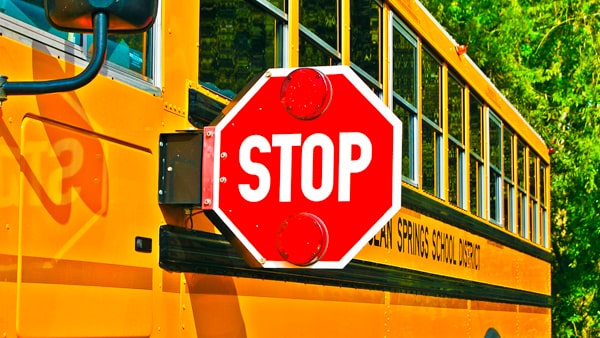
The only time you do not have to stop for a school bus whose red lights are flashing and Stop arm is extended is when you:
  1. A. A driver meeting the bus on a two-lane road
  2. B. A driver traveling directly behind the bus
  3. C. A driver meeting the bus on a highway with three or more marked lanes
  4. D. A driver meeting the bus where the roadway has a wide shoulder

Correct answer: C. – A driver meeting the bus on a highway with three or more marked lanes

Drivers traveling in the same direction as the bus must stop when its required visual signals are operating. An opposite-direction driver need not stop on a highway with three or more marked traffic lanes. A separate exception applies when the bus and approaching driver are on opposite sides of a highway divided into separate roadways.

Source: RCW 46.61.370(1)–(3) – Overtaking or meeting school bus, exceptions—Duties of bus driver—Penalty—Safety cameras.
Question 2

When parking downhill where there is no curb, how should you position the front wheels?

  1. A. Toward the center of the road
  2. B. Parallel with the road
  3. C. Toward the edge of the road
  4. D. In either direction because no curb is present

Correct answer: C. – Toward the edge of the road

Turn the steering wheel and tires toward the road’s edge when there is no curb. If the vehicle begins to roll, this position directs it away from traffic rather than toward the center of the roadway. The Washington driver guide also instructs drivers to set the parking brake whenever parking on a hill.

Source: Washington State Driver Guide — § 4.18, “Parking on a hill—If there is no curb”

Question 3

Which warning sign tells you that the physical separation between opposing roadways ends ahead?

  1. A. The lane-ends sign showing a travel lane tapering inward
  2. B. The divided-highway-ends sign showing opposing arrows beside the end of a divider
  3. C. The two-way-traffic sign showing one upward and one downward arrow
  4. D. The sign displaying arrows that point left and right

Correct answer: B. – The divided-highway-ends sign showing opposing arrows beside the end of a divider

The Divided Highway Ends warning sign indicates that the separated roadways will soon join an undivided roadway. Drivers should be prepared for opposing traffic that is no longer separated by a median or other divider. It is different from the Two-Way Traffic sign, although both warn about opposing traffic patterns.

Source: Washington State Driver Guide — § 4.12, “Other traffic signs”

Question 4

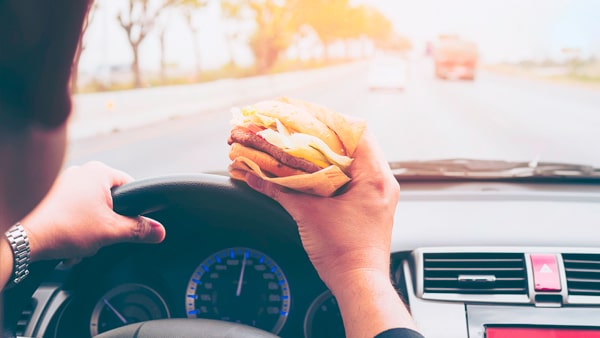
Eating or drinking while a vehicle is moving is dangerous because it:

Drivers who eat and drink while driving:
  1. A. Eliminates ordinary driving errors
  2. B. Makes it impossible to drive below the speed limit
  3. C. Improves concentration by preventing hunger
  4. D. Can distract the driver and contribute to lane-position or control errors

Correct answer: D. – Can distract the driver and contribute to lane-position or control errors

Eating and drinking can take visual, physical, or mental attention away from driving. Distracted drivers are more prone to swerving from their lane, following too closely, and missing traffic controls or other road users. Meals and drinks should be handled before driving or during a safe stop.

Source: Washington State Driver Guide — § 3.4, “Avoiding distracted driving”, Washington State Driver Guide — § 3.5, “Pay Attention”

Question 5

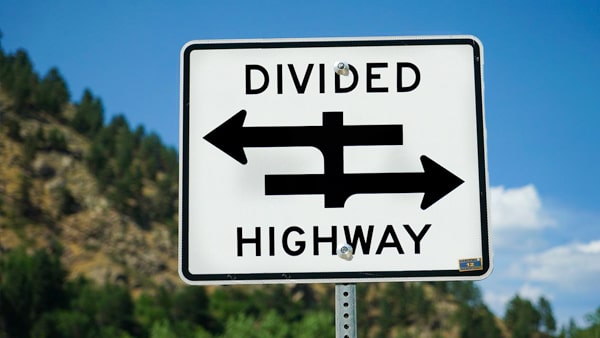
What does a DIVIDED HIGHWAY CROSSING sign indicate?

This sign means:
  1. A. Traffic must turn either left or right
  2. B. The road ends at a T-intersection
  3. C. The roadway crosses or enters a divided highway
  4. D. The roadway passes over a divided highway

Correct answer: C. – The roadway crosses or enters a divided highway

The sign identifies a crossing where the intersecting highway has separate roadways for opposing traffic. Follow the sign’s arrows and use the authorized median openings when entering or crossing. Washington law requires travel on the right-hand roadway of a divided highway and prohibits crossing the divider except at an authorized opening, crossover, or intersection.

Source: WSDOT Sign Fabrication Manual M 55-05 — R6-3/R6-3A, “Divided Highway Crossing” , RCW 46.61.150 – Driving on divided highways.

Question 6

A posted maximum speed limit represents:

The posted speed limits show:
  1. A. The slowest speed legally permitted
  2. B. The speed every vehicle must maintain
  3. C. The highest legal speed under favorable conditions
  4. D. A safe speed under every roadway condition

Correct answer: C. – The highest legal speed under favorable conditions

A posted maximum is the highest lawful speed when conditions are favorable. Washington’s basic speed rule also requires a reasonable and prudent speed for existing and potential hazards. Reduce your speed for poor visibility, slippery pavement, curves, pedestrians, traffic, or other conditions requiring additional caution, even when that means driving below the posted limit.

Source: RCW 46.61.400(1)–(3) – Basic rule and maximum limits., Washington State Driver Guide — Ch. 5, § 5.1, “Speed limits”