Washington DOL Permit Test Simulator

4.5 out of 5 (4369 votes)
80% Passing score
40 Questions
8 Mistakes allowed
Washington’s knowledge test is built around the Driver Guide, but the real issue is not just whether you glanced through the guide once. The official WA permit test has 40 multiple-choice questions, and you need 32 correct answers to pass. Eight misses are allowed, yes, but that cushion can disappear pretty quickly when road signs, lane markings, right-of-way rules, work zones, speed, stopping distance, and distracted-driving laws all start blending together. This Washington DOL permit test simulator gives you a more realistic way to practice before you sit for the official exam. Each practice test uses 40 multiple-choice questions, with the same 80% passing target used on the real Washington knowledge test. The questions cover the core material drivers are expected to know: traffic laws, signs and signals, pavement markings, intersections, safe driving choices, and sharing the road with pedestrians, bicyclists, motorcycles, emergency vehicles, and larger vehicles. It is not meant to feel like a random trivia drill. It is meant to feel close enough to the real thing that test day feels familiar, maybe even a little boring, which is exactly where you want to be. The random question pool helps, too. You are not just looping through the same answers until your memory does the work for you. One attempt might expose a weak spot with warning signs; the next might catch you on lane use or who has the right-of-way at an intersection. That can feel slightly irritating in the moment, granted, but it is useful irritation. It tells you what still needs attention before you pay a testing location, schedule around your DOL visit, or count on a score that is not quite steady yet. There is also a licensing angle worth keeping straight. Teens and adults may follow different paths in Washington — teens can begin earlier with approved driver training, while adults 18 and older are not required to complete teen driver education — but the general knowledge-test standard stays the same: 40 questions, 32 correct. A passing knowledge-test score is valid for 2 years, so once you clear it, you have some breathing room. Use this free Washington permit practice test as a serious checkpoint, not just a warm-up. Take it once, see where you stand, then keep going until passing feels routine rather than lucky.
FREE DMV Practice Test App
Study for your Washington permit test or driver’s license with the NextDoorDriving app. 700+ DMV questions and answers, 100% free!
Download on the App Store

Sample Washington Permit Test Questions

Question 1

Which statement about medications and driving is accurate?

Which of these statements is true about driving and taking drugs?
  1. A Only illegal drugs can affect driving ability
  2. B Over-the-counter medicines can impair driving
  3. C A prescription medicine is always safe if it does not cause sleepiness
  4. D Warning labels about machinery do not apply to driving

Correct answer: B – Over-the-counter medicines can impair driving

Washington’s driver guide warns that over-the-counter medicines can cause drowsiness and affect driving. Prescription medicines may also affect judgment, vision, alertness, coordination, or reflexes. Read all warning labels and ask a doctor or pharmacist about possible effects. A warning against operating heavy machinery includes operating a motor vehicle.

Source: Washington State Driver Guide — Ch. 3, § 3.1, “Medications and driving”
Question 2

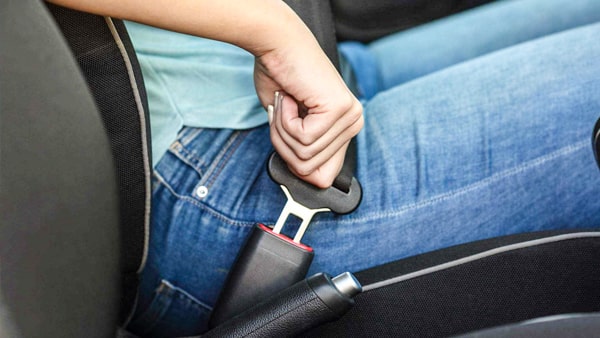
For the best protection, safety belts should be used by:

Seat belts can be most effective as injury preventive devices when they are worn by:
  1. A Only the person operating the vehicle
  2. B Passengers only during long trips
  3. C Everyone only while traveling on a freeway
  4. D The driver and every passenger on every trip

Correct answer: D – The driver and every passenger on every trip

Seat belts provide protection whenever a vehicle is moving, regardless of trip length or road type. Washington law requires people age 16 or older in covered vehicles to wear properly adjusted and securely fastened belts. The driver must also ensure that passengers under 16 are using a safety belt or approved child restraint. A violation is a traffic infraction.

Source: RCW 46.61.688(2)–(5) – Safety belts, use required—Penalties—Exemptions., Washington State Driver Guide — Ch. 2, § 2.6, “Seat belts and occupant protection”

Question 3

Which statement about slippery pavement is correct?

  1. A Bridges normally freeze after the surrounding roadway
  2. B Pavement cannot be slippery when rain first begins on a hot day
  3. C Shaded areas can conceal ice on cold, wet days
  4. D Only heavy trucks can hydroplane

Correct answer: C – Shaded areas can conceal ice on cold, wet days

Washington weather can create isolated icy areas even when most of the roadway appears clear. On cold, wet days, shady locations may remain icy because they receive less warming from sunlight. Reduce speed and leave extra space when ice may be present. Pavement can also become especially slippery during the first few minutes of rain on a hot day.

Source: Washington State Driver Guide — Ch. 5, § 5.6, “Slippery roads”

Question 4

Which vehicle should receive extra following space to improve your view of traffic ahead?

  1. A A station wagon
  2. B A large tour bus
  3. C A standard passenger car
  4. D Each vehicle requires exactly the same gap

Correct answer: B – A large tour bus

Increase your following distance behind a large bus or truck so you have a broader view of the roadway ahead. Large vehicles can hide traffic signals, stopped vehicles, and other developing hazards. They also require more room to stop than smaller vehicles. Do not follow so closely that your view and available response space are restricted.

Source: Washington State Driver Guide — Ch. 4, § 4.4, “Sharing with large vehicles”

Question 5

Which statement about properly worn safety belts is true?

  1. A They are needed only at highway speeds
  2. B Being thrown from a vehicle usually improves survival chances
  3. C They generally create more danger if a vehicle enters water
  4. D They substantially reduce the risk of fatal injury in a crash

Correct answer: D – They substantially reduce the risk of fatal injury in a crash

Correctly wearing a safety belt substantially lowers the risk of fatal injury in a crash. The lap and shoulder portions restrain the body and help prevent contact with the vehicle interior or ejection. Seat belts also work with airbags; an airbag is not a substitute for buckling up. Wear the belt properly whenever the vehicle is moving.

Source: Washington State Driver Guide — Ch. 2, § 2.6, “Seat belts and occupant protection”

Question 6

If your tires begin hydroplaning on a wet roadway, you should first:

If the roadway is wet and your car starts to skid, you should:
  1. A Ease off the accelerator and keep the steering wheel steady
  2. B Shift to a low gear and turn sharply toward the shoulder
  3. C Press and release the brakes rapidly and forcefully
  4. D Shift into neutral and make an abrupt steering correction

Correct answer: A – Ease off the accelerator and keep the steering wheel steady

Hydroplaning occurs when water separates the tires from the road surface. Take your foot off the accelerator, hold the steering wheel steady, and look where you want the vehicle to travel. Avoid jerking the wheel. If braking becomes necessary, use gentle pressure; forceful braking in a vehicle without antilock brakes can make the loss of traction worse.

Source: Washington State Driver Guide — Ch. 5, § 5.6, “Hydroplaning”