


Washington Road Signs Test

4.7 out of 5 (1196 votes)
80% Passing score
10 Questions
2 Mistakes allowed
Washington road signs are not decoration. They are part of the official 40-question Washington DOL knowledge test, mixed in with traffic laws, lane markings, right-of-way, intersections, safe driving habits, distracted driving rules, and all the other material that sounds obvious until you have four multiple-choice answers staring back at you. The official passing score is 32 out of 40, so you get 8 mistakes before the whole thing turns into a “come back and try again” situation. Not a disaster, obviously. Still irritating. This Washington DMV road sign practice test gives you 20 multiple-choice questions built around the signs and markings you are expected to recognize before you get behind the wheel in Washington. That means regulatory signs, warning signs, work zone signs, service signs, destination signs, school-zone warnings, railroad crossings, pedestrian crossings, merge signs, stop and yield signs, “wrong way” and “do not enter” signs, plus those pavement markings that seem quiet and harmless but are, technically, telling you exactly what you are allowed to do. Rude of them to be that important, but there we are. The point is not to memorize a bunch of shapes in a panic the night before your appointment. It is to catch the small gaps early, especially the ones hiding in the Washington Driver Guide where your eyes may have politely wandered off. After you finish the practice test, you can review what you missed, look at the correct answers, and run through it again without making a big ceremony out of it. Retaking it is useful, not dramatic. The more familiar the sign patterns become, the less likely you are to second-guess yourself on the real knowledge test. Teen drivers can use this while working toward an instruction permit, whether they are starting at 15 with an approved driver training course or waiting until 15½ without one. Adults can use it too, particularly first-time Washington applicants, new residents brushing up on local rules, or anyone who would rather find out now that they’ve been shaky on work zone signs than discover it at an approved testing location with a timer involved.
FREE DMV Practice Test App
Study for your Washington permit test or driver’s license with the NextDoorDriving app. 700+ DMV questions and answers, 100% free!
Download on the App Store

Sample Washington Permit Test Questions

Question 1

On a standard vertical three-color traffic signal, what is the order from top to bottom?
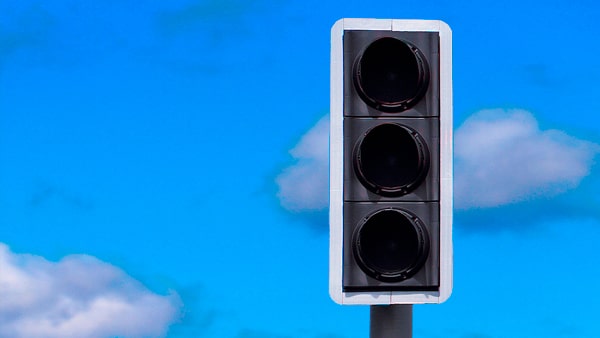
From top to bottom, the following is the proper order for traffic lights:
  1. A. Red, yellow, green
  2. B. Red, green, yellow
  3. C. Green, red, yellow
  4. D. Green, yellow, red

Correct answer: A. – Red, yellow, green

Washington has adopted the 11th Edition of the Manual on Uniform Traffic Control Devices. For a vertically arranged signal face, red indications must be above yellow and green indications. A standard three-section vertical signal consequently displays red at the top, yellow in the middle, and green at the bottom.

Source: WAC 468-95-010 – General (adopting MUTCD, 11th ed., § 4E.04, “Positions of Signal Indications within a Vertical Signal Face”)
Question 2

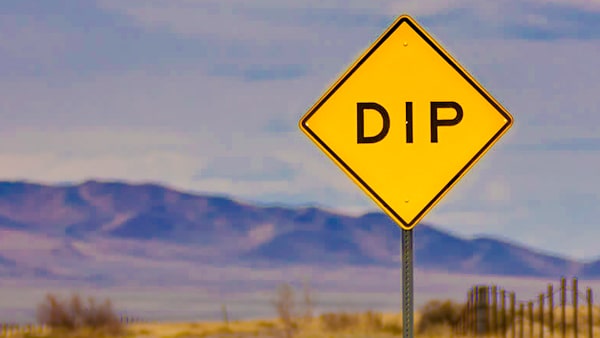
A yellow diamond sign bearing the word “DIP” warns of:

This sign means:
  1. A. A depression in the roadway ahead
  2. B. A soft roadway shoulder
  3. C. A pedestrian crossing
  4. D. A required stop

Correct answer: A. – A depression in the roadway ahead

The DIP warning sign alerts drivers to a depression in the roadway profile ahead. It is a warning sign, not a stop or regulatory sign. Be prepared to adjust your driving for the surface change and for any advisory speed or additional warning displayed with the sign.

Source: WAC 468-95-010 – General (adopting MUTCD, 11th ed., § 2C.26, “BUMP and DIP Signs (W8-1 and W8-2)”)

Question 3

Which color separates traffic traveling in opposite directions?

  1. A. White
  2. B. Red
  3. C. Black
  4. D. Yellow

Correct answer: D. – Yellow

Yellow lines separate traffic moving in opposite directions. They may be broken, solid, or used in combinations that indicate where passing is permitted or prohibited. White lines generally separate lanes of traffic traveling in the same direction or mark the roadway edge.

Source: Washington State Driver Guide — Ch. 4, § 4.16, “White and yellow line”

Question 4

Which centerline prohibits passing by traffic in both directions?

  1. A. One solid yellow line beside one broken yellow line
  2. B. A single broken yellow line
  3. C. Two solid yellow lines
  4. D. A single broken white line

Correct answer: C. – Two solid yellow lines

The Washington State Driver Guide explains that double solid yellow centerlines mark the middle of a two-way road and prohibit passing in both directions. A broken yellow line may permit passing when safe. With a solid-and-broken combination, only traffic beside the broken line may pass when conditions and other rules allow it.

Source: Washington State Driver Guide — Ch. 4, § 4.16, “Double solid yellow centerline”, RCW 46.61.130(1)–(2) – No-passing zones

Question 5

Orange signs or flags along the roadway warn drivers about:

  1. A. Permanent road closures only
  2. B. Work activity or temporary changes in roadway conditions
  3. C. Ordinary speed-limit zones
  4. D. High-occupancy vehicle lanes

Correct answer: B. – Work activity or temporary changes in roadway conditions

Orange is the warning color for construction and maintenance activity. These devices may identify temporary traffic patterns, work areas, or people and equipment near the roadway. Pay attention to the specific message or symbol because it explains the condition ahead and how traffic is being directed.

Source: Washington State Driver Guide — Ch. 4, § 4.12, “Signs” and “Work zone signs”

Question 6

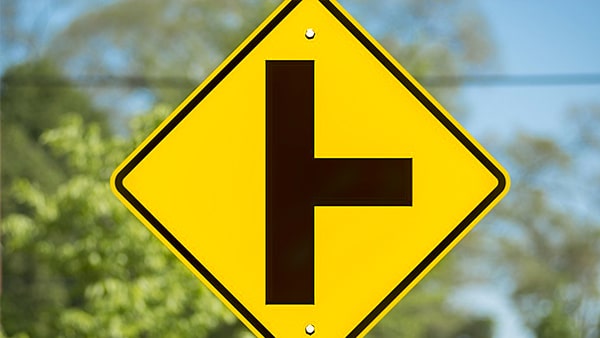
A yellow diamond sign showing a short black line entering the main vertical line from the right means:

This sign means:
  1. A. All traffic must turn right
  2. B. A side road enters from the right ahead
  3. C. All traffic must continue straight
  4. D. Right turns are prohibited

Correct answer: B. – A side road enters from the right ahead

The Side Road warning sign indicates an intersection where a road enters from the side shown by the symbol. It warns of the intersection and the possibility of turning or entering traffic. Because it is a warning sign, it does not require traffic to turn or prohibit a particular turn.

Source: WAC 468-95-010 – General (adopting MUTCD, 11th ed., § 2C.41, “Intersection Warning Signs (W2-1 through W2-8)”)