Washington Road Signs Test Simulator

4.8 out of 5 (638 votes)
80% Passing score
25 Questions
5 Mistakes allowed
Washington road signs deserve more attention than most people give them during permit test prep. Road signs are easy to recognize at a glance, but the test expects you to know exactly what each sign means and what you should do when you see it. With sign shapes, work zone warnings, lane-use markings, railroad crossings, school zones, merge signs, service signs, destination signs, the difference between “I recognize that” and “I can answer it correctly under test wording” is where people lose points. This Washington road signs practice test is built for that gap. The official Washington DOL knowledge test is a written, multiple-choice exam based on the Washington State Driver Guide, and it covers much more than signs: traffic laws, right-of-way, intersections, stopping distance, safe driving habits, distracted and impaired driving, pavement markings, and sharing the road with pedestrians, bicyclists, motorcycles, emergency vehicles, and large trucks. Still, road sign knowledge is a real part of the exam, not decoration in the handbook. The actual WA driver knowledge test has 40 questions, and you need 32 correct answers to pass. That is an 80% score, with up to 8 missed questions allowed. This simulator keeps the same passing standard in a tighter road-sign format: 20 randomized questions, with 16 correct answers needed to pass. The math is simple, which is nice, because the signs are where the little details start doing their little details thing. Each session pulls from a broader mix of Washington road sign topics, so you are not just clicking through the same memorized order. You may see regulatory signs, warning signs, work zone signs, guide signs, service signs, sign colors and shapes, pavement markings, “wrong way,” “do not enter,” “yield,” “no passing,” pedestrian, railroad, merge, and school zone signs. Some of it will feel familiar. Some of it will expose that slightly uncomfortable “wait, I thought I knew this” feeling. Good. That is what practice is supposed to do before test day, not during it. Use this WA DOL practice test while studying the official Washington State Driver Guide, especially the signs section. A passing knowledge-test score in Washington is valid for 2 years, but the real value here is more immediate and more practical: reading signs quickly enough to make the right decision in Seattle rain, mountain-pass weather, construction zones, rural roads, and ordinary intersections that suddenly require your full attention.

FREE DMV Practice Test App
Study for your Washington permit test or driver’s license with the NextDoorDriving app. 700+ DMV questions and answers, 100% free!
Download on the App Store

Sample Washington Permit Test Questions

Question 1

A solid yellow no-passing line may be crossed:

  1. A To pass a slower vehicle traveling in your direction
  2. B Only during daylight hours
  3. C Whenever the opposing lane appears clear
  4. D To make a legal left turn into or from an alley, private road, or driveway

Correct answer: D – To make a legal left turn into or from an alley, private road, or driveway

Washington prohibits driving left of pavement striping that marks a no-passing zone, but this restriction does not apply to a driver turning left into or from an alley, private road, or driveway. The turn must be made with reasonable safety. A left-turning driver must also yield to approaching traffic that presents an immediate hazard.

Source: RCW 46.61.130(2)–(3) – No-passing zones, RCW 46.61.185(1) – Vehicle turning left—Vulnerable users of a public way—Fine, RCW 46.61.305(1) – When signals required—Improper use prohibited

Question 2

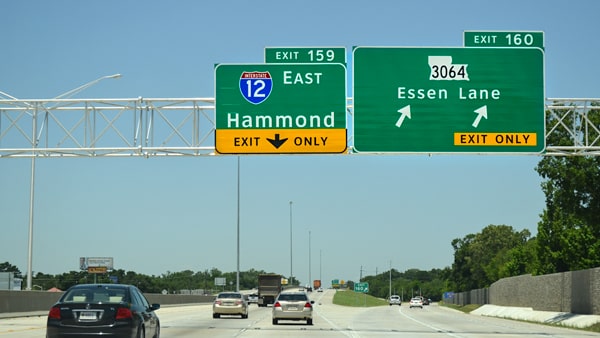
On a Washington freeway, a yellow “EXIT ONLY” panel above your lane means:

If you see this sign above your lane, you:
  1. A You cannot use that lane to leave the freeway
  2. B You may either exit or continue on the main roadway
  3. C The lane continues through the interchange
  4. D The lane leaves the main roadway at the exit

Correct answer: D – The lane leaves the main roadway at the exit

A yellow “EXIT ONLY” panel identifies a lane drop at an interchange. Traffic remaining in that lane follows the exit rather than continuing on the main roadway. If you intend to stay on the freeway, move safely into a through lane before the exit lane separates.

Source: WAC 468-95-010 – General (adopting MUTCD, 11th ed., § 2E.28, “Signing for Interchange Lane Drops without an Optional Exit Lane”)

Question 3

In Washington, when may you turn left at a steady red signal?

  1. A From a two-way street onto another two-way street when traffic is clear
  2. B Without stopping when no vehicles are approaching
  3. C After stopping, from a one-way or two-way street onto a one-way street carrying traffic to the left
  4. D Whenever the vehicle ahead makes the same turn

Correct answer: C – After stopping, from a one-way or two-way street onto a one-way street carrying traffic to the left

After stopping, a driver may turn left from a one-way or two-way street onto a one-way street carrying traffic in the direction of the turn. The movement is prohibited if a sign says otherwise. Before turning, the driver must remain stopped for vehicles lawfully within or approaching the intersection and for pedestrians lawfully in the intersection.

Source: RCW 46.61.055(3)(a) – Traffic control signal legend

Question 4

What must you do when red lights flash at a railroad crossing?

  1. A Stop only when a train is visible
  2. B Stop exactly 10 feet from the signal
  3. C Stop 15 to 50 feet from the nearest rail and wait until the warnings end and crossing is safe
  4. D Reduce speed and cross without stopping

Correct answer: C – Stop 15 to 50 feet from the nearest rail and wait until the warnings end and crossing is safe

Washington requires a driver to stop between 15 and 50 feet from the nearest rail when a crossing signal warns of an approaching train or other on-track equipment. Do not proceed until the crossing can be made safely. The driver guide directs motorists to wait until the red lights stop flashing and the other warnings deactivate.

Source: RCW 46.61.340(1) – Approaching railroad grade crossings, Washington State Driver Guide — Ch. 4, § 4.7, “Sharing the road with trains”

Question 5

When may a driver cross a broken white or broken yellow line?

  1. A After determining that the movement can be made safely
  2. B Whenever turning into a driveway
  3. C Only when the vehicle ahead is disabled
  4. D Only when traveling on a one-way street

Correct answer: A – After determining that the movement can be made safely

A broken white line may be crossed to change lanes when it is safe. A broken yellow line may permit use of the opposing lane to pass, but other passing restrictions still apply. Washington law requires a driver to ascertain that a movement from the current lane can be made safely before beginning it.

Source: RCW 46.61.140(1) – Driving on roadways laned for traffic, Washington State Driver Guide — Ch. 4, § 4.16, “Road markings”

Question 6

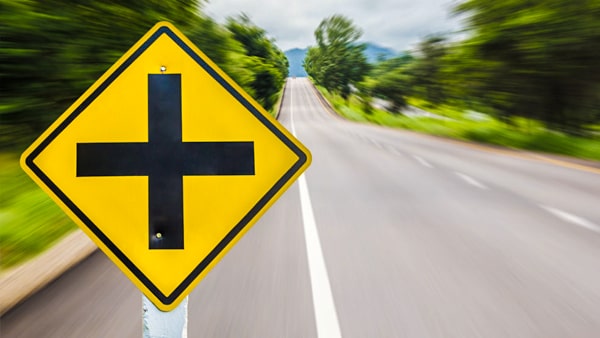
A yellow diamond sign displaying a black cross warns of:

This sign shows one type of:
  1. A A crossroad intersection ahead
  2. B A series of roadway curves
  3. C A required right turn
  4. D A lane shift ahead

Correct answer: A – A crossroad intersection ahead

The black cross is the symbol used for a Cross Road warning sign. It alerts drivers that an intersection is ahead and that vehicles could turn or enter from the intersecting road. The symbol depicts the general configuration of the approaching intersection.

Source: WAC 468-95-010 – General (adopting MUTCD, 11th ed., § 2C.41, “Intersection Warning Signs (W2-1 through W2-8)”)