


West Virginia CDL Class B Practice Test (WV) 3

4.8 out of 5 (63 votes)
80% Passing score
20 Questions
4 Mistakes allowed
If you're gearing up for the West Virginia CDL Class B test, you've found the perfect DMV practice test to kick-start your preparation. This is the third WV permit practice test in our comprehensive series, designed specifically for those aiming to secure a Class B Commercial Driver's License in West Virginia. Featuring 20 meticulously crafted CDL test questions, this learners practice test challenges your knowledge and understanding of the critical aspects of commercial driving. To pass this WV CDL class B practice test, you need to answer at least 16 sample permit test questions correctly. The questions are drawn directly from the official 2026 CDL driver's manual, ensuring that the material you study here is relevant and up-to-date. If it's in the manual, it's on the practice test, so you can trust that you're studying the right information. Our WV CDL practice permit test covers a wide range of subjects, including pre-trip vehicle inspections, basic vehicle control, shifting gears-yes, there are questions on downshifting-tackling hills and steep downgrades, effective communication with other drivers, controlling your speed, and maintaining drug and alcohol awareness. One of the key advantages of our West Virginia CDL practice test for a class B license is the ability to take it as many times as necessary. Each attempt helps you get more comfortable with the material, reinforcing your knowledge and boosting your confidence. Whether it's your first try or your fifteenth, the same set of WV CDL test questions and answers will appear, allowing you to track your progress and identify areas that might need more attention. We pride ourselves on providing reliable and regularly updated content. Our WV CDL permit practice test is frequently revised to reflect the most current driving laws and regulations, ensuring that you're studying the latest and most relevant information. As of 2026, all our content is updated to meet the current standards. Prepare effectively for your West Virginia CDL Class B test with our third DMV practice test, and you'll be well on your way to mastering the skills and knowledge required to pass the real thing in 2026. With consistent practice and dedication, achieving your CDL is within reach!
FREE CDL Practice Test App
Pass your West Virginia CDL General Knowledge test with the NextDoorDriving app. Real questions and answers—100% free and ad-free.
Download on the App Store

Sample West Virginia CDL Test Questions - General Knowledge

Question 1

How far ahead should a commercial driver normally scan while driving?

  1. A 2 to 5 seconds
  2. B 5 to 10 seconds
  3. C 12 to 15 seconds
  4. D 15 to 25 seconds

Correct answer: C – 12 to 15 seconds

West Virginia’s CDL manual recommends looking at least 12 to 15 seconds ahead—the distance the vehicle will travel during that time. This is about one block at lower speeds and roughly one-quarter mile at highway speeds. Drivers must also continue shifting their attention between nearby conditions and the roadway farther ahead.

Source: West Virginia Commercial Driver’s License Manual with AAMVA Booklet — § 2.4.1, “How Far Ahead to Look”
Question 2

A driver may continue carrying liquid or gas in a leaking tank if the leak is small.

  1. A TRUE
  2. B FALSE

Correct answer: B – FALSE

West Virginia’s CDL manual directs drivers not to carry liquids or gases in a leaking tank. The instruction applies even when the product is not classified as hazardous material. A tank-vehicle inspection must include the tank body, valves, pipes, connections, hoses, covers, and vents for signs of leakage.

Source: West Virginia Commercial Driver’s License Manual with AAMVA Booklet — § 8.1.1, “Leaks”

Question 3

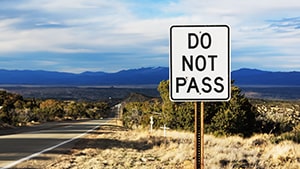
What action does this regulatory sign prohibit?

This sign indicates that the driver should _____________.
  1. A Passing unless traffic is moving slowly
  2. B Overtaking and passing another vehicle
  3. C Continuing without first stopping
  4. D Returning to the right lane after passing

Correct answer: B – Overtaking and passing another vehicle

A Do Not Pass sign marks or emphasizes a restriction on overtaking and passing. It may be placed at the beginning of and within a zone where limited sight distance or other conditions make passing inappropriate. The restriction continues until the no-passing zone ends or passing is otherwise permitted.

Source: Manual on Uniform Traffic Control Devices for Streets and Highways, 11th Edition with Revision 1 — § 2B.36, “DO NOT PASS Sign (R4-1)”

Question 4

What is the general meaning of an orange highway sign?

  1. A Temporary traffic control, such as road construction or maintenance
  2. B A permanent general warning
  3. C Route and destination guidance
  4. D A requirement to stop

Correct answer: A – Temporary traffic control, such as road construction or maintenance

Orange is the standard color associated with temporary traffic control. Orange signs commonly warn about road work, maintenance operations, temporary lane arrangements, workers, equipment, or other temporary conditions. Drivers should watch for changing traffic patterns and follow the displayed instructions.

Source: Manual on Uniform Traffic Control Devices for Streets and Highways, 11th Edition with Revision 1 — § 1D.05, “Color Code”

Question 5

Which group includes items a driver should monitor or inspect during a trip?

  1. A Gauges, exhaust components, lights, cargo, and coupling devices
  2. B Gauges, brakes, lights, pumps, and cargo hoses
  3. C Gauges, brakes, lights, cargo securement, and coupling devices
  4. D Gauges, shock absorbers, brake shoes, frame members, and suspension springs

Correct answer: C – Gauges, brakes, lights, cargo securement, and coupling devices

West Virginia’s CDL manual tells drivers to watch gauges for trouble and inspect critical items during stops. These items include brakes, lights and reflectors, trailer connections, coupling devices, and cargo-securement devices. Tires, wheels, and rims must also be checked; any sight, sound, smell, or feel suggesting trouble should be investigated.

Source: West Virginia Commercial Driver’s License Manual with AAMVA Booklet — § 2.1.2, “Types of Vehicle Inspection”, West Virginia Commercial Driver’s License Manual with AAMVA Booklet — § 2.1.6, “Inspection during a Trip”

Question 6

Which condition is an example of a brake defect?

  1. A A cracked brake drum
  2. B Oil, grease, or brake fluid on a shoe or pad
  3. C A dangerously thin, missing, or broken brake shoe
  4. D All of these conditions

Correct answer: D – All of these conditions

Cracked brake drums, contaminated shoes or pads, and dangerously worn, broken, or missing shoes are all brake defects. Cracks can weaken a drum, while oil, grease, or brake fluid reduces the friction required for stopping. These conditions must be identified during the vehicle inspection and corrected before unsafe operation.

Source: West Virginia Commercial Driver’s License Manual with AAMVA Booklet — § 2.1.3, “Bad Brake Drums or Shoes”