


West Virginia General Knowledge CDL Prep Test (WV) 4

5 out of 5 (55 votes)
80% Passing score
20 Questions
4 Mistakes allowed
Welcome to your fourth West Virginia CDL prep test, designed to sharpen your skills and prepare you for the real DMV written test. This test comprises 20 learners questions, where you'll need to correctly answer at least 16 to pass. This set of sample DMV questions will remain the same each time you take the test, allowing you to focus on mastering the material. Our WV CDL prep test was created to closely mirror the actual 2026 DMV CDL permit test. While the DMV does not release their exact questions, our learners permit practice tests are designed to replicate the format and subject matter you will encounter. This approach helps you to not only memorize answers but also understand the underlying concepts, giving you a deeper and more practical knowledge. At the end of each West Virginia CDL practice test, you'll receive a detailed summary of your performance. This summary will highlight which DMV questions you got wrong and provide the correct answers, offering a valuable learning opportunity. By reviewing these summaries, you can identify areas where you need improvement and focus your study efforts accordingly. The CDL practice questions are drawn from a large pool, ensuring comprehensive coverage of the material. This variety helps you to be well-prepared for the CDL test, as you will be exposed to a wide range of topics and question formats. Whether you are just starting your preparation or looking to solidify your knowledge, this West Virginia general knowledge CDL prep test is an excellent tool to help you succeed. Taking multiple learners permit practice tests can significantly increase your chances of passing the actual CDL written test. Our authentic practice experience ensures that you become familiar with the types of questions and the phrasing used in the real WV CDL knowledge test. This familiarity is particularly beneficial for learners who thrive on understanding the material deeply rather than just memorizing answers. Start practicing today and build your confidence with each WV CDL prep test. By the time you face the real DMV knowledge test, you will be well-prepared and ready to achieve your CDL!
FREE CDL Practice Test App
Pass your West Virginia CDL General Knowledge test with the NextDoorDriving app. Real questions and answers—100% free and ad-free.
Download on the App Store

Sample West Virginia CDL Test Questions - General Knowledge

Question 1

A curve warning sign with a 40 mph advisory plaque indicates that:
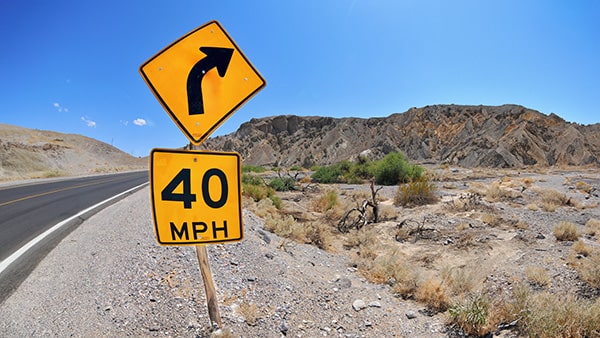
This sign warns drivers to _______________.
  1. A Vehicles traveling under 40 mph must remain in the right lane
  2. B Drivers are required to maintain at least 40 mph
  3. C 40 mph is the recommended operating speed for the curve under favorable conditions
  4. D Drivers should travel faster than 40 mph through the curve

Correct answer: C – 40 mph is the recommended operating speed for the curve under favorable conditions

An advisory speed plaque displays the recommended operating speed for the condition shown on the warning sign. Here, 40 mph is the advised speed for the curve under free-flowing conditions. Weather, road surface, traffic, vehicle characteristics, or cargo may require a commercial driver to travel more slowly.

Source: Manual on Uniform Traffic Control Devices for Streets and Highways, 11th Edition with Revision 1 — § 2C.59, “Advisory Speed Plaque (W13-1P) and Confirmation Advisory Speed Plaque (W13-1aP)”

Question 2

What must a driver do when approaching this sign?

When approaching this sign _______________.
  1. A Watch only for children entering the roadway
  2. B Enter the intersection quickly
  3. C Slow down and yield to traffic with the right-of-way, stopping if necessary
  4. D Proceed because other traffic must yield

Correct answer: C – Slow down and yield to traffic with the right-of-way, stopping if necessary

A Yield sign requires the driver to slow to a reasonable speed and give the right-of-way to conflicting traffic. Stop when necessary for safety before entering the intersection or roadway. The sign does not give the approaching driver priority over other traffic.

Source: Manual on Uniform Traffic Control Devices for Streets and Highways, 11th Edition with Revision 1 — Ch. 2B, “YIELD Sign (R1-2)”

Question 3

Unless a listed crossing exception applies, which commercial vehicles must stop before railroad tracks?

  1. A Every commercial motor vehicle
  2. B Buses transporting passengers and specified vehicles carrying hazardous materials
  3. C Commercial vehicles traveling at night
  4. D Only vehicles approaching an unmarked crossing

Correct answer: B – Buses transporting passengers and specified vehicles carrying hazardous materials

West Virginia law requires buses transporting passengers and specified commercial vehicles carrying hazardous materials to stop at railroad grade crossings, subject to listed exceptions. The stop must be made within 50 feet but not closer than 15 feet from the tracks. Other CMV drivers must slow sufficiently, exercise due caution, and confirm that the tracks are clear.

Source: West Virginia Commercial Driver’s License Manual — § 2.15, “Railroad-highway Crossings”, W. Va. Code § 17C-12-3 – Certain vehicles must stop at all railroad grade crossings

Question 4

Which factors should guide your choice of speed on a long, steep downgrade?

  1. A Perception distance, reaction time, and traffic speed
  2. B Vehicle length, mirror size, and engine horsepower
  3. C Vehicle and cargo weight, grade length and steepness, road conditions, and weather
  4. D Posted speed, stopping distance, and the number of traffic lanes

Correct answer: C – Vehicle and cargo weight, grade length and steepness, road conditions, and weather

Gravity causes a vehicle to gain speed on a downgrade. Select and maintain a speed appropriate for the total weight of the vehicle and cargo, the grade’s length and steepness, road conditions, and weather. Enter the downgrade in a proper low gear and use engine braking as the principal method of controlling speed.

Source: West Virginia Commercial Driver’s License Manual — § 2.6.6, “Speed on Downgrades”

Question 5

Which item is not included in the general CMV emergency-equipment checklist?

  1. A A properly charged and rated fire extinguisher
  2. B Spare electrical fuses when the vehicle does not use circuit breakers
  3. C A first-aid kit
  4. D Warning devices for a stopped vehicle

Correct answer: C – A first-aid kit

The West Virginia CDL inspection checklist includes a properly charged fire extinguisher, spare electrical fuses unless circuit breakers are used, and approved warning devices. A first-aid kit is not one of the three general items on that checklist. Additional equipment may be required for a specialized vehicle or operation.

Source: West Virginia Commercial Driver’s License Manual — § 2.1, “Vehicle Inspection,” “Emergency Equipment”, 49 CFR § 393.95 – Emergency equipment on all power units

Question 6

What are the two functions of a combination vehicle’s emergency air line?

  1. A It supplies air to the trailer tanks
  2. B It controls the trailer emergency brakes
  3. C It performs both functions
  4. D It applies only the tractor’s service brakes

Correct answer: C – It performs both functions

The emergency or supply line carries air to the trailer air tanks and controls the trailer’s emergency brakes. A loss of pressure in this line causes the trailer emergency brakes to apply. The pressure loss also causes the tractor protection valve to close, helping prevent the tractor’s air supply from escaping.

Source: West Virginia Commercial Driver’s License Manual — § 6.2.4, “Trailer Air Lines,” “Emergency Air-line”