


West Virginia CDL Practice Test: General Knowledge (WV) 6

5 out of 5 (37 votes)
80% Passing score
50 Questions
10 Mistakes allowed
Welcome to your sixth West Virginia CDL General Knowledge Practice Test, tailored specifically for aspiring commercial drivers. This DMV practice test is an essential tool in your preparation arsenal, designed to thoroughly prepare you for the actual WV CDL test. With 50 DMV questions covering a wide array of topics, including vehicle equipment, accident procedures, pre-trip inspections, and even some crucial points on hazardous materials, this online learners permit practice test ensures you are well-versed in all critical areas. You'll need to get at least 40 of these CDL test questions correct to pass, making sure you grasp the fundamental knowledge required for safe and efficient driving. One of the standout features of this WV CDL practice test is the flexibility it offers. Unlike the real WV permit test, which comes with time constraints, this DMV practice test allows you to take your time and work through each question at your own pace. This way, you can focus on understanding each concept thoroughly without the pressure of a ticking clock. This approach not only enhances your learning experience but also boosts your confidence as you prepare for the actual written knowledge test in 2026. Our WV permit practice test is meticulously updated and is current for the year 2026, reflecting the latest standards and regulations in the industry. This ensures that the material you are studying is relevant and up-to-date, giving you the most accurate preparation possible. While some resources might tempt you with 'cheat sheets' or shortcuts, these methods can be unreliable and often come with legal and ethical risks. Our WV DMV practice test, however, is a tried and tested tool that provides a legitimate and effective way to prepare. It includes visual aids like images of road signs and traffic scenarios, catering to visual learners and making the learning process more engaging and effective. By choosing our WV CDL practice test, you're opting for a reliable, comprehensive study tool that's designed to help you succeed in 2026. Prepare with confidence, knowing that you're using a resource that has helped many others pass their general knowledge tests and start their careers on the road.
FREE CDL Practice Test App
Pass your West Virginia CDL General Knowledge test with the NextDoorDriving app. Real questions and answers—100% free and ad-free.
Download on the App Store

Sample West Virginia CDL Test Questions - General Knowledge

Question 1

Containerized freight is generally associated with which type of trip?

  1. A A trip exempt from hazardous-material rules
  2. B A trip exempt from vehicle weight limits
  3. C A trip that includes transportation by rail or ship
  4. D A trip for which cargo securement is unnecessary

Correct answer: C – A trip that includes transportation by rail or ship

Containerized loads are generally used when freight travels part of the journey by rail or ship, with truck delivery at one or both ends. Containers must still be properly secured to the vehicle. Although a driver normally cannot inspect the contents of a sealed container, gross and axle weight limits must still be checked.

Source: West Virginia Commercial Driver’s License Manual — § 3.3.5, “Sealed and Containerized Loads”
Question 2

Your signal is green, but vehicles are still occupying the intersection. What should you do?

  1. A Wait outside the intersection until there is room to proceed
  2. B Enter the intersection and wait for traffic to move
  3. C Use the horn and continue through
  4. D Change lanes while crossing the intersection

Correct answer: A – Wait outside the intersection until there is room to proceed

West Virginia traffic-signal law permits movement on green but requires drivers to yield to vehicles lawfully within the intersection. If traffic is occupying or blocking your path, remain outside until you have room to proceed. Entering without adequate space can leave the commercial vehicle obstructing cross traffic when the signal changes.

Source: W. Va. Code § 17C-3-5 – Traffic-control signal legend, West Virginia Commercial Driver’s License Manual — § 13.1.2, “Intersections”

Question 3

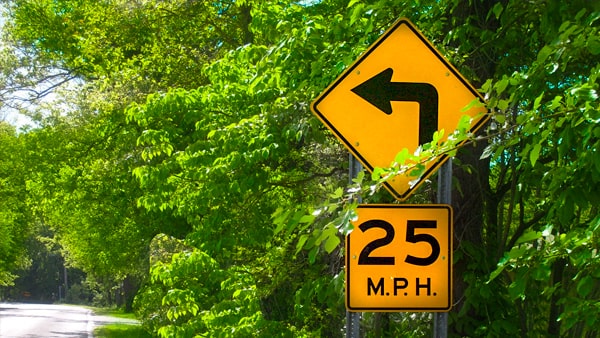
A yellow warning sign shows the roadway curving to the left, with an advisory-speed plaque below it. What should you do?

This sign warns drivers to ____________.
  1. A Reduce speed for a curve to the right
  2. B Reduce speed before entering the curve to the left
  3. C Accelerate before making a sharp left turn
  4. D Stop before beginning a right turn

Correct answer: B – Reduce speed before entering the curve to the left

A curve warning sign shows the direction in which the roadway bends. The supplemental advisory-speed plaque identifies a recommended speed for traveling through the condition under favorable circumstances. Reduce speed before entering the left curve and adjust further when vehicle weight, weather, road surface, or other conditions require it.

Source: Manual on Uniform Traffic Control Devices for Streets and Highways, 11th ed. — Part 2, Ch. 2C, “Warning Signs and Object Markers”

Question 4

May authorized inspectors examine a commercial vehicle and place it out of service?

  1. A No, only the carrier may inspect it
  2. B Only when the vehicle is at a state border
  3. C They may inspect it but cannot issue an out-of-service order
  4. D Yes, and an unsafe vehicle may remain out of service until required repairs are made

Correct answer: D – Yes, and an unsafe vehicle may remain out of service until required repairs are made

Federal and state inspectors may inspect a commercial vehicle in West Virginia. If an authorized inspector determines that the vehicle is unsafe, it may be placed out of service. It cannot be operated until the required repairs are completed according to the out-of-service order.

Source: West Virginia Commercial Driver’s License Manual — § 2.1, “Vehicle Inspection”, 49 CFR § 396.9 – Inspection of motor vehicles and intermodal equipment in operation

Question 5

Which gauge response is normal after starting a commercial vehicle’s engine?

  1. A The exhaust gauge must immediately reach 190 degrees
  2. B The coolant-temperature gauge should begin rising gradually toward its normal range
  3. C Air pressure should require 10 to 15 minutes to begin rising
  4. D Oil pressure should require four to five minutes to reach normal

Correct answer: B – The coolant-temperature gauge should begin rising gradually toward its normal range

After the engine starts, oil pressure should reach its normal range within seconds. Air pressure should also build at the rate required for the vehicle’s system. The coolant-temperature gauge normally begins a gradual rise toward the normal operating range as the engine warms.

Source: West Virginia Commercial Driver’s License Manual — § 2.1.5, “Seven-step Inspection Method,” “Look at the Gauges”

Question 6

Which statement about alcoholic beverages is correct?

  1. A Some drivers are unaffected by alcohol
  2. B Equivalent amounts of alcohol impair performance regardless of whether they come from beer, wine, or liquor
  3. C Coffee and fresh air quickly remove alcohol from the body
  4. D Drinking quickly reduces alcohol’s effect on driving

Correct answer: B – Equivalent amounts of alcohol impair performance regardless of whether they come from beer, wine, or liquor

Alcohol itself affects human performance, regardless of the beverage containing it. Equivalent amounts of alcohol from beer, wine, or liquor can produce comparable impairment. Drinking faster raises BAC because alcohol enters the body faster than the liver can process it, and only time lowers the amount of alcohol in the body.

Source: West Virginia Commercial Driver’s License Manual — § 2.22.1, “Alcohol and Driving,” “What Is a Drink?”