


West Virginia CDL Practice Test (WV) 2026

4.8 out of 5 (104 votes)
80% Passing score
20 Questions
4 Mistakes allowed
Are you ready to tackle your first step towards obtaining a Commercial Driver's License (CDL) in West Virginia? Our first WV CDL practice test is the perfect place to start. With 20 multiple-choice questions, this DMV practice test mimics the real written permit test, requiring you to get at least 16 correct answers to pass. These sample permit test questions cover a wide array of topics, including pre-trip vehicle inspections, basic vehicle control, shifting gears, handling hills and downgrades, communicating with other drivers, controlling speed, and drug and alcohol awareness. Whether you're aiming for a Class A or Class B driver's license, and regardless of the endorsements you seek, the general knowledge test is your initial hurdle. Our West Virginia CDL practice test is identical for all license classes, ensuring comprehensive preparation. Remember, while this WV learners permit practice test is an invaluable tool, it does not replace traditional drivers ed courses. In West Virginia, completing a state-certified Entry Lever Driver Training course prior to applying for a commercial learners permit is mandatory. This WV permit practice test should be used alongside your drivers ed course to reinforce your learning and identify areas that might need more attention. What makes our West Virginia CDL practice test particularly useful is its flexibility. You can take the DMV practice test as many times as necessary to get comfortable with the material. Repeated attempts will help you internalize the knowledge and become confident in your ability to tackle the actual WV permit test in 2026. Additionally, our WV permit practice test comes with real permit test answers and helpful study aids to assist you whenever you encounter a difficult question. This feature ensures that you are not just memorizing answers but understanding the concepts behind them, leading to a deeper comprehension and better retention of the material. Get started with our first WV CDL practice test today and pave the way for a successful test experience. It's not just about passing the DMV knowledge test in 2026; it's about becoming a knowledgeable and safe driver on the roads of West Virginia!
FREE CDL Practice Test App
Pass your West Virginia CDL General Knowledge test with the NextDoorDriving app. Real questions and answers—100% free and ad-free.
Download on the App Store

Sample West Virginia CDL Test Questions - General Knowledge

Question 1

What maneuver does this regulatory sign prohibit?
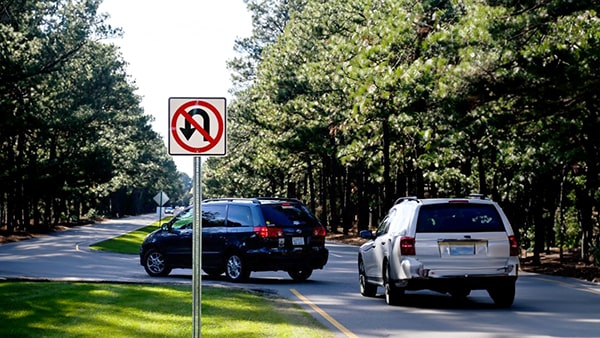
This sign indicates that ______________.
  1. A Making any turn at the intersection
  2. B Making a U-turn
  3. C Continuing straight ahead
  4. D Entering a one-way street

Correct answer: B – Making a U-turn

This is a No U-Turn sign. It prohibits turning the vehicle around to travel in the opposite direction at the location where the restriction applies. It does not prohibit every type of turn or indicate that the roadway is one-way.

Source: Manual on Uniform Traffic Control Devices for Streets and Highways, 11th Edition with Revision 1 — Ch. 2B, “Movement Prohibition Signs (R3-1 through R3-4, R3-18, and R3-27)”

Question 2

A commercial driver should use low-beam headlights at all times when driving at night.

  1. A TRUE
  2. B FALSE

Correct answer: B – FALSE

West Virginia’s CDL manual advises using high beams whenever their use is safe and legal. Using low beams continuously reduces the distance a driver can see ahead. High beams should not be used within 500 feet of an approaching vehicle, and cab lighting should be kept low enough to preserve outside vision.

Source: West Virginia Commercial Driver’s License Manual with AAMVA Booklet — Section 2, “Use High Beams When You Can”

Question 3

If your commercial vehicle catches fire, you should drive into a service station because firefighting equipment may be available there.

  1. A TRUE
  2. B FALSE

Correct answer: B – FALSE

West Virginia’s CDL manual specifically warns drivers not to pull a burning vehicle into a service station. Get off the road, stop in an open area, and remain away from buildings, trees, brush, vehicles, and other materials that could ignite. Notify emergency services and provide your location.

Source: West Virginia Commercial Driver’s License Manual with AAMVA Booklet — § 2.21.3, “Fire Fighting”

Question 4

If you cannot avoid crossing deep standing water, what should you do while crossing to help keep the brakes usable?

  1. A Maintain light pressure on the brake pedal
  2. B Press the accelerator and brake pedal as hard as possible
  3. C Disconnect the steering-axle brakes
  4. D Reduce engine speed and avoid using the brakes

Correct answer: A – Maintain light pressure on the brake pedal

Slow down, select a low gear, and maintain light brake pressure while crossing the water. This keeps the linings against the drums or discs and helps limit the entry of water, mud, sand, and silt. After leaving the water, continue light pressure briefly to dry the brakes, then test them when it is safe.

Source: West Virginia Commercial Driver’s License Manual with AAMVA Booklet — § 2.13.2, “Wet Brakes”

Question 5

Which statement about a commercial vehicle’s overhead clearance is correct?

  1. A Posted clearance measurements are always exact
  2. B Repaving cannot reduce the clearance below an overpass
  3. C The weight of the cargo can affect the vehicle’s height
  4. D None of these statements is correct

Correct answer: C – The weight of the cargo can affect the vehicle’s height

West Virginia’s CDL manual explains that cargo weight can change a vehicle’s height; an empty van may be higher than a loaded one. A bridge cleared while loaded might not be cleared when empty. Repaving or packed snow can also reduce the available space below a bridge or overpass.

Source: West Virginia Commercial Driver’s License Manual with AAMVA Booklet — § 2.7.4, “Space Overhead”

Question 6

In West Virginia, a first conviction for operating a CMV under the influence of alcohol or a controlled substance generally results in CMV disqualification for:

  1. A 6 months
  2. B 2 years
  3. C 1 year
  4. D 3 years

Correct answer: C – 1 year

West Virginia law imposes a one-year disqualification from operating a commercial motor vehicle for a first conviction involving alcohol or a controlled substance. A first offense committed while operating a CMV carrying hazardous materials that require placarding results in a three-year disqualification. Refusal of required chemical testing can trigger the same periods.

Source: West Virginia Commercial Driver’s License Manual with AAMVA Booklet — § 1.3.2, “Alcohol, Leaving the Scene of an Accident, and Commission of a Felony”, W. Va. Code § 17E-1-13(b)(1)–(3) — Disqualification