


West Virginia DMV Practice Test 2

4.8 out of 5 (158 votes)
80% Passing score
20 Questions
4 Mistakes allowed
The WV DMV permit test is built around practical driving knowledge, not trivia, and that is the better way to study for it. This second West Virginia DMV practice test gives you 20 focused questions that cover the rules new drivers are expected to know before they apply for a learner’s permit: road signs, right-of-way, seat belt use, lane position, safe following distance, turns, visibility, and the judgment needed when conditions are less than ideal. That last part matters in West Virginia. A lot of driving here happens on roads that do not leave much room for lazy habits—rural two-lane routes, curves that tighten quickly, hills, fog, rain, and stretches where visibility can change before you have fully settled into the drive. So the goal of this DMV practice permit test is not just to help you recognize the correct answer on a screen. It is to make the rules feel usable, the way they need to be usable when you are actually behind the wheel. The practice format also gives you room to make mistakes without turning them into DMV problems. Missed answers come with explanations, so you can see whether you misunderstood the law, rushed through the wording, or simply guessed on something you had only half-studied. It is a small distinction, but an important one. Guessing correctly on a practice question feels fine for about two seconds; understanding why the answer is correct is what helps on the official WV DMV written test. It is also worth knowing the licensing details around the test itself. West Virginia offers automated knowledge testing at DMV locations, and learner’s permit applicants may also use the official KnowTo Drive online option. The online test requires a desktop or laptop with a front-facing camera, plus a keyboard and mouse or mouse pad. Phones are not accepted. Passing online does not give you permission to drive; you still have to go to the DMV for document processing and permit issuance, and that passing online score is valid for 6 months. First-time applicants should also be ready for the document and vision requirements. In general, you need proof of identity, proof of Social Security number, and two proofs of West Virginia residency. Applicants must pass a vision screening as well, usually meeting a 20/40 standard with or without corrective lenses. If glasses or contacts are needed, the license can carry that restriction. In the meantime, use this West Virginia DMV permit practice test as a real check on your preparation before test day.
FREE DMV Practice Test App
Study for your West Virginia permit test or driver’s license with the NextDoorDriving app. 700+ DMV questions and answers, 100% free!
Download on the App Store

Sample West Virginia Permit Test Questions

Question 1

Which statement is true when driving through a West Virginia highway work zone?

  1. A You must obey authorized flaggers and temporary traffic-control instructions
  2. B You need to slow down only when workers are visible
  3. C Temporary traffic directions may be ignored when traffic is light
  4. D Permanent signs always override a flagger’s directions

Correct answer: A – You must obey authorized flaggers and temporary traffic-control instructions

Drivers must obey traffic-control instructions given by law-enforcement officers or persons authorized to act as flaggers in construction and maintenance areas. Work-zone devices and flaggers are used to regulate, warn, and guide traffic safely through changing conditions. Remain alert and follow the temporary directions even when they alter the normal traffic pattern.

Source: W. Va. Code § 17C-3-4a(a) – Obedience to traffic-control instructions at site of street or highway construction or maintenance; penalty, West Virginia Driver’s Licensing Handbook — Ch. V, “Flaggers”
Question 2

When an authorized emergency vehicle approaches with the required warning light and audible signal, you must:

  1. A Move as close as possible to the right edge or curb, clear of the intersection, and stop
  2. B Enter the right lane and continue driving slowly
  3. C Stop immediately in the intersection
  4. D Accelerate until you are ahead of the emergency vehicle

Correct answer: A – Move as close as possible to the right edge or curb, clear of the intersection, and stop

West Virginia law requires other drivers to yield, move parallel and as close as possible to the right-hand edge or curb, and stop clear of an intersection. Remain stopped until the emergency vehicle has passed unless a police officer directs otherwise. The emergency-vehicle driver still has a duty to operate with due regard for highway users’ safety.

Source: W. Va. Code § 17C-9-5(a)(1), (b) – Operation of vehicles and streetcars on approach of authorized emergency vehicles

Question 3

Why must motorists watch for bicyclists using ordinary traffic lanes?

  1. A Bicyclists are required to ride facing traffic
  2. B Bicyclists have roadway rights and duties similar to vehicle drivers
  3. C Bicyclists always have priority over every other road user

Correct answer: B – Bicyclists have roadway rights and duties similar to vehicle drivers

West Virginia law grants a person riding a bicycle on a roadway the rights and duties that generally apply to vehicle drivers, subject to bicycle-specific rules and provisions that cannot apply. A bicyclist may lawfully occupy a traffic lane, including when avoiding hazards or when a lane is too narrow to share safely side by side.

Source: W. Va. Code § 17C-11-2 – Traffic laws apply to persons riding bicycles, W. Va. Code § 17C-11-5(a) – Riding on roadways and bicycle paths

Question 4

Where must you first stop when approaching a STOP sign with a crosswalk?

  1. A Past the crosswalk where you can see cross traffic
  2. B Beside the sign regardless of roadway markings
  3. C Before entering the crosswalk
  4. D At least five feet before the sign

Correct answer: C – Before entering the crosswalk

West Virginia law requires a driver approaching a STOP sign to stop before entering the crosswalk on the near side. If no crosswalk exists, stop at a clearly marked stop line. If neither is present, stop at the nearest point where approaching traffic can be seen before entering the intersection.

Source: W. Va. Code § 17C-12-5(d) – Vehicles must stop at through highways; erection of signs, West Virginia Driver’s Licensing Handbook — Ch. V, “Single Message Shaped Signs”

Question 5

Which actions can properly alert other road users to what you are doing?

  1. A Signal before turning or changing lanes
  2. B Gently flash your brake lights to warn a close follower
  3. C Use the horn and lights to warn others during a brake failure
  4. D All of the above

Correct answer: D – All of the above

Turn signals tell others that you intend to turn or change lanes. Gently tapping the brakes can flash the brake lights to warn a driver who is following too closely. During a brake failure, the horn and lights may be used to warn surrounding traffic. Each method should be used only in the situation for which it is intended.

Source: West Virginia Driver’s Licensing Handbook — Ch. VI, “Driving Signals”, West Virginia Driver’s Licensing Handbook — Ch. VI, “Tailgating”, West Virginia Driver’s Licensing Handbook — Ch. IX, “Brake Failure”

Question 6

When parking uphill next to a curb, how should you position the front wheels?

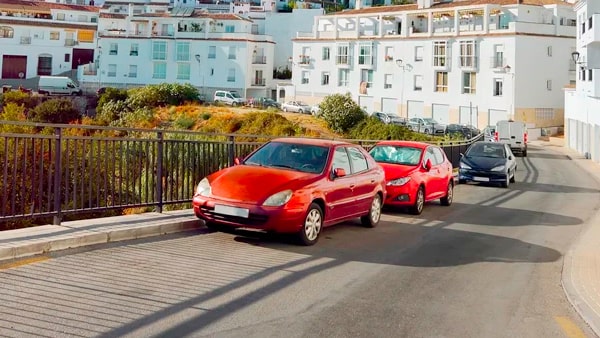
When parking your vehicle facing uphill with a curb, you should point your front wheels:
  1. A Turn them toward the curb
  2. B Turn them away from the curb
  3. C Either direction is acceptable
  4. D Leave them straight

Correct answer: B – Turn them away from the curb

The West Virginia handbook directs drivers parking uphill with a curb to turn the front wheels away from the curb. Set the parking brake and place an automatic transmission in Park. With a manual transmission, use first gear when facing uphill. These steps help prevent an unattended vehicle from rolling into traffic.

Source: West Virginia Driver’s Licensing Handbook — Ch. VI, “Parking on Hills”