


West Virginia Practice Permit Test 3

4.8 out of 5 (129 votes)
80% Passing score
20 Questions
4 Mistakes allowed
West Virginia’s learner’s permit process is pretty straightforward on paper, but there are enough age rules, document requirements, and testing details tucked into it that you do want to study with the actual DMV process in mind. This WV DMV learners permit practice test gives you that kind of preparation: not just a quick quiz on signs, but a focused run-through of the rules, wording, and driving knowledge you’re expected to bring into the real exam. The practice test includes 20 multiple-choice questions based on the official West Virginia Driver’s Manual, with a passing score of 16 correct answers. That matters because the real WV knowledge test is not trying to reward vague familiarity. It checks whether you understand road signs, right-of-way rules, safe driving habits, state traffic laws, and the West Virginia-specific rules that tend to matter both on the test and later, when you are actually behind the wheel and not just clicking answers on a screen. For applicants ages 15 to 17, the knowledge test is part of West Virginia’s Graduated Driver Licensing system. Teen drivers first apply for a Level 1 GDL Instruction Permit, which means they must be at least 15, pass the vision screening, pass the knowledge test, provide a valid School Driver Eligibility Certificate, and have parent or legal guardian consent on form DMV-DS-23P. And, slightly tedious but important, minors need to show a certified birth certificate and a signed Social Security card each time they apply and test for that Level 1 permit. Adults have a different path, though the knowledge test still sits near the front of it. Applicants 18 and older usually apply for a regular Class E instruction permit before the road skills test. After the application and required documents are handled, they take the vision and knowledge tests. That permit is valid for 6 months and allows driving only with a licensed driver age 21 or older in the front seat. If it expires, the vision and knowledge tests have to be taken again. First-time adult drivers may also need to hold the permit for at least 30 days before taking the road test. This West Virginia permit practice test also gives you room to review laws that are easy to skim past, including WV’s ban on texting while driving and restrictions on handheld device use. Those details are not filler. They are part of being ready for the exam and, more importantly, for driving legally in the state. New residents should pay attention, too. West Virginia requires drivers moving into the state to apply for a WV license within 30 days. Most transfer applicants must surrender their out-of-state license or provide a current certified driving record, pass a vision screening, and complete a brief alcohol awareness course. If the out-of-state license is expired, the applicant may be treated like a first-time applicant and required to take all exams. So yes, this is a WV DMV practice test. But used properly, it is also a practical check on whether you understand the licensing steps, the permit rules, and the driving laws well enough to walk into the DMV with fewer surprises.
FREE DMV Practice Test App
Study for your West Virginia permit test or driver’s license with the NextDoorDriving app. 700+ DMV questions and answers, 100% free!
Download on the App Store

Sample West Virginia Permit Test Questions

Question 1

An orange diamond sign showing a person holding a flag warns that:
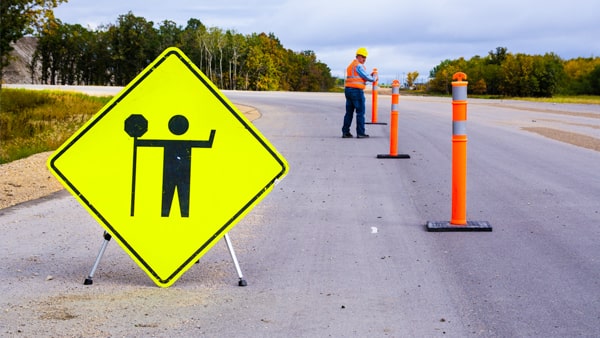
This sign means:
  1. A Pedestrians are crossing ahead
  2. B The work zone has ended
  3. C A school crossing is ahead
  4. D A flagger may be directing traffic ahead

Correct answer: D – A flagger may be directing traffic ahead

This symbol warns that a flagger may be controlling traffic in or near a work zone. Flaggers use red-orange flags or STOP/SLOW paddles to stop, slow, or guide vehicles. Approach cautiously, reduce speed as necessary, and follow the flagger’s directions through the work area.

Source: West Virginia Driver’s Licensing Handbook — Ch. V, “Construction and Maintenance Signs—Flaggers”, West Virginia Driver’s Licensing Handbook — Ch. VII, “Construction Zones”
Question 2

What is a primary benefit of wearing a seat belt correctly?

  1. A It prevents traffic crashes from occurring
  2. B It reduces the chance of injury or death in a crash
  3. C It prevents every type of body movement
  4. D It increases the force placed on the occupant

Correct answer: B – It reduces the chance of injury or death in a crash

A properly worn seat belt spreads crash forces over stronger parts of the body and helps keep an occupant from being thrown forward or ejected. The lap belt should fit snugly over the lower hips, and the shoulder belt should cross the shoulder. Correct use substantially reduces the likelihood of serious injury or death.

Source: West Virginia Driver’s Licensing Handbook — Ch. VIII, “Safety Equipment—Safety Belts”

Question 3

Before changing lanes where bicyclists may be present, which check is especially important?

  1. A Assume any bicyclist will yield
  2. B Check the mirrors and look over your shoulder for a blind spot
  3. C Look only for bicycles traveling against traffic
  4. D Check only the lane directly ahead

Correct answer: B – Check the mirrors and look over your shoulder for a blind spot

Bicycles are small, lightweight, and may be difficult to notice in surrounding traffic. Before changing lanes, check the mirrors and look over the appropriate shoulder to examine the blind spot. The West Virginia handbook also directs drivers to remain extra alert for bicycles and to leave plenty of room when passing them.

Source: West Virginia Driver’s Licensing Handbook — Ch. IV, “Road Test—Lane Changes”, West Virginia Driver’s Licensing Handbook — Ch. VI, “Sharing the Road with Bicycles”

Question 4

Under West Virginia law, what must you do when an authorized emergency vehicle approaches immediately with the required lights and siren?

When you hear the sirens or see the red emergency lights of a closely approaching emergency vehicle, you must:
  1. A Accelerate to stay ahead of it
  2. B Continue slowly in your lane
  3. C Move as close as possible to the right edge, clear of the intersection, and stop
  4. D Stop within the intersection

Correct answer: C – Move as close as possible to the right edge, clear of the intersection, and stop

Yield the right-of-way and move parallel to, and as close as possible to, the right-hand edge or curb. Stop in a position clear of an intersection and remain stopped until the emergency vehicle passes. A police officer may direct you to act differently, in which case you must follow the officer’s instructions.

Source: W. Va. Code §17C-9-5(a)(1) – Operation of vehicles and streetcars on approach of authorized emergency vehicles

Question 5

Which sign directs drivers to pass to the right of a divider or obstruction?

  1. A A yellow diamond sign showing a divided highway ending
  2. B A white rectangular KEEP RIGHT sign with a right-pointing arrow
  3. C A yellow diamond sign showing a sharp left turn
  4. D A yellow diamond sign showing a lane ending

Correct answer: B – A white rectangular KEEP RIGHT sign with a right-pointing arrow

A KEEP RIGHT sign directs traffic to travel to the right of a divider, island, or similar obstruction. It is a rectangular regulatory sign containing words, an arrow, or a symbol that shows the required direction. The other choices warn of changing roadway conditions rather than directing traffic around an obstruction.

Source: West Virginia Driver’s Licensing Handbook — Ch. V, “Square & Rectangular Signs—Lane Directions”

Question 6

Following another vehicle too closely:

  1. A Can never result in a traffic violation
  2. B Disrupts traffic and increases the chance of a crash
  3. C Prevents other vehicles from entering your lane
  4. D Improves traffic flow during congestion

Correct answer: B – Disrupts traffic and increases the chance of a crash

Tailgating leaves too little room to react when the vehicle ahead slows or stops. The handbook identifies it as an impatient behavior that disrupts traffic and increases the chance of causing a crash. State law requires a reasonable and prudent following distance based on vehicle speed, traffic, and highway conditions.

Source: W. Va. Code §17C-7-10(a) – Following too closely, West Virginia Driver’s Licensing Handbook — Ch. VIII, “Impatience”