


West Virginia Practice Permit Test 4

4.9 out of 5 (87 votes)
80% Passing score
20 Questions
4 Mistakes allowed
This WV DMV practice test focuses on child passenger safety first, which is exactly the kind of topic many drivers think they understand until the written test asks for the actual West Virginia rule. The test includes 20 multiple-choice questions covering child safety seat requirements, safe driving around young passengers, general road rules, right-of-way decisions, and other material you may see on the West Virginia DMV written test. It is still a full WV practice permit test, not just a single-topic quiz, but child safety is the main thread running through it. That focus matters. West Virginia law requires children under age eight to be properly secured in a federally approved child safety seat, and the knowledge test may expect you to understand more than the general idea of “buckle kids in.” You need to know the rule, recognize how it applies, and avoid guessing your way through questions that sound familiar but are actually checking for a specific legal requirement. This learners permit practice test gives those details room instead of burying them under generic driving questions. The format is simple in the useful way: 20 questions, immediate feedback, and explanations that tell you why the correct answer is correct. To pass this WV DMV practice permit test, you need at least 16 correct answers out of 20. Missed questions are not treated like the end of the world; they are more like a nudge toward the part of the handbook you probably skimmed too fast. And, well, that happens. Especially with safety rules that feel obvious until the age limit, seat requirement, or wording becomes the thing being tested. Once you are using the practice test to tighten up the written-test material, the adult licensing process is the next piece to understand. If you are 18 or older, you may apply for a regular Class E instruction permit rather than going through the teen graduated licensing stages. Adult applicants must complete the application, present the required documents, pass the vision screening, and pass the knowledge test. After receiving the Class E instruction permit, you practice with a licensed driver age 21 or older seated in the front seat. If you have never held a Level 2 license or a comparable license before, you generally must hold the Class E instruction permit for at least 30 days before taking the road skills test. After passing the road test, first-time applicants also complete a brief DUI awareness course. This West Virginia DMV practice permit test does not replace the handbook or official DMV requirements, but it does give you a focused way to prepare for the written exam, especially the child passenger safety material that deserves more attention than a quick skim.
FREE DMV Practice Test App
Study for your West Virginia permit test or driver’s license with the NextDoorDriving app. 700+ DMV questions and answers, 100% free!
Download on the App Store

Sample West Virginia Permit Test Questions

Question 1

A yellow diamond showing two opposing arrows separated below but joining above warns that:
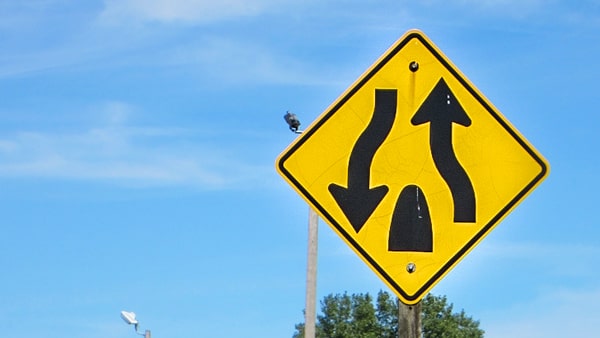
This sign means:
  1. A A turn is required at the next intersection
  2. B The divided highway is ending
  3. C A one-way street begins ahead
  4. D The road is closed ahead

Correct answer: B – The divided highway is ending

This warning sign marks the end of a divided highway. Traffic traveling in opposite directions will no longer be separated by a median or other physical barrier. Be prepared for an undivided, two-way roadway and remain to the right of approaching traffic.

Source: West Virginia Driver’s Licensing Handbook — Ch. V, “Diamond & Warning Signs”

Question 2

Under West Virginia law, a driver passing on a two-lane road must return to the right before coming within what distance of an oncoming vehicle?

  1. A 100 feet
  2. B 200 feet
  3. C 300 feet
  4. D 500 feet

Correct answer: A – 100 feet

The passing vehicle must return to the right-hand side before coming within 100 feet of an approaching vehicle. The left side of the roadway must also be visible and free of oncoming traffic for enough distance to complete the pass safely. After overtaking, the driver may not return right until safely clear of the passed vehicle.

Source: W. Va. Code § 17C-7-5(a) – Same—Limitations on Overtaking on the Left; Penalty, W. Va. Code § 17C-7-3(a)(1) – Overtaking and Passing Vehicle or Bicycle Proceeding in Same Direction—Passing on the Left Generally; Penalty

Question 3

If another driver fails to yield even though traffic rules favor you, what is the safest response?

  1. A Insist on proceeding first
  2. B Yield when necessary to avoid a collision
  3. C Always stop and let every other driver proceed

Correct answer: B – Yield when necessary to avoid a collision

The West Virginia handbook explains that safety comes before right-of-way. If another driver does not follow the right-of-way rules, give way rather than forcing a conflict. Right-of-way rules establish who should proceed, but they do not make an unsafe movement safe.

Source: West Virginia Driver’s Licensing Handbook — Ch. VI, “Right-of-Way”

Question 4

At a West Virginia railroad crossing, an active mechanical signal warns that a train is approaching. What must you do?

  1. A Stop 15 to 50 feet from the nearest rail and proceed only when safe
  2. B Reduce speed and cross without stopping
  3. C Stop only after the train becomes visible
  4. D Sound the horn and continue across

Correct answer: A – Stop 15 to 50 feet from the nearest rail and proceed only when safe

A driver must stop between 15 and 50 feet from the nearest rail when an electric or mechanical signal warns of a train’s immediate approach. The driver may not proceed until it is safe. A violation is a misdemeanor punishable by a $100 fine or up to 10 days in jail, with three license points; the statutory penalty exception covers a malfunctioning signal.

Source: W. Va. Code § 17C-12-1(a)(1), (c) – Obedience to Signal Indicating Approach of Train

Question 5

When parking an automatic-transmission vehicle on any hill, which step is required regardless of curb direction?

  1. A Place a rear wheel against the curb
  2. B Set the parking brake and shift into Park
  3. C Leave the front wheels parallel when there is no curb
  4. D Always turn the front wheels toward the curb

Correct answer: B – Set the parking brake and shift into Park

The proper direction of the front wheels changes according to whether the vehicle faces uphill or downhill and whether a curb is present. The parking brake should always be set. For an automatic transmission, place the selector in Park; for a manual transmission, use reverse downhill or first gear uphill.

Source: West Virginia Driver’s Licensing Handbook — Ch. VI, “Parking on Hills”

Question 6

When glare from an approaching vehicle’s headlights affects your vision at night, where should you look?

When a car with bright headlights comes toward you at night, you should:
  1. A Toward the center line
  2. B Directly above the headlights
  3. C Directly below the headlights
  4. D Toward the right edge of the road

Correct answer: D – Toward the right edge of the road

Avoid looking directly into the lights of an approaching vehicle. Instead, use the right edge of the road as a visual guide until the vehicle passes. The driver’s handbook also directs drivers to reduce speed when facing headlight glare and to maintain a speed that permits stopping within the illuminated area ahead.

Source: West Virginia Driver’s Licensing Handbook — Ch. VI, “Headlights and Their Use”