


West Virginia Permit Practice Test 6

4.9 out of 5 (63 votes)
80% Passing score
20 Questions
4 Mistakes allowed
Our sixth WV practice permit test gives you 20 questions with a practical goal: answer at least 16 correctly and prove you are getting close to real test readiness. This version puts a clear focus on turn signals, which is one of those topics that can seem too basic to study until you realize how often it shows up in actual driving decisions. Turning, changing lanes, merging, pulling from a curb, entering traffic — the signal is not decoration. It is the part of the maneuver that tells everyone else what you are about to do, assuming you use it early enough and in the right situation. The test is free to take on a phone, desktop, or app, but the better reason to use it is that it gives you repeated contact with West Virginia permit test wording. Some questions will feel straightforward. Others may ask about a familiar rule from a slightly different angle, and that is where practice starts doing its work. A good WV practice permit test should not just hand you a score and send you away. It should make weak spots easier to see before the official DMV knowledge test makes them expensive, inconvenient, and a little embarrassing. For younger drivers, this practice test also belongs to a larger licensing path. West Virginia’s Graduated Driver Licensing program begins with the Level 1 GDL Instruction Permit at age 15. To get it, an applicant must pass the vision screening and knowledge test, provide a valid School Driver Eligibility Certificate, and have parent or legal guardian consent unless the marriage-certificate exception applies. After that, the rules are fairly strict. A licensed driver age 21 or older must sit in the right front passenger seat, driving is limited to 5:00 a.m. through 10:00 p.m., and the permit holder has to follow passenger limits, seat belt requirements, zero-alcohol rules, and the ban on wireless device use except for calling 911. And then, because the permit is only the first step, Level 2 has its own conditions. A driver must be at least 16, hold Level 1 for 180 consecutive conviction-free days, pass the road skills test, and either complete 50 supervised driving hours, including 10 at night, or finish an approved West Virginia Department of Education driver education course. Level 2 allows more independence, although nighttime limits, passenger restrictions, and conviction-free driving still matter before Level 3 becomes available at age 17. So the practice test is not just a warm-up for the exam. It is a clean way to put the rules, the timing, and the actual driving expectations into your head before West Virginia starts holding you to them.
FREE DMV Practice Test App
Study for your West Virginia permit test or driver’s license with the NextDoorDriving app. 700+ DMV questions and answers, 100% free!
Download on the App Store

Sample West Virginia Permit Test Questions

Question 1

Traffic beyond a railroad crossing is moving slowly. When should you begin crossing the tracks?
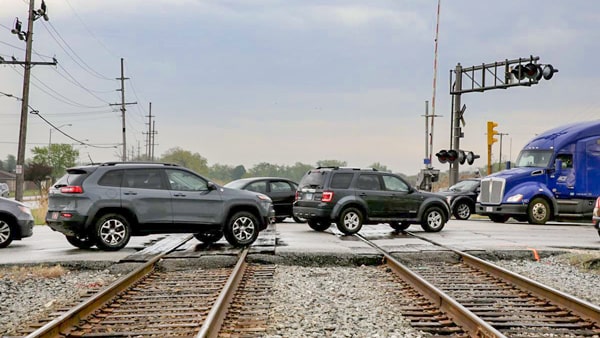
Before you reach the intersection, when crossing railroad tracks in slow traffic, you should:
  1. A After sounding your horn
  2. B When there is room to stop on the tracks
  3. C As soon as the crossing gates begin rising
  4. D Only when there is enough space to clear the tracks completely

Correct answer: D – Only when there is enough space to clear the tracks completely

Do not enter a railroad crossing until the vehicle ahead has moved far enough for you to clear all tracks. Otherwise, traffic could leave your vehicle trapped in a train’s path. Wait before the crossing until sufficient space is available on the other side.

Source: West Virginia Driver’s Licensing Handbook — Ch. V, “Railroad Crossing Signs and Signals”

Question 2

At a West Virginia intersection without traffic signals, a pedestrian is crossing within an unmarked crosswalk on your half of the roadway. What must you do?

  1. A Yield to the pedestrian, slowing or stopping if necessary
  2. B Yield only if the pedestrian has a green signal
  3. C Proceed after reducing speed
  4. D Proceed because no crosswalk lines are painted

Correct answer: A – Yield to the pedestrian, slowing or stopping if necessary

When signals are absent or not operating, a driver must yield to a pedestrian in a crosswalk who is on the driver’s half of the roadway or approaching it closely enough to be in danger. Crosswalks include certain unmarked areas connecting sidewalks at intersections. A pedestrian may not suddenly enter the path of a vehicle that is too close to yield.

Source: W. Va. Code § 17C-1-43(a) – Crosswalk, W. Va. Code § 17C-10-2(a) – Pedestrians’ Right-of-Way in Crosswalks

Question 3

Which image shows the warning that a roadway’s median separation ends ahead?

  1. A Lane-ends-ahead.jpg
  2. B Divided-highway-ends.jpg
  3. C Two-way-traffic-ahead.jpg
  4. D Turn-left-or-right.jpg

Correct answer: B – Divided-highway-ends.jpg

The divided-highway-ends sign warns that the median or physical barrier separating opposite directions of travel will end. Drivers will continue onto an undivided roadway carrying two-way traffic. Stay in the proper right-hand lane and watch for approaching vehicles.

Source: West Virginia Driver’s Licensing Handbook — Ch. V, “Diamond & Warning Signs”

Question 4

If alcohol will be served at an event, which plan best prevents impaired driving?

  1. A Drink coffee before driving home
  2. B Ride with a friend who has agreed not to drink
  3. C Take a cold shower before leaving
  4. D Stop drinking 30 minutes before driving

Correct answer: B – Ride with a friend who has agreed not to drink

The West Virginia handbook describes a designated driver as a selected or volunteer companion who does not drink while responsible for driving others home. The designated driver should be chosen before the activity begins. Coffee, cold showers, exercise, and similar remedies do not quickly remove alcohol; time is the only sobering influence.

Source: West Virginia Driver’s Licensing Handbook — Ch. III, “Designated Driver”, West Virginia Driver’s Licensing Handbook — Ch. III, “Driving Impaired or Under the Influence”

Question 5

What can happen when alcohol is combined with a prescription or over-the-counter drug?

  1. A The medicine cancels the alcohol’s effects
  2. B The alcohol makes the medicine safer to use
  3. C The combination can create dangerous driving impairment
  4. D There is no interaction because they are different substances

Correct answer: C – The combination can create dangerous driving impairment

Prescription and over-the-counter drugs may cause drowsiness, loss of coordination, hallucinations, or other serious effects. Alcohol also interferes with alertness, judgment, and vision. Combining alcohol with drugs can be dangerous or deadly, and a driver should not operate a vehicle when either substance impairs safe driving ability.

Source: West Virginia Driver’s Licensing Handbook — Ch. III, “Other Drugs”, West Virginia Driver’s Licensing Handbook — Ch. III, “Driving Impaired or Under the Influence”

Question 6

Why does West Virginia’s graduated licensing program use stages and restrictions for young drivers?

  1. A To compensate for naturally slow reflexes
  2. B To prevent young drivers from taking any risks
  3. C To let young drivers build skill and experience gradually
  4. D To encourage young drivers to travel below normal traffic speed

Correct answer: C – To let young drivers build skill and experience gradually

The graduated driver’s license program allows drivers ages 15 through 18 to develop driving skills and confidence through a series of measured steps. Intermediate-license restrictions allow a young driver to gain experience while limiting certain higher-risk conditions. Skill and experience develop over time through practice and responsible driving.

Source: West Virginia Driver’s Licensing Handbook — “Graduated Driver’s License (GDL)”, West Virginia Driver’s Licensing Handbook — Ch. I, “Level 2 GDL Intermediate Driver’s License”