West Virginia DMV Sign Test 4

5 out of 5 (46 votes)
80% Passing score
20 Questions
4 Mistakes allowed
West Virginia road signs deserve more attention than most drivers give them, partly because they are everywhere and partly because the state’s roads do not leave much room for guessing. A curve warning on a mountain road, a railroad crossing sign near a rural route, a lane-use signal in town—these are not decorative pieces of roadside information. They tell you what to do before the road makes the decision for you. This WV DMV road signs practice test gives you a focused way to study that material before the West Virginia permit test, a license renewal review, or any moment when your sign knowledge feels a little too fuzzy for comfort. The official West Virginia knowledge test is based on the West Virginia Driver’s Licensing Handbook, and road signs are only one part of it. The exam also covers traffic laws, rules of the road, pavement markings, traffic signals, safe driving practices, alcohol and DUI laws, sharing the road, and basic driver responsibilities. For a standard Class E instruction permit or driver’s license, the knowledge exam includes at least 25 questions, with 19 correct answers required to pass. That is a 76% passing score, which sounds manageable, and it is manageable, but only if the material has actually been studied rather than skimmed in a tired half-hour the night before. This WV DMV signs practice test narrows in on the traffic-control-device material: regulatory signs, warning signs, guide signs, railroad crossing signs and signals, lane-use controls, traffic lights, crosswalk signals, and pavement markings. The 20 multiple-choice questions are meant to help you recognize not just the words on a sign, but the meaning built into its color, shape, and placement. Red usually signals a stop, prohibition, or immediate restriction. Yellow warns. Green guides. Shapes matter too, sometimes before you even have time to read the sign properly, which sounds like a small thing until it matters. And, the DMV visit itself has its own complications. First-time applicants generally need one proof of identity, one proof of Social Security number, and two proofs of West Virginia residency. Applicants under 18 may also need parent or guardian consent, a School Driver Eligibility Certificate, and other GDL documents. So yes, study the signs, review the explanations after each missed answer, and pay attention to the paperwork before you walk in. A solid WV practice permit test helps with the exam; being prepared for the rest keeps the day from getting derailed before the test even starts.

FREE DMV Practice Test App
Study for your West Virginia permit test or driver’s license with the NextDoorDriving app. 700+ DMV questions and answers, 100% free!
Download on the App Store

Sample West Virginia Permit Test Questions

Question 1

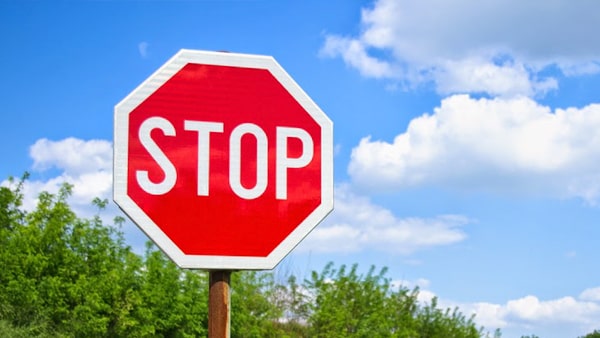
What does an octagonal STOP sign require?

This sign means:
  1. A Slow down and stop only when another vehicle approaches
  2. B Stop completely, yield as required, and proceed when it is safe
  3. C Roll slowly through if the intersection appears clear
  4. D Stop only for vehicles on the intersecting roadway

Correct answer: B – Stop completely, yield as required, and proceed when it is safe

A STOP sign requires a complete stop, not merely a reduction in speed. After stopping at the required location, yield to traffic that is in the intersection or approaching closely enough to be an immediate hazard. Also yield to pedestrians before proceeding.

Source: W. Va. Code § 17C-12-5(d) – Vehicles must stop at through highways; erection of signs, W. Va. Code § 17C-9-3(b) – Vehicle entering through highway or stop intersections, West Virginia Driver’s Licensing Handbook — Ch. V, “Single Message Shaped Signs”

Question 2

A steady circular yellow signal warns that which signal will appear next?

  1. A Flashing yellow
  2. B Steady green
  3. C Steady red
  4. D Flashing red

Correct answer: C – Steady red

A steady yellow signal warns drivers that a red or stop signal will be displayed immediately afterward. West Virginia law states that traffic must not enter or still be crossing the intersection when the red signal is displayed. The yellow interval gives notice that the green phase is ending.

Source: W. Va. Code § 17C-3-5(b)(1) – Traffic-control signal legend, West Virginia Driver’s Licensing Handbook — Ch. V, “Traffic Lights”

Question 3

After stopping at a STOP sign, when may you enter the intersection?

When you see this sign, you must:
  1. A After yielding to pedestrians and traffic presenting an immediate hazard
  2. B As soon as you have slowed below 10 mph
  3. C Only after a traffic signal turns green
  4. D Immediately if you intend to turn right

Correct answer: A – After yielding to pedestrians and traffic presenting an immediate hazard

After making a complete stop, a driver must proceed cautiously. Traffic already in the intersection, or approaching so closely that it presents an immediate hazard, must be given the right-of-way. The driver must also yield to pedestrians before moving through the intersection.

Source: W. Va. Code § 17C-9-3(b) – Vehicle entering through highway or stop intersections, West Virginia Driver’s Licensing Handbook — Ch. V, “Single Message Shaped Signs”

Question 4

Two center lines separate opposing traffic. When may you pass if the line on your side is broken yellow?

You may cross a double line to pass another vehicle if the line on your side is:
  1. A Never, because there are two center lines
  2. B Only by driving on the shoulder
  3. C When passing is otherwise legal and can be completed safely
  4. D Only when turning into a driveway

Correct answer: C – When passing is otherwise legal and can be completed safely

A broken yellow line on your side permits passing when the maneuver can be completed safely. You must still have adequate visibility and enough space to return before meeting approaching traffic. Signs, solid lines, intersections, hills, curves, and other restrictions may prohibit passing even when part of the center marking is broken.

Source: West Virginia Driver’s Licensing Handbook — Ch. V, “Pavement Markings”, West Virginia Driver’s Licensing Handbook — Ch. VI, “Passing”

Question 5

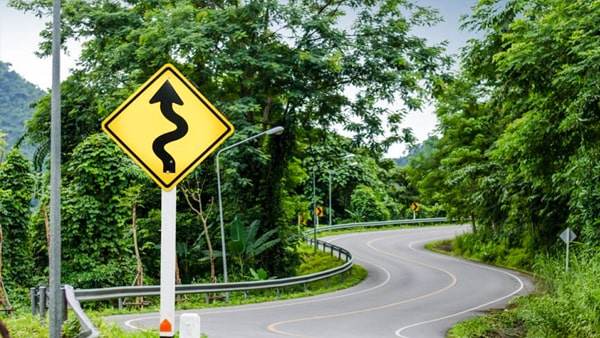
A yellow diamond sign displaying a winding arrow warns that:

This sign tells you that:
  1. A Turns are prohibited on the roadway
  2. B The roadway becomes narrower
  3. C A winding section or sharp curves are ahead
  4. D The pavement becomes slippery when wet

Correct answer: C – A winding section or sharp curves are ahead

The winding arrow is a warning that curves or sharp turns are ahead. Yellow diamond signs alert drivers to possible roadway dangers rather than establishing a general traffic prohibition. Reduce speed before entering a curve and follow an advisory speed plaque when one is posted with the warning sign.

Source: West Virginia Driver’s Licensing Handbook — Ch. V, “Diamond & Warning Signs”, West Virginia Driver’s Licensing Handbook — Ch. IV, “How You Will Be Tested — Curves”

Question 6

What is a center lane marked by solid yellow lines next to the through lanes reserved for?

  1. A Passing slower traffic
  2. B Driving during daylight hours
  3. C Regular travel in either direction
  4. D Preparing for left turns from either direction

Correct answer: D – Preparing for left turns from either direction

A center left-turn lane is reserved for vehicles preparing to turn left from either direction. Its boundaries have solid yellow lines next to the regular through lanes and broken yellow lines toward the center lane. It must not be used as a through lane or as a passing lane.

Source: West Virginia Driver’s Licensing Handbook — Ch. V, “Pavement Markings”, West Virginia Driver’s Licensing Handbook — Ch. V, “Dual Turn Lane”