


Wisconsin CDL Practice Test (WI) 2026

4.8 out of 5 (141 votes)
80% Passing score
20 Questions
4 Mistakes allowed
Greetings, future driver! Eager to start your journey towards mastering the Wisconsin CDL? You've come to the right place! This is your very first Wisconsin CDL practice test, perfect for getting those wheels turning. With 20 carefully crafted multiple-choice questions, you'll get a real feel for what the actual permit test will be like. You need to answer at least 16 correctly to pass, but don't sweat it if you don't nail it on the first go - this practice permit test is here to help you learn! Each DMV test question provides immediate feedback with detailed explanations, so you'll understand exactly why an answer is correct or not. This way, you're not just memorizing Wisconsin CDL test answers, but actually learning the material. Whether you're aiming for a Class A or Class B license, or planning to add some endorsements, you'll start with the general knowledge test. This Wisconsin CDL practice test covers a wide range of topics, from pre-trip vehicle inspection and basic vehicle control to shifting gears, handling hills, communicating with other drivers, controlling speed, and even drug and alcohol awareness. One of the best things about this Wisconsin DMV practice test is that it's not timed. You can take as long as you need on each question, ensuring you fully grasp the material without the pressure of a ticking clock. This differs from the real 2026 CDL permit test, where time is limited, but here you can focus on understanding and retaining the information at your own pace. And remember, this is a no-pressure environment. Unlike the real Wisconsin CDL permit test, there's no stress here - just a friendly space to learn and prepare. The same set of CDL test questions and answers will appear each time you take this Wisconsin CDL practice test, so you can work on it as much as you need to feel confident. So, buckle up and get started on the road to your Wisconsin CDL!
FREE CDL Practice Test App
Pass your Wisconsin CDL General Knowledge test with the NextDoorDriving app. Real questions and answers—100% free and ad-free.
Download on the App Store

Sample Wisconsin CDL Test Questions - General Knowledge

Question 1

When a commercial vehicle is stopped on a one-way or divided highway, where should the three reflective triangles be placed?

  1. A 10 feet, 100 feet, and 200 feet toward approaching traffic
  2. B 25 feet, 100 feet, and 250 feet toward approaching traffic
  3. C 50 feet, 100 feet, and 300 feet toward approaching traffic
  4. D 75 feet, 100 feet, and 400 feet toward approaching traffic

Correct answer: A – 10 feet, 100 feet, and 200 feet toward approaching traffic

The Wisconsin Commercial Driver’s Manual directs drivers to place warning devices 10 feet, 100 feet, and 200 feet toward approaching traffic on a one-way or divided highway. The devices must be set out within 10 minutes when a commercial vehicle is stopped on the roadway or shoulder. This arrangement gives approaching drivers progressively earlier warning.

Source: Wisconsin Commercial Driver’s Manual — § 2.5.2, “Communicating Your Presence”, 49 CFR § 392.22 — Emergency Signals; Stopped Commercial Motor Vehicles

Question 2

A heavy vehicle is approaching a downhill exit ramp that curves. What should the driver do?

  1. A Enter at the ramp’s posted speed regardless of the load
  2. B Reduce to a safe speed before reaching the curve
  3. C Wait until inside the curve before downshifting
  4. D Shift to a higher gear before entering the ramp

Correct answer: B – Reduce to a safe speed before reaching the curve

Downhill ramps that also curve are particularly hazardous for commercial vehicles. The downgrade makes speed reduction more difficult, and braking while turning can reduce stability. Slow to a safe speed before entering the curved portion of the ramp and select the proper gear before the curve.

Source: Wisconsin Commercial Driver’s Manual — § 2.8.2, “Hazardous Roads—Off-Ramps/On-Ramps”

Question 3

An unblocked cargo article is longer than 5 feet but no longer than 10 feet. What is the minimum number of tiedowns required?

  1. A 1
  2. B 2
  3. C 3
  4. D 4

Correct answer: B – 2

Federal cargo-securement rules require at least two tiedowns for an article that is longer than 5 feet but no longer than 10 feet when it is not blocked against forward movement. This requirement applies regardless of the article’s weight. A shorter article weighing 1,100 pounds or less may qualify for a one-tiedown minimum.

Source: 49 CFR § 393.110(b)(1)–(2) — Additional Requirements for Determining the Minimum Number of Tiedowns

Question 4

What does an orange WORKERS warning sign indicate?

This sign warns drivers that _____________.
  1. A Only road workers need to obey the sign
  2. B Workers may be in or near the roadway
  3. C The roadway is completely closed ahead
  4. D All traffic must follow a posted detour

Correct answer: B – Workers may be in or near the roadway

In Wisconsin, the WORKERS sign alerts road users that workers may be in or near the roadway. It does not by itself indicate that the road is closed or that a detour is required. Work zones may also contain construction vehicles, narrowed lanes, sharp turns, or uneven surfaces, making slower and more careful driving necessary.

Source: Wisconsin Manual on Uniform Traffic Control Devices — § 6H.18, “Workers Signs (W21-1 and W21-1a)”, Wisconsin Commercial Driver’s Manual — § 2.8.2, “Hazardous Roads—Work Zones”

Question 5

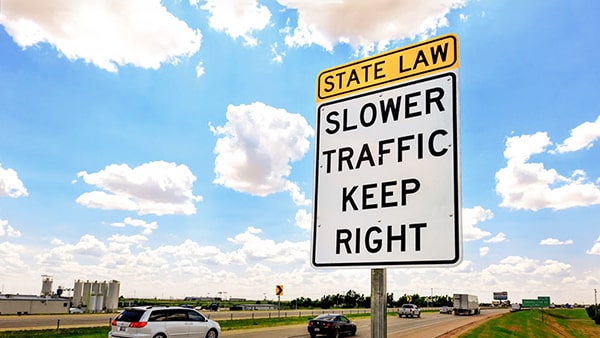
What action is directed by a SLOWER TRAFFIC KEEP RIGHT sign?

This sign indicates that drivers ___________.
  1. A Use the right-hand lane when traveling slower than other traffic
  2. B Remain in the right lane for the entire trip
  3. C Pass slower vehicles on their right
  4. D Increase speed until you match the fastest traffic

Correct answer: A – Use the right-hand lane when traveling slower than other traffic

Wisconsin’s SLOWER TRAFFIC KEEP RIGHT sign directs traffic moving more slowly than the general flow to use the right-hand lane. It does not prohibit every lawful use of another lane or authorize passing on the right in all situations. Keeping slower traffic right leaves the left lane available for passing when appropriate.

Source: Wisconsin Manual on Uniform Traffic Control Devices — § 2B.38, “KEEP RIGHT EXCEPT TO PASS Sign (R4-16), SLOWER TRAFFIC KEEP RIGHT Sign (R4-3), and TRUCKS USE RIGHT LANE Sign (R4-5)”

Question 6

Which hazard classes are listed under closed-cargo-space guidance as prohibited from overhang or tailgate loading?

  1. A Class 1 explosives only
  2. B Class 4 flammable solids only
  3. C Class 5 oxidizers only
  4. D Classes 1, 4, and 5

Correct answer: D – Classes 1, 4, and 5

Classes 1, 4, and 5 are all included in the closed-cargo-space guidance on overhang and tailgate loads. Federal hazardous-materials regulations contain specific loading requirements for Class 1 materials and require Class 4 and Class 5 lading to be contained within the vehicle body, covered, and transported with any tailgate secured, subject to stated exceptions.

Source: Wisconsin Commercial Driver’s Manual — § 9.4, “Use Closed Cargo Space”, 49 CFR § 177.835 — Class 1 (Explosive) Materials, 49 CFR § 177.838 — Class 4 (Flammable Solid) Materials, Class 5 (Oxidizing) Materials, and Division 4.2 (Self-Heating and Pyrophoric Liquid) Materials