


Wisconsin DMV Practice Test

4.7 out of 5 (540 votes)
80% Passing score
20 Questions
4 Mistakes allowed
This Wisconsin DMV practice test is built for the part of studying where the handbook starts to feel familiar, but you still need to know whether the information will hold up in question form. It includes 20 multiple-choice questions covering Wisconsin traffic laws, road signs, traffic signals, right-of-way rules, safe driving habits, and the everyday responsibility of driving with a valid driver’s license. The format is intentionally close to the real WI DMV permit test, not because practice should feel intimidating, but because guessing your way through broad “I think I know this” confidence is a poor study plan. As you move through the questions, the immediate feedback does more than tell you whether you were right. It slows the mistake down a little. A wrong answer comes with an explanation, so you can see what the rule actually says, where your thinking drifted, and why the correct answer fits. That is the useful part, really—the small correction before the real test, when there is still time to fix it. Reviewing missed questions at the end can also help you spot patterns, especially with signs, right-of-way situations, and those plain-sounding rules that are easy to skim past. Wisconsin testing rules vary depending on the applicant. Teen applicants ages 15 to 17 may take the Class D knowledge test online through Wisconsin DMV’s KnowTo Drive provider or in person at a DMV customer service center. The online option is available only to applicants age 17 or younger, requires a laptop or desktop with internet and a webcam, and must be monitored by a parent or guardian. Phones and tablets are not allowed. Passing online does not finish the permit process, either; the applicant still has to visit a DMV service center to purchase the instruction permit. Licensing has its own path after that, and it is worth keeping the details straight. Adult first-time drivers must pass the knowledge test, complete a vision screening, obtain an instruction permit, hold it for at least 7 days, and pass the driving skills test before receiving a Wisconsin probationary license. Adults are not required to complete driver education, behind-the-wheel training, or the teen 50-hour supervised driving requirement. A knowledge test may also be required for new drivers, some new Wisconsin residents, drivers whose license has been expired more than 8 years, and applicants adding certain classes or endorsements. This Wisconsin DMV permit practice test fits best as a working review alongside the Wisconsin driver handbook, road sign charts, flashcards, or an online driver education course. It gives the rules somewhere to land—question by question, correction by correction—until the real Wisconsin DMV written test feels less like a surprise and more like material you have already handled.
FREE DMV Practice Test App
Study for your Wisconsin permit test or driver’s license with the NextDoorDriving app. 700+ DMV questions and answers, 100% free!
Download on the App Store

Sample Wisconsin Permit Test Questions

Question 1

Under Wisconsin law, what may you do when facing a steady green signal?

  1. A Slow and prepare to stop before the intersection
  2. B Stop before proceeding in every case
  3. C Proceed if you make all required yields
  4. D Proceed straight but never turn right

Correct answer: C – Proceed if you make all required yields

A steady green signal permits a driver to proceed straight or make a lawful turn unless a sign prohibits the maneuver. The driver must still yield to vehicles and pedestrians lawfully within the intersection or an adjacent crosswalk. Check that the intended path is clear before proceeding.

Source: Wis. Stat. § 346.37(1)(a)1. – Traffic-control signal legend
Question 2

Traffic is backed up beyond an intersection. What must you verify before entering?

  1. A That you can move slowly behind the last vehicle
  2. B That you can stop close to the vehicle ahead
  3. C That a clear path exists through the intersection
  4. D That drivers ahead can hear your horn

Correct answer: C – That a clear path exists through the intersection

Look across the intersection before entering and make sure your intended path is clear. If traffic beyond the intersection leaves no room for your vehicle, remain before the intersection until space becomes available. This prevents your vehicle from being stranded in the crossing path.

Source: Wisconsin Motorists’ Handbook — Section 3, “C. Intersections”

Question 3

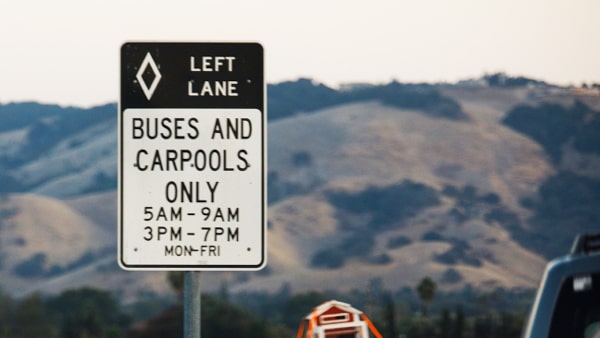
A lane sign reads “HOV 2+ ONLY.” When may you use that lane?

You can drive in a carpool lane if:
  1. A When your vehicle has at least two occupants and any posted time restrictions are satisfied
  2. B When you are driving an empty passenger van
  3. C Whenever you need to pass slower traffic
  4. D Whenever you are behind schedule

Correct answer: A – When your vehicle has at least two occupants and any posted time restrictions are satisfied

Wisconsin’s traffic-control-device manual uses HOV signs to identify lanes with minimum occupancy requirements. “HOV 2+” requires at least two people in the vehicle unless another posted exception applies. Drivers must also follow any days, hours or access restrictions displayed with the lane sign.

Source: Wisconsin Manual on Uniform Traffic Control Devices — Part 2, Ch. 2G, “Preferential and Managed Lane Signs”

Question 4

How far down the road should you generally be able to see to recognize hazards before making sudden moves?

  1. A Four to six seconds
  2. B Six to eight seconds
  3. C 10 to 15 seconds
  4. D 15 to 30 seconds

Correct answer: C – 10 to 15 seconds

The recommended sight distance is 10 to 15 seconds ahead of your vehicle. If you cannot see that far because of traffic, weather or road design, reduce speed to maintain better control. Continue scanning around the vehicle and checking mirrors for hazards beside and behind you.

Source: Wisconsin Motorists’ Handbook — Section 3, “E. Sight Distance Rule”

Question 5

You intend to turn across tracks at a grade crossing while a rail vehicle is approaching. What should you do?

  1. A Turn because rail vehicles normally move slowly
  2. B Cross on the right side of the rail vehicle
  3. C Wait until the rail vehicle has passed and it is safe to cross
  4. D Sound your horn and complete the turn quickly

Correct answer: C – Wait until the rail vehicle has passed and it is safe to cross

Wisconsin crossing standards require road users to yield when rail traffic occupies a crossing or is close enough that crossing would be unsafe. This principle applies to trains and light-rail equipment, including streetcars and trolleys. Do not turn across the tracks until the rail vehicle has passed and the crossing is safe.

Source: Wisconsin Manual on Uniform Traffic Control Devices — Part 8, Ch. 8B, “Signs and Markings”

Question 6

Which statement about safety belts is correct in Wisconsin?

  1. A They are needed only for high-speed driving
  2. B Being thrown from a vehicle is usually safer
  3. C Air bags make safety belts unnecessary
  4. D They help prevent injury and ejection during a crash

Correct answer: D – They help prevent injury and ejection during a crash

Safety belts help keep occupants properly positioned and reduce the chance of being thrown from a vehicle. They should be fastened before the vehicle begins moving and remain in use throughout the trip. Air bags provide supplemental protection and do not replace properly worn lap and shoulder belts.

Source: Wisconsin Motorists’ Handbook — Section 12, “D. Seat Belts (Safety Belts)”