Wisconsin DMV Practice Test 2

4.8 out of 5 (373 votes)
80% Passing score
20 Questions
4 Mistakes allowed
A Wisconsin DMV practice test should prepare you for more than the obvious questions. Road signs, right-of-way rules, seat belt requirements, safe following distance, lane changes, and those small legal details that tend to blur together after a while—all of it can show up when you sit for the Wisconsin DMV written test. This second Wisconsin DMV practice permit test gives you 20 questions that let you work through that material in a focused way, without paying for a test or relying on some “DMV test cheat sheet” that may or may not be based on anything useful. The point is not to memorize a few answers and hope the official WI DMV permit test cooperates. That is a thin plan, and not a great one. A better approach is to use the Wisconsin practice permit test repeatedly, notice which topics slow you down, and go back over the rules until the answers start making sense instead of just looking familiar. For new drivers, that can support what you are learning in driver education. For renewing drivers or seniors reviewing the rules, it can uncover the bits of Wisconsin driving law that have become a little rusty, which happens more often than people like to admit. Wisconsin’s licensing process also includes a few details worth knowing before test day. Instruction permit and driver license applicants must pass a vision screening, and for a regular Class D license, Wisconsin requires at least 20/100 vision in one eye and a minimum field of vision standard. If your vision is below certain levels, DMV may ask for a specialist report, add restrictions, or require a driving skills test. So, yes, the written knowledge test matters, but it sits inside a larger process. For the Class D knowledge test, Wisconsin DMV customer service centers generally handle in-person testing on a walk-in basis, usually by touchscreen computer. In-person knowledge and signs tests are free. Drivers ages 15 to 17 may also have the online Class D knowledge test option through KnowTo Drive, though that version has a $10 fee per attempt, requires parent or guardian monitoring, and must be taken on a laptop or desktop with internet and webcam access. Retakes are not unlimited in the casual sense, either. A Wisconsin knowledge test retake is allowed no sooner than the next day, and the same test can be taken five times within one year before special DMV permission is needed. Practice does not handle your documents, fees, application form, residency proof, or teen-driver requirements. It does handle the part people can actually improve before they show up: knowing the rules clearly enough that the real test feels like review, not guesswork.
FREE DMV Practice Test App
Study for your Wisconsin permit test or driver’s license with the NextDoorDriving app. 700+ DMV questions and answers, 100% free!
Download on the App Store

Sample Wisconsin Permit Test Questions

Question 1

When parking downhill on a road without a curb, where should your front wheels point?

  1. A Left, toward the center of the road
  2. B Right, toward the side of the road
  3. C Straight ahead
  4. D In either direction if the transmission is in Park

Correct answer: B – Right, toward the side of the road

The Wisconsin handbook directs drivers parking downhill to turn the wheels all the way to the right. This instruction applies even when there is no curb. Set the parking brake after positioning the vehicle and wheels.

Source: Wisconsin Motorists’ Handbook — § 3J, “Hill parking”

Question 2

How should you check the blind spot before changing lanes?

  1. A Always look over your right shoulder
  2. B Use only the inside rearview mirror
  3. C Look over the shoulder toward the lane you plan to enter
  4. D Always look over your left shoulder

Correct answer: C – Look over the shoulder toward the lane you plan to enter

Signal and make sure the neighboring lane is clear before moving. Look over the shoulder in the direction of the lane change—left for a leftward move and right for a rightward move. Mirrors alone do not show every area in a vehicle’s blind spots.

Source: Wisconsin Motorists’ Handbook — § 3H, “Changing lanes”

Question 3

Under Wisconsin’s inattentive-driving law, a non-driving activity becomes prohibited when it:

Preparing to smoke and smoking while driving:
  1. A Is performed below the speed limit
  2. B Takes less than one minute
  3. C Interferes or appears to interfere with safe driving
  4. D Can be performed with one hand

Correct answer: C – Interferes or appears to interfere with safe driving

Drivers may not engage in an activity that interferes, or reasonably appears to interfere, with their ability to drive safely. This rule can apply to many activities rather than only electronic-device use. Drivers should concentrate on driving and keep their eyes on the road.

Source: Wis. Stat. § 346.89(1) – Inattentive driving., Wisconsin Motorists’ Handbook — § 9B, “Distracted Driving”

Question 4

In Wisconsin, besides for oncoming traffic, when must you dim your high beams?

  1. A When approaching or following another vehicle within 500 feet from behind
  2. B Whenever another vehicle approaches you from behind
  3. C After the vehicle ahead is more than 500 feet away
  4. D Whenever an unoccupied vehicle is parked off the roadway

Correct answer: A – When approaching or following another vehicle within 500 feet from behind

A driver approaching or following another vehicle within 500 feet to its rear must dim the high beams. The requirement is intended to prevent glare from reflecting into the other driver’s eyes. The same statute also requires dimming for an oncoming vehicle within 500 feet.

Source: Wis. Stat. § 347.12(1)(a), (b) – Use of multiple-beam headlamps.

Question 5

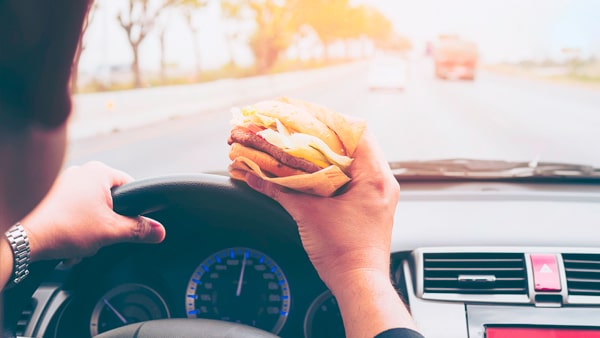
To reduce distraction, the driver’s handbook advises you to eat:

Drivers who eat and drink while driving:
  1. A While moving slowly on a quiet street
  2. B Only when holding the food with one hand
  3. C While following another vehicle closely
  4. D When the vehicle is parked, not while driving

Correct answer: D – When the vehicle is parked, not while driving

The Wisconsin handbook specifically advises drivers to eat while their vehicle is parked rather than while driving. A non-driving activity is unlawful if it interferes or reasonably appears to interfere with safe vehicle operation. Waiting until you are parked keeps your attention available for the driving task.

Source: Wis. Stat. § 346.89(1) – Inattentive driving., Wisconsin Motorists’ Handbook — § 9B, “Distracted Driving”

Question 6

Which symbol appears on the Two-Way Traffic warning sign?

  1. A A lane line ending beside a straight arrow
  2. B Two arrows separated by a median
  3. C One upward arrow and one downward arrow
  4. D Arrows pointing left and right

Correct answer: C – One upward arrow and one downward arrow

The Two-Way Traffic sign is a yellow diamond with one arrow pointing upward and another pointing downward. It warns that the roadway ahead carries opposing traffic. Drivers commonly encounter it when leaving a one-way roadway and entering a two-way road.

Source: Wisconsin Motorists’ Handbook — § 4A, “2-Way Traffic”