


Wisconsin DMV Practice Test 3

4.9 out of 5 (284 votes)
80% Passing score
20 Questions
4 Mistakes allowed
Wisconsin’s instruction permit process starts with the written material, but it does not stop there, and that is where a lot of first-time drivers get a little confused. The Wisconsin DMV learners permit test checks whether you understand road signs, traffic laws, safe driving practices, and the rules that keep showing up once you are actually behind the wheel. This Wisconsin DMV practice test gives you 20 questions built around those same kinds of topics, including sign recognition, right-of-way decisions, safe following habits, and legal rules such as handheld mobile device use. You need 16 correct answers to pass, which is a fair target — firm enough to show whether you know the material, not so inflated that one missed detail ruins the whole thing. And, anyway, the practice test is only one piece of the larger licensing path. In Wisconsin, a Class D instruction permit, often called “temps,” is available starting at age 15. Before the state issues that permit, applicants must pass the knowledge test, the signs test, and a vision screening, then provide the required identity, residency, legal-status, and Social Security documentation. Applicants under 18 have more to handle: they must be enrolled in or have completed driver education, meet school enrollment or graduation requirements, have an adult sponsor, and avoid being identified as habitually truant. It is a lot of paperwork around what feels like one test, but that is the process. This WI DMV permit practice test is useful because it lets you make mistakes while the stakes are still low. After you finish, you can review the answers, read the explanations, and see where your knowledge is thin before the official Wisconsin knowledge test makes that weakness more expensive. For teen drivers, the permit is the first stage of Wisconsin’s Graduated Driver License program, followed by a probationary license and then a regular Class D license. Drivers under 18 must hold the permit for at least 6 months, stay violation-free for the 6 months before applying for a probationary license, complete driver education, and log 50 supervised driving hours, including 10 at night. Drivers 18 or older do not need driver education and must hold the permit for at least 7 days before moving toward the road test. Updated for 2026, this Wisconsin temps practice test is built to support the real licensing sequence, not just a quick cram session.
FREE DMV Practice Test App
Study for your Wisconsin permit test or driver’s license with the NextDoorDriving app. 700+ DMV questions and answers, 100% free!
Download on the App Store

Sample Wisconsin Permit Test Questions

Question 1

A yellow diamond W6-1 sign showing opposing arrows separated by a median symbol warns that:
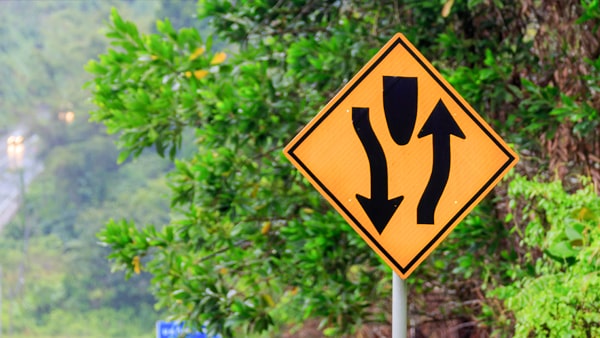
This sign means:
  1. A. The divided highway ends ahead
  2. B. A one-way street begins
  3. C. A one-way street ends
  4. D. A divided section of highway begins ahead

Correct answer: D. – A divided section of highway begins ahead

The W6-1 Divided Highway sign is placed in advance of a roadway section where opposing traffic will be separated. The separation may consist of a median or another physical barrier. Do not confuse it with the Divided Highway Ends sign, which warns that separated roadways will return to two-way traffic.

Source: Wisconsin Manual on Uniform Traffic Control Devices — Part 2, Ch. 2C, § 2C.20, “Divided Highway Sign (W6-1)”

Question 2

In Wisconsin, a driver extends the left arm from the window with the forearm pointing upward. What is being signaled?

  1. A. A left turn
  2. B. A right turn
  3. C. Slowing or stopping
  4. D. Continuing straight

Correct answer: B. – A right turn

A left arm extended outward and bent upward is the hand signal for a right turn. A straight horizontal left arm signals a left turn, while a downward-pointing arm signals slowing or stopping. Drivers may use these signals when vehicle turn signals are unavailable or difficult for others to see.

Source: Wis. Stat. § 346.35 – Method of giving signals on turning and stopping, Wisconsin Motorists’ Handbook — Section 3, “K. Communication”

Question 3

Unless signs or markings direct otherwise, where should a Wisconsin driver begin a left turn from a one-way street?

  1. A. In the lane nearest the left curb or roadway edge
  2. B. In any lane that appears safe
  3. C. In the lane nearest the right curb
  4. D. In whichever lane has the least traffic

Correct answer: A. – In the lane nearest the left curb or roadway edge

The approach for a left turn must be made from the farthest-left lane lawfully available to traffic moving in your direction. On a one-way street, this is normally the lane next to the left curb or edge. A left turn onto another one-way street should also enter the farthest-left lawful lane unless signs or pavement markings direct a different course.

Source: Wis. Stat. § 346.31(1), (3)(a), (c) – Required position and method of turning at intersections

Question 4

Why should every driver be concerned about alcohol- or drug-impaired driving?

  1. A. It presents little danger to sober drivers
  2. B. An impaired driver puts everyone sharing the road at risk
  3. C. It concerns law enforcement but not other motorists
  4. D. It endangers only people who have consumed alcohol

Correct answer: B. – An impaired driver puts everyone sharing the road at risk

Alcohol and other drugs interfere with thinking, decision-making and the ability to judge distance, speed and vehicle movement. An impaired driver has an increased risk of crashing. The danger extends to passengers, pedestrians, bicyclists and other motorists, regardless of whether those people have used alcohol or drugs.

Source: Wisconsin Motorists’ Handbook — Section 9, “A. Alcohol, Drugs and Driving”

Question 5

In good driving conditions, what following interval does the Wisconsin Motorists’ Handbook recommend?

  1. A. Two seconds
  2. B. Three seconds
  3. C. Four seconds
  4. D. Five seconds

Correct answer: C. – Four seconds

Use a four-second following distance under ordinary conditions. Begin counting when the vehicle ahead passes a fixed roadside object; your vehicle should not reach that object before four seconds have passed. Add more time on slippery roads, when towing or carrying a heavy load, and when following large vehicles, motorcycles or bicycles.

Source: Wisconsin Motorists’ Handbook — Section 3, “F. Space Between Vehicles”

Question 6

Which action does not provide an adequate safety check before backing?

Safely backing up your vehicle includes all of the following except:
  1. A. Turning your body to look through the rear window
  2. B. Backing no faster than a slow walking pace
  3. C. Tapping the horn and then relying only on the mirrors
  4. D. Looking left and right before moving back into traffic

Correct answer: C. – Tapping the horn and then relying only on the mirrors

Move slowly and directly look behind the vehicle when backing. The Wisconsin handbook says not to depend only on mirrors or a backup camera; turn your body and look over your right shoulder through the rear window. A horn may attract attention, but it does not replace checking the area behind the vehicle.

Source: Wisconsin Motorists’ Handbook — Section 3, “I. Backing”, Wisconsin Motorists’ Handbook — Section 3, “K. Communication”