Wisconsin Practice Permit Test 5

4.9 out of 5 (206 votes)
80% Passing score
20 Questions
4 Mistakes allowed
This fifth Wisconsin DMV practice test is best treated as a serious rehearsal, not a quick skim through a few familiar driving rules. The real Wisconsin Class D knowledge test pulls from the Wisconsin Motorists’ Handbook and covers a fairly wide spread of material: traffic laws, safe driving practices, road signs, signals, pavement markings, right-of-way rules, sharing the road, driver responsibility, teen GDL rules, and impaired driving laws. That last area matters here, because this permit practice test puts extra weight on DUI and OWI topics—the kind of material that is both legal knowledge and plain, practical survival knowledge, which sounds dramatic, but there it is. The practice test includes 20 multiple-choice questions, with scenarios that may ask you to think through blood alcohol content, alcohol’s effect on judgment and reaction time, consequences for impaired driving, and the everyday road rules that still show up around those questions. Some items use visual aids, too, which is helpful because a sign, lane marking, or road situation often makes more sense when you can actually see what is being asked. It is still a Wisconsin practice permit test, yes, but a good one should do more than tell you whether you guessed correctly. It should make the rule stick a little better the next time. For comparison, the official Wisconsin DMV Class D knowledge test has 50 multiple-choice questions. You need 40 correct answers to pass, so the passing score is 80%, and the test usually takes about 45 minutes. In-person knowledge testing is generally handled on a walk-in basis at DMV customer service centers, often by touchscreen computer with instant feedback. Audio assistance may be available if requested, and paper testing may be available as well. If you fail, Wisconsin DMV says you may retake the test no sooner than the next day, with up to 5 attempts in 1 year before special DMV permission is required. Adult first-time drivers have a few more steps after the studying part, and this is where people sometimes blur the details. Adults must complete the MV3001 application, provide the required identity, residency, legal-status, name, and date-of-birth documents, pass the knowledge test, signs test, and vision screening, obtain an instruction permit, usually hold it for at least 7 days, and then pass the driving skills test. Adults do not have the teen driver education or GDL supervised-hour requirements, but probationary-license rules still apply.

FREE DMV Practice Test App
Study for your Wisconsin permit test or driver’s license with the NextDoorDriving app. 700+ DMV questions and answers, 100% free!
Download on the App Store

Sample Wisconsin Permit Test Questions

Question 1

In Wisconsin, a prohibited alcohol concentration test is used to determine:

  1. A A driver’s reaction time
  2. B The measurable alcohol concentration in a person’s system
  3. C A driver’s eyesight
  4. D A driver’s steering ability

Correct answer: B – The measurable alcohol concentration in a person’s system

A prohibited alcohol concentration test measures alcohol in a person’s system rather than reaction time, eyesight or driving skill. The handbook identifies breath and blood testing, while the implied-consent statute addresses chemical testing of breath, blood or urine for alcohol or controlled substances. The test results provide chemical evidence, not a general evaluation of driving ability.

Source: Wis. Stat. § 343.305(2)–(3) – Tests for intoxication; administrative suspension and court-ordered revocation, Wisconsin Motorists’ Handbook — Section 9, “A. Alcohol, Drugs and Driving—Implied Consent”

Question 2

What should a driver understand about combining alcohol with prescription or nonprescription medicine?

  1. A Medicine cancels alcohol’s effects
  2. B Alcohol makes medicine safer to use
  3. C Both substances may impair driving and make the combination unsafe
  4. D The substances cannot affect driving at the same time

Correct answer: C – Both substances may impair driving and make the combination unsafe

Alcohol affects thinking, decision-making and the ability to judge distance, speed and vehicle movement. Prescription and nonprescription medicines may also negatively affect driving, particularly when their labels warn against operating heavy machinery. Check medication warnings and do not drive after using alcohol or any substance that may impair safe vehicle operation.

Source: Wisconsin Motorists’ Handbook — Section 9, “A. Alcohol, Drugs and Driving”

Question 3

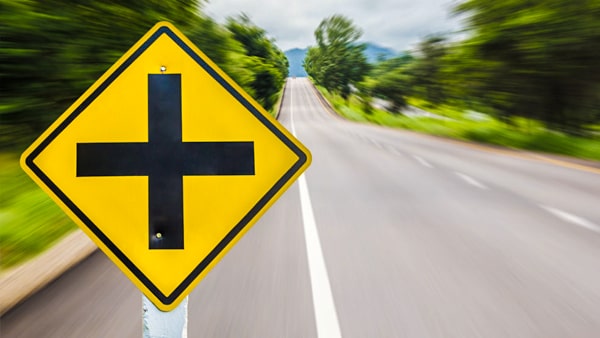
A yellow diamond sign displaying a black cross warns that you are approaching:

This sign shows one type of:
  1. A A crossroad intersection
  2. B A winding section of road
  3. C A required right turn
  4. D A lane shift

Correct answer: A – A crossroad intersection

This warning sign indicates that another road crosses your route ahead. Approach the intersection attentively and look for vehicles or pedestrians that may enter your path. Yellow diamond signs warn of hazards or roadway conditions ahead.

Source: Wisconsin Motorists’ Handbook — § 4A, “Warning”, Wisconsin Motorists’ Handbook — § 3C, “Intersections”

Question 4

A school bus ahead in your lane is stopped with red warning lights flashing. What must you do?

  1. A Stop at least 20 feet away until the bus moves or the red lights are turned off
  2. B Move left and pass at a reduced speed
  3. C Stop only until the children leave the bus
  4. D Proceed unless the bus driver extends the stop arm

Correct answer: A – Stop at least 20 feet away until the bus moves or the red lights are turned off

In Wisconsin, stop at least 20 feet from a school bus displaying flashing red warning lights. Remain stopped until the bus resumes motion or its operator turns off the lights. The divided-highway exception applies only to traffic traveling in the opposite direction, not to a vehicle approaching the bus from behind.

Source: Wis. Stat. § 346.48(1) – Vehicles to stop for school buses displaying flashing lights, Wisconsin Motorists’ Handbook — § 10C, “School Buses”

Question 5

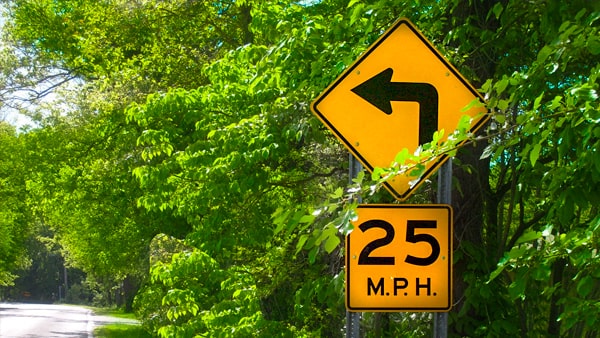
A yellow warning sign curves left and has a 25 MPH plaque beneath it. What does it indicate?

This sign means:
  1. A A left curve where you must drive at least 25 mph
  2. B A right curve where you must drive at least 25 mph
  3. C A right curve with an advisory speed of 25 mph
  4. D A left curve with an advisory speed of 25 mph

Correct answer: D – A left curve with an advisory speed of 25 mph

The main sign warns that the road curves left. The plaque gives an advisory speed of 25 mph for traveling through the curve under favorable conditions; it does not tell drivers to maintain a minimum speed. A lower speed may be appropriate when weather, visibility, or pavement conditions are unfavorable.

Source: Wisconsin Manual on Uniform Traffic Control Devices — Part 2, § 2C.07, “Horizontal Alignment Warning Signs”, Wisconsin Manual on Uniform Traffic Control Devices — Part 2, § 2C.08, “Advisory Speed Plaque (W13-1P)”

Question 6

Which statement about stopping beside another parked vehicle is correct in Wisconsin?

  1. A It is always allowed if the driver remains inside
  2. B It is allowed whenever property is being delivered
  3. C It is generally prohibited unless official signs or pavement markings designate double parking
  4. D It is allowed for any vehicle displaying a disabled parking permit

Correct answer: C – It is generally prohibited unless official signs or pavement markings designate double parking

Wisconsin generally prohibits stopping or leaving a vehicle on the roadway side of a parked vehicle unless official signs or pavement markings clearly designate double parking. The statute separately allows a temporary, attended stop while actually loading or unloading passengers or property. Merely remaining in the vehicle or making a delivery does not create an unlimited exception.

Source: Wis. Stat. § 346.53(1)(f) – Parking prohibited in certain specified places