Wisconsin Drivers Ed Practice Test 8

4.9 out of 5 (126 votes)
80% Passing score
20 Questions
4 Mistakes allowed
A Wisconsin DMV practice test should probably do more than ask you three sign questions, pat itself on the back, and send you to take the real test unprepared. This free Wisconsin drivers ed practice test sticks with the stuff that actually trips people up: intersection rules, right-of-way, four-way stops, and those moments where two drivers both seem convinced the other person is supposed to move first. Terrific. Very educational in traffic, less fun on the official Class D knowledge test. The practice test includes 20 multiple-choice questions, which is enough to expose the weak spots without turning studying into a full evening of regret. It is especially useful if you are getting ready for the in-person Wisconsin knowledge test at a DMV customer service center, where most locations use touchscreen computers and testing is usually walk-in. Drivers ages 15 to 17 may also have the online KnowTo Drive option, though that version comes with a few strings attached: parent or guardian monitoring, a laptop or desktop, webcam checks, a $10 fee per try, and only two online attempts before the next attempt has to happen at the DMV. So, yes, practicing for free before paying to find out what you do not know is the smarter order of events. And the knowledge test is only one piece of the licensing process, because of course it is. Wisconsin instruction permit and driver license applicants also need to pass a vision screening. Regular Class D applicants must meet the state’s minimum vision standards, and some drivers may be sent to a vision specialist or receive license restrictions such as daytime-only driving or required mirrors. Not the dramatic part of learning to drive, maybe, but still part of the deal. This WI temps practice test gives you room to make mistakes before the official attempts start counting. Wisconsin lets you retake the knowledge test no sooner than the next day, but the same test can only be taken five times in one year before special DMV permission enters the picture, which is not exactly the achievement badge anyone is aiming for. Use the practice permit test once, miss a few questions, mutter about the wording, then take it again. That is the whole point. When it is time for the real permit or license, bring the required documents too: application, identity proof, legal presence, Wisconsin residency, Social Security number, name-change paperwork if needed, and the fee. Under-18 applicants get extra requirements, naturally. The DMV enjoys a complete file.
FREE DMV Practice Test App
Study for your Wisconsin permit test or driver’s license with the NextDoorDriving app. 700+ DMV questions and answers, 100% free!
Download on the App Store

Sample Wisconsin Permit Test Questions

Question 1

Which driving habit helps other road users respond safely to your actions?

  1. A Clearly communicating your presence and intended movements
  2. B Ignoring nearby drivers and concentrating only on your lane
  3. C Using side roads whenever traffic becomes heavy
  4. D Avoiding all travel during peak traffic hours

Correct answer: A – Clearly communicating your presence and intended movements

Drivers should let others know where they are and what they plan to do. Turn signals communicate an intended turn or lane change, while headlights, brake lights, and hazard lights improve communication in other situations. A horn may be used to attract attention when necessary to help prevent a crash.

Source: Wisconsin Motorists’ Handbook — § 3K, “Communication”
Question 2

Which location does the driver handbook identify as a place where parking is not allowed?

  1. A Along a curb marked yellow
  2. B Within 1,000 feet of a police station
  3. C Near any school while children are present
  4. D With the vehicle’s wheels parallel to the roadway

Correct answer: A – Along a curb marked yellow

The Wisconsin Motorists’ Handbook states that parking is not allowed where yellow markings appear on the curb. Drivers must also check for posted No Parking signs before leaving a vehicle. Parking parallel to the road is not itself prohibited, and the handbook does not establish the broad police-station or school restrictions described in the other choices.

Source: Wisconsin Motorists’ Handbook — § 3J, “Parking”

Question 3

Black symbols or lettering on an orange road sign warn of:

  1. A Construction, maintenance, or workers near the roadway
  2. B Motorist services such as fuel and lodging
  3. C A crash at the exact location of the sign
  4. D A mandatory stop ahead in every case

Correct answer: A – Construction, maintenance, or workers near the roadway

Orange diamond or rectangular signs identify construction, maintenance, or emergency work areas. They warn that workers, equipment, lane changes, or flaggers may be ahead or near the roadway. Reduce speed as directed and follow the instructions of flaggers and other traffic-control devices.

Source: Wisconsin Motorists’ Handbook — § 4C, “Construction”

Question 4

As you approach a sharp curve, when should you reduce your speed?

  1. A Before entering the curve
  2. B Only after reaching the middle of the curve
  3. C Immediately after entering the curve
  4. D Only as you begin leaving the curve

Correct answer: A – Before entering the curve

Adjust your speed before entering a sharp curve so that you approach it at a controlled speed. The driver handbook directs motorists to slow as needed for curved roads and to prepare to slow when a sharp-turn warning sign appears. Your speed must remain reasonable for the curve, visibility, pavement, and other existing conditions.

Source: Wis. Stat. § 346.57(2) – Speed restrictions, Wisconsin Motorists’ Handbook — § 3B, “Changing Speed for Conditions”, Wisconsin Motorists’ Handbook — § 4A, “Warning”

Question 5

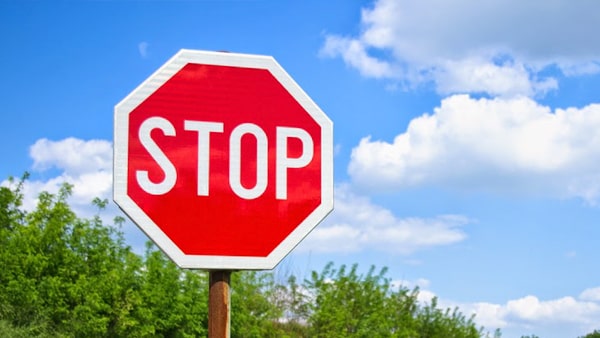
What does a red, eight-sided STOP sign require?

When you see this sign, you must:
  1. A Come to a complete stop and wait until the path is clear
  2. B Reduce speed and continue without stopping
  3. C Stop and wait for a green traffic signal
  4. D Slow only when cross traffic is visible

Correct answer: A – Come to a complete stop and wait until the path is clear

A STOP sign requires a complete stop before entering the intersection. After stopping, yield as required and proceed only when the path is clear. The sign does not require waiting for a green light unless a traffic signal is also controlling the intersection.

Source: Wis. Stat. § 346.46(1) – Vehicles to stop at stop signs and school crossings, Wisconsin Motorists’ Handbook — § 4B, “Regulatory”

Question 6

Which statement about medication and driving is correct?

Which of these statements is true about driving and taking drugs?
  1. A Only illegal drugs can interfere with safe driving
  2. B Prescription and nonprescription drugs can impair driving
  3. C A prescription drug is always safe if it does not cause drowsiness
  4. D Every type of medication affects driving in the same way

Correct answer: B – Prescription and nonprescription drugs can impair driving

Prescription and nonprescription drugs can negatively affect driving, even when they are legally obtained. In Wisconsin, operating while under the influence of any drug is prohibited when the drug makes the person incapable of safely driving. Read warning labels, and do not drive when a medication warns against operating vehicles or heavy machinery.

Source: Wis. Stat. § 346.63(1)(a) – Operating under influence of intoxicant or other drug, Wisconsin Motorists’ Handbook — § 9A, “Alcohol, Drugs and Driving”