


Wisconsin Temps Practice Test 9

4.8 out of 5 (115 votes)
80% Passing score
20 Questions
4 Mistakes allowed
Practice Test 9 in our Wisconsin DMV practice test series stays on one subject: school buses. That is deliberate. Wisconsin drivers are expected to know when to stop, when to yield, and how to respond when children are getting on or off a bus, and those rules are not the place to rely on a half-remembered guess from driver’s ed. This Wisconsin temps practice test gives you 20 focused questions on school bus interactions, with a passing target of 16 correct answers. Conveniently, or maybe just mathematically, that matches the 80% standard Wisconsin uses on its official knowledge and road signs tests. The actual Class D knowledge test is broader. It has 50 questions, and you need 40 correct to pass. The road signs test is separate: 15 questions, with 12 correct required. Plan on about 45 minutes for testing at the DMV, which sounds manageable, and usually is, but it is still enough time for weak spots to become very obvious. A topic-specific Wisconsin permit practice test helps you catch those weak spots before the official screen is asking the questions and counting the misses. The questions here are based on the official Wisconsin drivers manual, which is exactly where your study time should be anchored. Not random internet lore, not someone’s cousin’s version of the rule, not an overbuilt “gotcha” question pretending to be helpful. The real DMV permit test comes from the manual, so this temporary license practice test keeps its attention there too. For teen drivers, the licensing path starts at age 15 with the instruction permit. Drivers ages 15 to 17 may take the Class D knowledge test online, but there are strings attached — a parent or guardian must monitor, the device has to be a laptop or desktop with a webcam, and phones and tablets are out. Online attempts cost $10 each, are offered in English and Spanish, and after two failed attempts, testing moves to a DMV service center. At the DMV, the knowledge and signs tests have no fee. After the permit, Wisconsin’s teen licensing requirements keep going: 6 months of permit holding, 6 violation-free months before the probationary license, 50 supervised driving hours including 10 at night, plus driver education with classroom, behind-the-wheel, and observation time. Adults have a shorter route, with a 7-day permit holding period and no required driver education or supervised hours, though first-time Class D drivers still need the road test. So this WI drivers temps practice test is test prep, yes. It is also rehearsal for the moment when a school bus stops, the lights come on, and the correct answer needs to be automatic.
FREE DMV Practice Test App
Study for your Wisconsin permit test or driver’s license with the NextDoorDriving app. 700+ DMV questions and answers, 100% free!
Download on the App Store

Sample Wisconsin Permit Test Questions

Question 1

In Wisconsin, a standard destination sign directing drivers toward a city or highway exit is usually:

  1. A Orange with black lettering
  2. B Green with white lettering
  3. C Yellow with black lettering
  4. D Red with white lettering

Correct answer: B – Green with white lettering

Standard destination and exit signs are generally rectangular and use a green background with white lettering. They provide directions and distances to places such as cities, states and airports. Brown destination signs are used for recreational, historical or scenic locations rather than ordinary highway destinations.

Source: Wisconsin Motorists’ Handbook — Section 4, “D. Destination”
Question 2

On a two-way road with one lane in each direction, a curve blocks your view of possible oncoming traffic. You must:

  1. A Wait until the road ahead is visible and passing can be completed safely
  2. B Use a longer turn signal before passing
  3. C Exceed the speed limit to pass quickly
  4. D Sound the horn and begin passing

Correct answer: A – Wait until the road ahead is visible and passing can be completed safely

Wisconsin prohibits driving left of the roadway center on a curve where the obstructed view could create a hazard if another vehicle approaches. A passing driver must also have a clearly visible left side that is free of oncoming traffic for enough distance to complete the pass safely. Wait until adequate sight distance is available.

Source: Wis. Stat. § 346.09(1)–(2) – Limitations on overtaking on left or driving on left side of roadway

Question 3

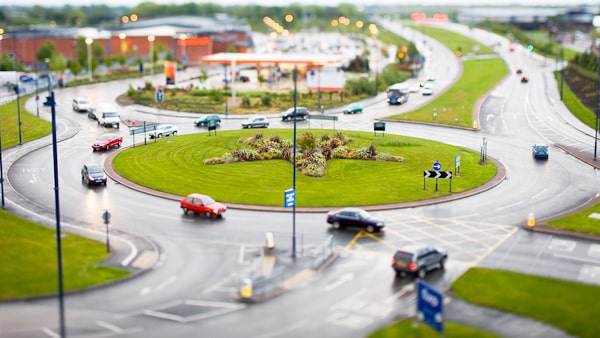
As you approach a Wisconsin roundabout, which traffic must you yield to?

You have the right-of-way when you are:
  1. A Vehicles waiting to enter on the opposite side
  2. B Traffic directly behind your vehicle
  3. C Vehicles approaching from your right outside the roundabout
  4. D Traffic already circulating to your left

Correct answer: D – Traffic already circulating to your left

Slow down and yield to traffic on your left that is already in the roundabout. Also yield to pedestrians, bicyclists and large vehicles as directed in the handbook. Enter only when a safe gap is available, remain in your selected lane and use the right-turn signal when exiting.

Source: Wisconsin Motorists’ Handbook — Section 6, “A. Roundabouts”

Question 4

When may a moving vehicle use only parking lamps instead of required headlights?

  1. A During the first 30 minutes after sunset
  2. B Never
  3. C When driving slowly in fog
  4. D When windshield wipers are operating

Correct answer: B – Never

Wisconsin law requires the vehicle’s headlamps and other required lamps during hours of darkness and specifically states that parking lamps cannot serve that purpose. The handbook says parking lights should be used only while parked and idling. A moving vehicle must use the required headlights whenever lighting conditions require them.

Source: Wis. Stat. § 347.06(1) – When lighted lamps required, Wisconsin Motorists’ Handbook — Section 3, “K. Communication—Parking Lights”

Question 5

Before moving into a passing lane, when should you activate your turn signal?

  1. A As your wheels begin crossing the lane line
  2. B At any convenient point during the pass
  3. C After you have entered the passing lane
  4. D Before moving, with enough time to communicate your plan

Correct answer: D – Before moving, with enough time to communicate your plan

A turn signal communicates where you plan to go and gives other road users time to respond. Before entering the passing lane, verify that the lane is clear, signal and check the appropriate blind spot. Complete the movement only when it can be made safely, and signal again before returning to the original lane.

Source: Wisconsin Motorists’ Handbook — Section 3, “K. Communication—Turn signal”, Wisconsin Motorists’ Handbook — Section 3, “H. Passing—Changing lanes”

Question 6

Before driving, you realize that anger is making it difficult to concentrate. What should you do?

  1. A Try to control the emotion while driving
  2. B Delay driving until you are calm enough to focus
  3. C Drive faster to shorten the trip
  4. D Choose any of these actions

Correct answer: B – Delay driving until you are calm enough to focus

Strong emotions can reduce your ability to concentrate and make sound driving decisions. The handbook advises against driving when you are very worried, excited, afraid, angry or depressed. Wait until the emotion is under control and you can give driving your full attention.

Source: Wisconsin Motorists’ Handbook — Section 3, “K. Communication”