Wisconsin Road Signs Test

4.6 out of 5 (236 votes)
80% Passing score
10 Questions
2 Mistakes allowed
For a Wisconsin Class D instruction permit, the DMV is not only checking whether you can spot a Stop sign from across the parking lot. The signs test matters, definitely, but it sits beside the larger knowledge test and the vision screening, and that combination is what actually gets you closer to your Wisconsin temps. This Wisconsin DMV practice test keeps that full picture in view, which is important because the real exam pulls from traffic laws, right-of-way rules, pavement markings, safe driving practices, road signs, signals, OWI rules, sharing the road, and a few driver-responsibility details that sound simple until you realize they are written in very DMV-ish language. The Class D knowledge test has 50 multiple-choice questions, and you need 40 correct answers to pass. Wisconsin’s road signs test is its own piece of the process: 15 questions, with 12 correct required. So, no, this is not just a casual scroll through sign shapes and colors, although those are part of it. You still need to recognize regulatory signs, warning signs, guide signs, traffic signals, pavement markings, and the small visual clues Wisconsin expects new drivers to understand without overthinking every lane line and arrow. This online Wisconsin permit practice test is meant to feel like useful prep, not a lecture dressed up as a quiz. It gives you practice with the kinds of questions that belong in the Wisconsin temps test world, while keeping the focus on what you actually need at the DMV. Teens ages 15 to 17 may be able to take the official Class D knowledge test online through KnowTo Drive, with a parent or guardian monitoring and a laptop or desktop with a webcam. Everyone else is usually looking at an in-person DMV test, walk-in style, often on a touchscreen computer, and the knowledge test can take about 45 minutes. A failed test is not the end of civilization, obviously, but Wisconsin makes you wait until at least the next day to retake it. Use this Wisconsin practice permit test to settle into the material before test day. Not cram wildly, not guess your way through. Just practice the rules, absorb the signs, and get familiar with the way Wisconsin asks about driving. That pays off whether you are headed through Milwaukee traffic, rolling past farm roads, or dealing with one of those intersections where everyone pauses for half a second too long and somehow makes it worse.
FREE DMV Practice Test App
Study for your Wisconsin permit test or driver’s license with the NextDoorDriving app. 700+ DMV questions and answers, 100% free!
Download on the App Store

Sample Wisconsin Permit Test Questions

Question 1

In Wisconsin, which is one permitted reason to cross double solid yellow centerlines?

  1. A To pass a vehicle traveling near the speed limit
  2. B To pass during daylight hours
  3. C To avoid waiting in traffic
  4. D To turn into a driveway when it is safe

Correct answer: D – To turn into a driveway when it is safe

A driver may cross double solid yellow centerlines to turn into a driveway when the turn can be completed safely. This does not create general permission to pass other traffic. A separate, narrow exception allows passing certain non-farm vehicles traveling at less than half the applicable speed limit when the pass is otherwise lawful and safe.

Source: Wis. Stat. § 346.09(3) – Limitations on overtaking on left or driving on left side of roadway., Wisconsin Motorists’ Handbook — Section 5, “Types of Line Markings—Yellow Lane Lines”
Question 2

Your signal turns green, but vehicles are still clearing the intersection. What should you do?

  1. A Enter the intersection and wait behind them
  2. B Drive around them if another lane appears open
  3. C Wait until cross traffic clears before proceeding
  4. D Enter immediately because the signal is green

Correct answer: C – Wait until cross traffic clears before proceeding

A green signal permits movement, but a driver who has been stopped must allow cross traffic to clear before proceeding. Entering too early can obstruct vehicles that are lawfully finishing their movement. Wait until the intersection is clear, then continue as permitted by the signal.

Source: Wisconsin Motorists’ Handbook — Section 5, “Traffic Signals—Green Lights”

Question 3

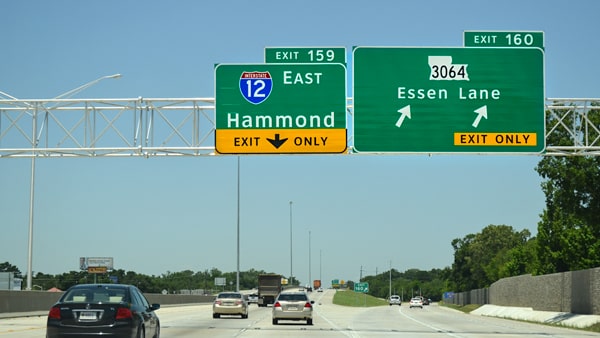
A yellow “EXIT ONLY” panel is displayed over your freeway lane. If you remain in that lane, you:

If you see this sign above your lane, you:
  1. A Are prohibited from taking the exit
  2. B May either exit or continue on the main roadway
  3. C Will continue through the interchange
  4. D Must leave the freeway at that exit

Correct answer: D – Must leave the freeway at that exit

An EXIT ONLY panel identifies a lane that leaves the main roadway rather than continuing through the interchange. A driver who stays in that lane must take the indicated exit. To remain on the freeway, change to a continuing lane before the lane drop and only when the movement can be made safely.

Source: Wisconsin Manual on Uniform Traffic Control Devices (2023) — § 2E.28, “Signing for Interchange Lane Drops Without an Optional Exit Lane”

Question 4

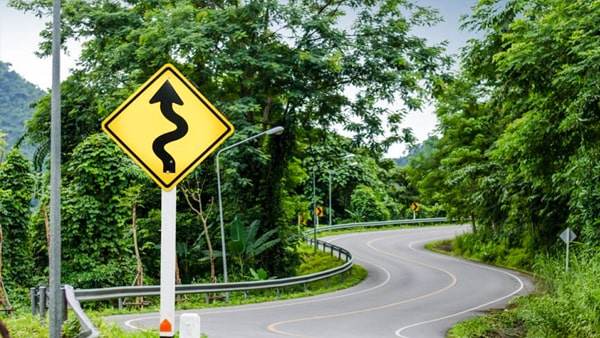
A yellow diamond sign with a long, winding arrow warns of:

This sign tells you that:
  1. A A prohibition on all turns
  2. B A roadway that narrows ahead
  3. C Several curves in succession
  4. D Pavement that becomes slippery when wet

Correct answer: C – Several curves in succession

The winding-road symbol warns of three or more turns or curves occurring close together. It is different from a turn or curve sign that represents a single change in alignment. Drivers should scan ahead and adjust speed as needed to travel safely through the successive curves.

Source: Wisconsin Manual on Uniform Traffic Control Devices (2023) — Part 2C, “Horizontal Alignment Signs”, Wisconsin Motorists’ Handbook — Section 4, “Warning—Curved Road”

Question 5

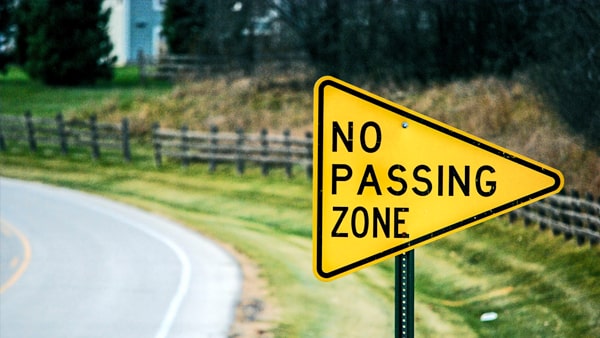
A yellow, pennant-shaped sign with black lettering identifies:

The sign with this shape and color is a _____________ sign.
  1. A A no-passing zone
  2. B A wrong-way entrance
  3. C A railroad crossing
  4. D A required stop

Correct answer: A – A no-passing zone

The yellow pennant sign marks a no-passing zone. Drivers may not pass other vehicles in the posted zone except where a specific legal exception applies. The sign’s distinctive shape helps drivers recognize the restriction even when visibility of its lettering is limited.

Source: Wisconsin Motorists’ Handbook — Section 4, “Regulatory—No Passing Zone”

Question 6

What must you do when approaching a red, eight-sided STOP sign?

This sign means:
  1. A Slow down and stop only when other vehicles are near
  2. B Come to a complete stop, yield, and proceed when safe
  3. C Continue cautiously without stopping if the road appears clear
  4. D Stop only for traffic approaching from the intersecting road

Correct answer: B – Come to a complete stop, yield, and proceed when safe

Wisconsin requires a driver approaching a STOP sign to stop before entering the intersection and yield to traffic on the uncontrolled roadway. Stop immediately before the marked stop line, or before the near crosswalk when no stop line exists. Merely slowing down does not satisfy the stopping requirement.

Source: Wis. Stat. § 346.46(1)–(2) – Vehicles to stop at stop signs and school crossings., Wisconsin Motorists’ Handbook — Section 4, “Regulatory—Stop”