


Wisconsin DMV Sign Test 3

4.9 out of 5 (106 votes)
80% Passing score
20 Questions
4 Mistakes allowed
Wisconsin puts road signs directly into the Class D instruction permit process, so this is not a throwaway review you skim once and hope for the best. Before you can move forward with a Wisconsin instruction permit, you are expected to pass the signs test, the general knowledge test, and the vision screening. That makes sign recognition one of those basic driver skills that feels obvious in theory, then gets a little more exacting once shapes, colors, signals, and pavement markings all start blending together. This Wisconsin DMV road signs practice test is built around that exact piece of the process. The real Wisconsin road signs test has 15 questions, and you need 12 correct answers to pass. In plain terms, you can miss 3. Not a huge cushion, honestly. So the practice here leans into the details Wisconsin drivers are expected to know: regulatory signs, warning signs, guide signs, traffic signals, pavement markings, sign colors, and the shape clues that often give away a sign’s meaning before you can even read the words. An octagon means stop. A triangle means yield. Fine, yes, those are the familiar ones. But the test may also expect you to connect a sign’s design with what you should actually do behind the wheel, and that is where careful practice pays off. The licensing path depends on who is applying. Teen applicants ages 15 to 17 may take the Class D knowledge test online through Wisconsin DMV’s KnowTo Drive provider or in person at a DMV customer service center. Online testing requires a laptop or desktop with internet, a webcam, and a parent or guardian monitoring the session; phones and tablets are not accepted. After passing online, teens still need to go to a DMV service center to purchase the instruction permit, which is the sort of extra step people forget until it matters. Adults age 18 and older follow a simpler but still structured route. First-time adult drivers must pass the knowledge test and vision screening, get an instruction permit, hold it for at least 7 days, and then pass the driving skills test before receiving a Wisconsin probationary license. They do not have to complete driver education, behind-the-wheel training, or the teen 50-hour supervised driving requirement. Use this Wisconsin temps practice test as a focused, updated 2026 review for the sign test portion. Each answer includes immediate feedback and an explanation, because guessing your way through road signs is a bad study plan and, frankly, a worse driving habit.
FREE DMV Practice Test App
Study for your Wisconsin permit test or driver’s license with the NextDoorDriving app. 700+ DMV questions and answers, 100% free!
Download on the App Store

Sample Wisconsin Permit Test Questions

Question 1

A curbside regulatory sign reads “ONE HOUR PARKING.” Parking there is:

  1. A Reserved for emergency vehicles
  2. B Allowed only while picking up passengers
  3. C Allowed only for the posted time limit
  4. D Prohibited at all times

Correct answer: C – Allowed only for the posted time limit

Wisconsin authorities may limit parking time when official signs, markers, or meters indicate the restriction. A ONE HOUR PARKING sign permits parking for no longer than the stated period, subject to any additional days or hours shown. Drivers should read the entire sign before leaving the vehicle.

Source: Wis. Stat. § 349.13(1e)(a), (c)1. – Authority to regulate the stopping, standing or parking of vehicles., Wisconsin Manual on Uniform Traffic Control Devices (2023) — § 2B.52, “Parking, Standing, and Stopping Signs (R7 and R8 Series)”
Question 2

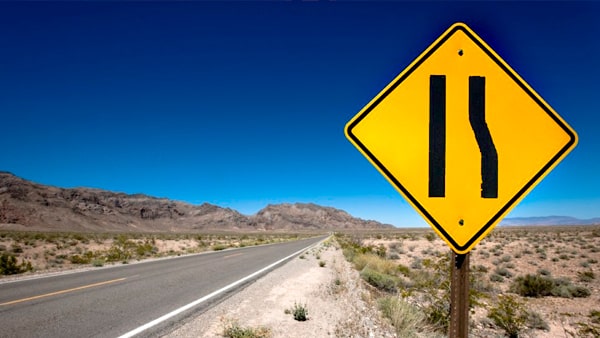
A yellow diamond sign showing the right lane tapering into the left lane warns that:

This sign means:
  1. A The right lane ends ahead
  2. B A divided highway begins
  3. C A steep hill is ahead
  4. D Trucks will cross the roadway

Correct answer: A – The right lane ends ahead

The lane-ends sign warns that the number of lanes in your direction of travel will be reduced. In this example, the right lane ends, requiring traffic in that lane to move left when safe. Drivers in either lane should observe surrounding traffic as they approach the transition.

Source: Wisconsin Motorists’ Handbook — Section 4, “Warning—Lane Ends”

Question 3

When your signal turns green, what should you check before entering the intersection?

  1. A Cross traffic and pedestrians have cleared the intersection
  2. B Every vehicle behind you has started moving
  3. C The signal will remain green until you cross
  4. D Oncoming vehicles have turned off their headlights

Correct answer: A – Cross traffic and pedestrians have cleared the intersection

Wisconsin drivers should look left, right and left again before proceeding through an intersection, even when they have the right-of-way. A green signal permits movement, but vehicles and pedestrians lawfully within the intersection or crosswalk must be allowed to clear. Enter only after confirming that your path is open.

Source: Wis. Stat. § 346.37(1)(a)1 – Traffic-control signal legend., Wisconsin Motorists’ Handbook — § 3C, “Intersections”, Wisconsin Motorists’ Handbook — § 5A, “Green Lights”

Question 4

A steady yellow light appears after your vehicle has entered the intersection. What should you do?

  1. A Stop immediately in the intersection
  2. B Reverse to the stop line
  3. C Wait for the light to turn green again
  4. D Continue carefully through the intersection

Correct answer: D – Continue carefully through the intersection

A steady yellow signal warns that the light is changing to red. Traffic approaching the intersection must stop unless it is too close to stop safely. If your vehicle is already within the intersection when yellow appears, continue through rather than stopping there.

Source: Wis. Stat. § 346.37(1)(b) – Traffic-control signal legend., Wisconsin Motorists’ Handbook — § 5A, “Yellow Lights”

Question 5

What may a driver do at two solid yellow centerlines?

  1. A Cross them to enter a driveway when it is safe
  2. B Use them as proof that the street is one-way
  3. C Drive between them as a shared turn lane
  4. D Cross them whenever another vehicle is moving slower

Correct answer: A – Cross them to enter a driveway when it is safe

Two solid yellow lines generally prohibit passing by traffic in either direction. They may be crossed to turn into a driveway when the movement can be made safely. The handbook also identifies a narrow passing exception for certain vehicles traveling below half the speed limit, but the lines do not permit passing any slower vehicle.

Source: Wisconsin Motorists’ Handbook — § 5B, “Yellow Lane Lines”

Question 6

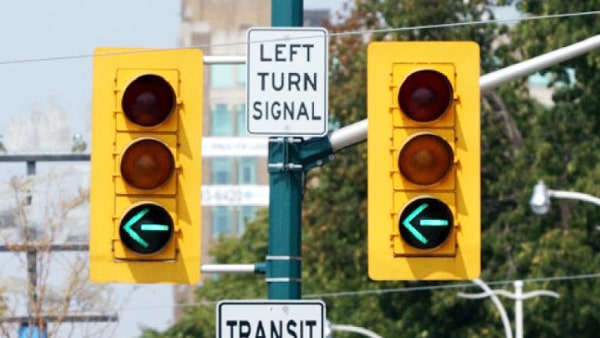
In Wisconsin, a steady green left arrow permits you to:

A green arrow pointing to the left on a traffic light means you may:
  1. A Turn left or continue straight from any lane
  2. B Turn left only after making a complete stop
  3. C Turn left cautiously after yielding to lawful intersection users
  4. D Turn without regard for pedestrians or vehicles already present

Correct answer: C – Turn left cautiously after yielding to lawful intersection users

A steady green arrow authorizes the movement shown by the arrow. The driver must cautiously enter and yield to pedestrians, bicyclists and other traffic lawfully using the intersection or crosswalk. The arrow does not provide an unconditional right-of-way over someone already present.

Source: Wis. Stat. § 346.37(1)(d)1 – Traffic-control signal legend., Wisconsin Motorists’ Handbook — § 5A, “Green Lights”