Wisconsin DMV Sign Test 4

4.5 out of 5 (702 votes)
80% Passing score
20 Questions
4 Mistakes allowed
For Wisconsin drivers, road sign prep sits in that strange category of “basic” material that still manages to cost people points. The official Class D signs test is short, yes, but short does not mean casual: 15 questions, 12 correct answers needed, and after 3 misses, the cushion is gone. It is part of the instruction permit process alongside the knowledge test and vision screening, so treating signs like something you can skim the night before is, well, not the strongest strategy. This Wisconsin DMV practice test gives you a cleaner way to study the road signs portion without turning the whole thing into a DMV handbook slog. The multiple-choice questions focus on the signs and markings Wisconsin expects drivers to understand: regulatory signs, warning signs, guide signs, shapes, colors, traffic signals, and pavement markings. Some of it feels obvious at first glance. Red tells you to stop, yield, or respond immediately. Yellow warns you before the situation gets messy. Green guides you along your route. And then, because driving is never quite as tidy as a chart in a manual, you also need to understand what those signs mean while traffic is moving, lanes are shifting, and somebody ahead of you is braking for reasons known only to them. The questions here are not copied from the actual Wisconsin DMV signs test, but they are written to reflect the format and level of thinking you should expect. After you complete the practice permit test, you will get a summary showing what you answered correctly and what you missed, with the correct answers included. That part is easy to underestimate. A score by itself tells you whether you passed; feedback tells you what to fix before you are sitting at the DMV trying to remember whether a sign shape means warning, regulation, or something you definitely should have reviewed more carefully. A few practical details belong in the picture, too. Wisconsin Class D signs and knowledge tests are available in multiple languages at DMV service centers, usually on touchscreen computers, though paper testing may be available. In-person knowledge testing is walk-in, not scheduled by appointment. Every permit and license applicant must pass a vision screening. Drivers ages 15 to 17 may qualify for the online Class D knowledge test through KnowTo Drive, but permits, documents, fees, and DMV processing still have their own steps. Use this Wisconsin road signs study guide before your permit test, renewal-related testing, or any Class D licensing situation where sign recognition is required. The point is not to memorize just enough to scrape by. The point is to recognize the signs quickly, understand what they mean, and walk into the test feeling good.

FREE DMV Practice Test App
Study for your Wisconsin permit test or driver’s license with the NextDoorDriving app. 700+ DMV questions and answers, 100% free!
Download on the App Store

Sample Wisconsin Permit Test Questions

Question 1

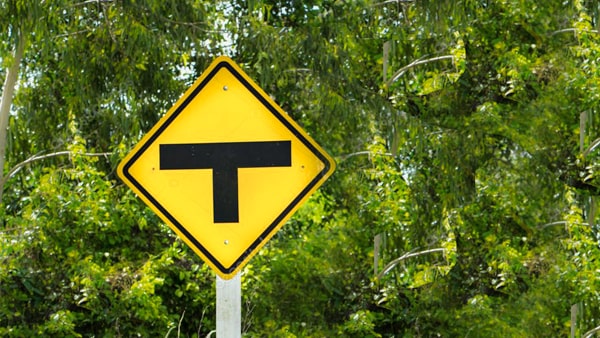
A yellow diamond sign with a black T-shaped symbol warns of what roadway feature?

This sign shows one type of:
  1. A A required right turn
  2. B A T-intersection
  3. C A lane shift
  4. D A winding road

Correct answer: B – A T-intersection

The T symbol is an intersection warning: the roadway you are traveling on terminates at a road that continues across your path. At an uncontrolled T-intersection in Wisconsin, a driver on the terminating highway must yield to traffic on the continuing highway. This differs from a crossroad symbol, which shows both roads continuing.

Source: Wis. Stat. § 346.18(3m) – General rules of right-of-way., Wisconsin Manual on Uniform Traffic Control Devices (2023) — Part 2C, “Intersection Warning Signs”

Question 2

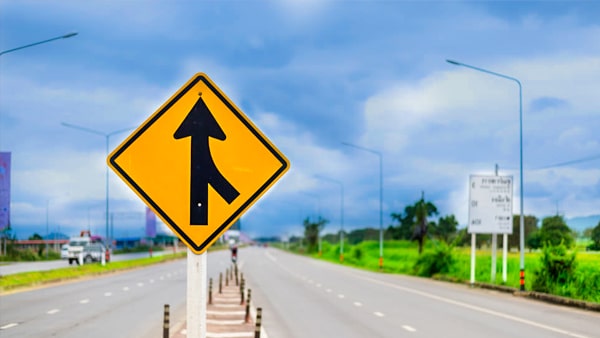
A yellow warning sign showing another traffic lane joining yours from the right means:

This sign means:
  1. A Two-way traffic begins ahead
  2. B The roadway narrows on both sides
  3. C Traffic will merge into your lane ahead
  4. D A divided highway begins ahead

Correct answer: C – Traffic will merge into your lane ahead

A merge sign warns that a traffic stream will join your roadway from the side. It does not indicate a divided highway or simply a narrower roadway. Observe the surrounding traffic and move to another lane only when doing so is safe.

Source: Wisconsin Motorists’ Handbook — Section 4, “Warning—Merge”

Question 3

Which centerline generally prohibits passing by traffic in either direction, subject to limited legal exceptions?

  1. A A broken white line
  2. B Two solid yellow lines
  3. C A broken yellow line
  4. D A solid white line

Correct answer: B – Two solid yellow lines

Two solid yellow centerlines separate opposing traffic and generally prohibit passing in either direction. Wisconsin recognizes a limited exception for carefully passing a non-farm vehicle traveling at less than half the applicable speed limit, when the maneuver is otherwise lawful and safe. The lines may also be crossed to enter a driveway when safe.

Source: Wis. Stat. § 346.09(3) – Limitations on overtaking on left or driving on left side of roadway., Wisconsin Motorists’ Handbook — Section 5, “Types of Line Markings—Yellow Lane Lines”

Question 4

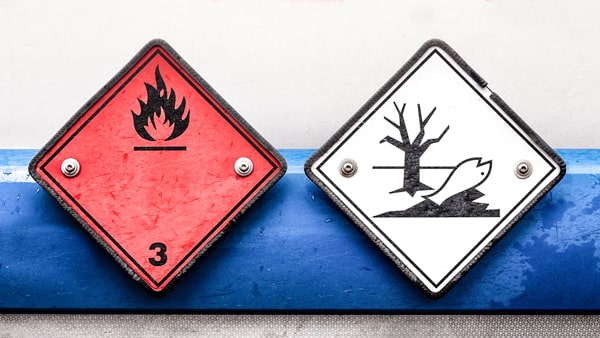
Under Wisconsin law, a truck has a hazardous-materials placard of a classification requiring railroad stops. Unless an exception applies, the driver must:

Which of the following is true about vehicles displaying a diamond-shaped sign (indicating a hazardous load)?
  1. A Avoid all freeways
  2. B Travel no faster than 35 mph
  3. C Stop before crossing railroad tracks at grade
  4. D Be given the right-of-way by other traffic

Correct answer: C – Stop before crossing railroad tracks at grade

The vehicle must stop between 15 and 50 feet from the nearest rail. The driver must then look and listen in both directions and determine that the crossing is clear before proceeding. Exceptions include crossings where an officer or flagger directs traffic to proceed, an official signal permits movement, or authorized abandoned or exempt signage is posted.

Source: Wis. Stat. § 346.45(1)–(3) – Certain vehicles to stop at railroad crossings.

Question 5

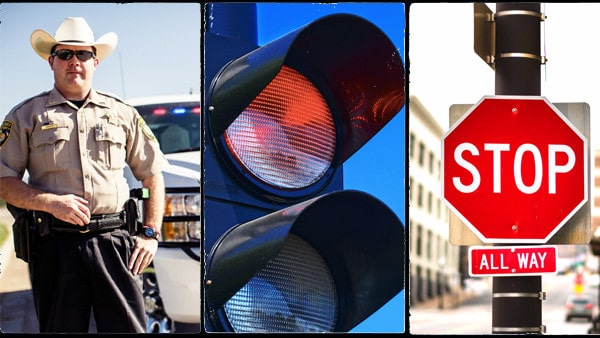
If these directions conflict, which one must a driver follow?

Which of the following must you obey over the other three?
  1. A A steady red traffic light
  2. B A lawful direction from a traffic officer
  3. C A STOP sign
  4. D A flashing red signal

Correct answer: B – A lawful direction from a traffic officer

Wisconsin requires drivers to comply with lawful orders, signals, and directions from traffic officers. An officer’s direction controls even when it differs from a traffic sign or signal. For example, a driver must remain stopped at a green light if directed to stop or may proceed against a red signal if directed to do so.

Source: Wis. Stat. § 346.04(1)–(2) – Obedience to traffic officers, signs and signals; fleeing from officer., Wisconsin Motorists’ Handbook — Section 4, “Signs”

Question 6

Before crossing a dashed white lane line, which condition must a driver verify?

  1. A The movement can be made safely
  2. B The vehicle ahead is disabled
  3. C A turn will be made within one block
  4. D Traffic behind is traveling more slowly

Correct answer: A – The movement can be made safely

A dashed white line separates lanes of traffic moving in the same direction and may be crossed when safe. Before leaving a lane, the driver must determine that the movement will not endanger traffic approaching from behind. Signaling and checking the area around the vehicle should occur before the lane change begins.

Source: Wis. Stat. § 346.13(1) – Driving on roadways laned for traffic., Wisconsin Motorists’ Handbook — Section 5, “Types of Line Markings—White Lane Lines”