Wisconsin Road Signs Test Simulator

4.6 out of 5 (297 votes)
80% Passing score
25 Questions
5 Mistakes allowed
Wisconsin’s temps test rewards people who study the actual material, not the people who skim a few signs and hope the rest feels familiar. That sounds obvious, sure, but it matters here. The Wisconsin DMV expects new drivers to know traffic laws, safe driving rules, pavement markings, right-of-way basics, impaired-driving rules, and road signs well enough to use them without pausing to mentally flip through a handbook. This Wisconsin DMV practice test is built around road signs, which are a required part of the Class D instruction permit process along with the knowledge test and vision screening. The official Class D knowledge test has 50 multiple-choice questions, and you need 40 correct to pass. The separate road signs test uses 15 questions, with 12 correct required. Our Wisconsin temps practice test gives you 20 sign-focused questions per round, and you’ll need 16 correct to pass, so the 80% standard stays in the picture without turning the whole thing into a full DMV afternoon. The simulator pulls a different set of questions each time, which is the part people should not brush past. Repeating the same memorized answers is easy. Recognizing a warning sign by shape, understanding a regulatory sign before the wording even settles in, catching what a pavement marking is telling you — that is the better kind of practice, even if it feels a little less tidy at first. You will see material tied to sign colors, sign shapes, guide signs, traffic signals, pavement markings, and the everyday visual cues Wisconsin drivers are expected to read quickly. This practice test works for first-time permit applicants, adults starting the licensing process, drivers coming back after a long gap, and anyone who wants a cleaner read on where their sign knowledge actually stands. Teens ages 15 to 17 may be able to take Wisconsin’s official Class D knowledge test online through KnowTo Drive with a parent or guardian monitoring, while in-person knowledge testing is handled at DMV customer service centers on a walk-in basis. Adults have their own path too: knowledge test, signs test, vision screening, instruction permit, and then the road test, without the teen driver education and 50-hour supervised-driving requirements. After each round, missed answers come with review, hints, and explanations. Use them. Not in a dramatic way, just use them. That’s where the weak spots show up, and that’s usually where the real score improvement starts.
FREE DMV Practice Test App
Study for your Wisconsin permit test or driver’s license with the NextDoorDriving app. 700+ DMV questions and answers, 100% free!
Download on the App Store

Sample Wisconsin Permit Test Questions

Question 1

What pavement marking directs drivers into lanes assigned to particular movements at an intersection?

  1. A Flashing red lights
  2. B Flashing yellow lights
  3. C White edge lines
  4. D White directional arrows within the lanes

Correct answer: D – White directional arrows within the lanes

White arrows painted within a lane show the direction or directions traffic in that lane must follow. A left-turn arrow, for example, identifies a lane designated for that movement. Drivers must use lanes according to the posted or marked directions.

Source: Wis. Stat. § 346.13(3) – Driving on roadways laned for traffic., Wisconsin Motorists’ Handbook — Section 5, “Types of Line Markings—White Lane Lines”
Question 2

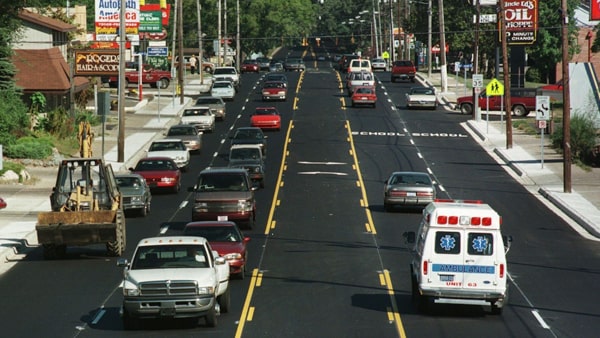
A shared center lane marked with left-turn arrows is intended for:

The center lane in the illustration is used for:
  1. A Normal through travel
  2. B Left turns and permitted U-turns
  3. C Passing slower vehicles
  4. D Emergency vehicles only

Correct answer: B – Left turns and permitted U-turns

In Wisconsin, a shared center lane is reserved for vehicles preparing to turn left or make a permitted U-turn. Drivers traveling in either direction may use it, but they should enter only when safe. It is not a regular travel lane or a lane for passing other vehicles.

Source: Wisconsin Motorists’ Handbook — Section 5, “Special Lanes—Shared Center Lane”

Question 3

At a Wisconsin stop sign, you stop behind the marked stop line but cannot adequately see cross traffic. What should you do next?

  1. A Wait five seconds and then enter the intersection
  2. B Sound the horn before continuing
  3. C Listen for traffic and proceed without moving forward
  4. D Advance carefully and stop again where you can see, then proceed when safe

Correct answer: D – Advance carefully and stop again where you can see, then proceed when safe

A driver must first stop immediately before the marked stop line. If traffic on the intersecting roadway cannot be efficiently observed from there, the driver must stop again before entering the intersection at a point that provides an adequate view. The driver must yield to traffic on the uncontrolled roadway before proceeding.

Source: Wis. Stat. § 346.46(1), (2)(a), (2)(c) – Vehicles to stop at stop signs and school crossings.

Question 4

A yellow, diamond-shaped traffic sign is generally what type of sign?

  1. A A warning sign for a condition or hazard
  2. B An interstate route marker
  3. C A school crossing sign only
  4. D A speed limit sign

Correct answer: A – A warning sign for a condition or hazard

Most warning signs have a yellow background, black symbols or lettering, and a diamond shape. They alert drivers to special roadway conditions or possible hazards ahead. Work-zone warnings commonly use a similar diamond shape with an orange background.

Source: Wisconsin Motorists’ Handbook — Section 4, “Warning”, Wisconsin Motorists’ Handbook — Section 4, “Construction”

Question 5

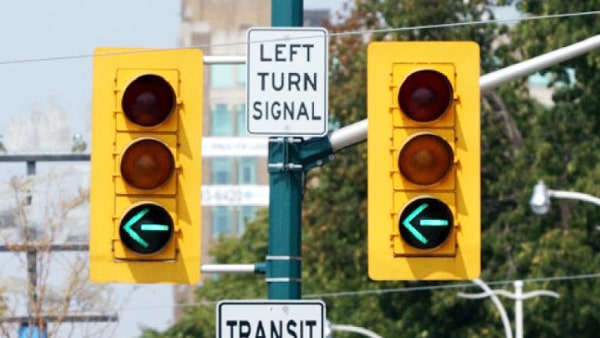
When facing a green left arrow at an intersection, a driver may:

On the intersection, if you see a green arrow pointing to the left, you can:
  1. A Proceed in any direction
  2. B Make the indicated left turn after yielding to lawful intersection users
  3. C Turn left or continue straight
  4. D Turn only after yielding to all approaching oncoming vehicles

Correct answer: B – Make the indicated left turn after yielding to lawful intersection users

In Wisconsin, a green arrow permits vehicles to enter the intersection for the movement shown by the arrow. Drivers must still yield to pedestrians, bicyclists, and other traffic lawfully using the intersection. A left green arrow does not authorize traveling straight unless another signal permits that movement.

Source: Wis. Stat. § 346.37(1)(d)1. – Traffic-control signal legend., Wisconsin Motorists’ Handbook — Section 5, “Traffic Signals—Green Lights”

Question 6

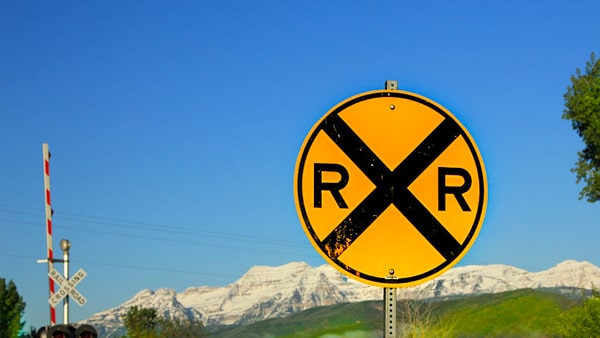
A round yellow sign displaying a black X and the letters “R R” warns that you are approaching:

This sign is a warning that you are approaching:
  1. A A roadway intersection
  2. B A pedestrian crosswalk
  3. C A railroad crossing
  4. D A blasting area

Correct answer: C – A railroad crossing

The round yellow railroad warning sign alerts drivers that a highway-rail crossing is ahead. Be alert for a train and observe any additional signs, flashing lights, bells, or gates at the crossing. Look in both directions before crossing, even when warning lights are not flashing.

Source: Wisconsin Motorists’ Handbook — Section 4, “Railroad Crossing—Railroad Crossing Warning”