


Wyoming Drivers Ed Practice Test 8

4.9 out of 5 (38 votes)
80% Passing score
20 Questions
4 Mistakes allowed
This Wyoming DMV practice test digs into the driving rules that seem perfectly reasonable on paper and then get a little confusing once several cars arrive at the same intersection. It is the eighth WY drivers ed practice test in the series, with 20 multiple-choice questions centered on advanced intersection etiquette, right-of-way rules, four-way stops, and those politely frozen moments where everyone appears to be waiting for someone else to make a decision. The practice test is built to make the rules feel practical, not just technically correct in a handbook sort of way. Some questions include images, which helps more than people admit, because intersection questions are easier when you can actually see the vehicles instead of trying to mentally arrange traffic like a tiny, stressful board game. After each question, you get immediate feedback with the correct answer and an explanation, so a wrong answer does not just sit there looking judgmental. You see what the rule was, why it applied, and how to think through it next time. The real Wyoming Class C knowledge test has 25 questions, and you need 20 correct answers to pass. That is an 80% score, with room to miss 5 questions. Wyoming allows the same written test to be taken twice in one day, which is useful to know, although relying on Attempt Number Two as your main strategy is a bold little choice. The licensing process has its own pile of numbers, because of course it does. A regular learner permit starts at age 15, while a restricted hardship learner permit may be available from 14 to 15. The learner permit is valid for 1 year and must be held for at least 10 days. For an intermediate permit, teen drivers generally need 50 supervised driving hours, including 10 at night. The intermediate stage lasts 6 months or until age 17, with driving limited to 5 a.m. through 11 p.m. and no more than one non-family passenger under 18. Use this Wyoming driving test practice with the official driver’s handbook, road sign review, and a bit of actual focus. The DMV handles the documents, fees, vision standards, and residency paperwork. This test helps with the part where you need to know who goes first, who waits, and why.
FREE DMV Practice Test App
Study for your Wyoming permit test or driver’s license with the NextDoorDriving app. 700+ DMV questions and answers, 100% free!
Download on the App Store

Sample Wyoming Permit Test Questions

Question 1

Which practice helps other road users understand what you intend to do?

  1. A Communicate by using appropriate signals, lights and the horn when necessary
  2. B Avoid signaling so others remain cautious
  3. C Drive only on lightly traveled side streets
  4. D Travel only outside peak traffic hours

Correct answer: A – Communicate by using appropriate signals, lights and the horn when necessary

Communicate your intentions before turning, changing lanes, slowing or stopping. Turn signals, brake lights and hazard lights provide information to other road users, while the horn may be used when an audible warning is necessary. Communication does not replace checking that the planned movement can be made safely.

Source: Wyoming Rules of the Road — “Safe driving tips (IPDE),” “Communicate”, W.S. 31-5-217 – Turning movements and required signals
Question 2

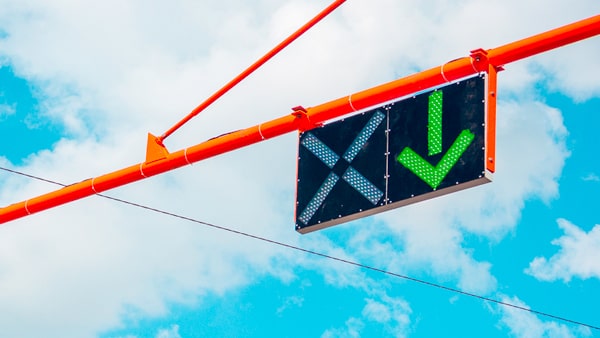
What does a steady downward green arrow on a lane-use control signal mean?

This green arrow on a lane use control signal means that:
  1. A The lane is open for travel
  2. B Traffic may not use the lane
  3. C You have unconditional right-of-way
  4. D All drivers must merge into the lane

Correct answer: A – The lane is open for travel

A steady downward green arrow over a traffic lane indicates that the lane is open for travel. It does not give an unconditional right-of-way or require every driver to enter that lane. Continue to obey other traffic controls and verify that any lane movement can be made safely.

Source: W.S. 31-5-209(a)(i), (iii) – Driving on roadways laned for traffic, Wyoming Rules of the Road — “Traffic signs, signals and road markings,” “Use of lanes”

Question 3

Which action gives following traffic proper notice before you make a turn?

  1. A Signal continuously for at least the last 100 feet before turning
  2. B Reduce the distance between your vehicle and the vehicle ahead
  3. C Wait until you begin turning before applying the brakes
  4. D Drive well below the normal flow of traffic

Correct answer: A – Signal continuously for at least the last 100 feet before turning

Wyoming requires a driver to signal continuously during at least the last 100 feet traveled before turning. Advance signaling communicates your intended movement to traffic behind you. The turn must also be made with reasonable safety, so check surrounding traffic before beginning it.

Source: Wyo. Stat. § 31-5-217(a)–(b) – Turning movements and required signals, Wyoming Driver License Manual — “Isolate your vehicle in traffic,” “Tailgaters”

Question 4

When traffic ahead indicates that you may need to stop, which action helps warn the driver behind you?

  1. A Turn and look continuously over your shoulder
  2. B Wait until the last moment, then brake firmly
  3. C Begin braking early and smoothly so your brake lights provide notice
  4. D Keep your left foot resting on the brake pedal

Correct answer: C – Begin braking early and smoothly so your brake lights provide notice

Beginning to brake early and smoothly activates your brake lights and gives following traffic notice that you are slowing. The driver manual recommends communicating with drivers behind through brake lights, turn signals and proper lane position. State law also requires an appropriate signal before stopping or suddenly decreasing speed when there is an opportunity to signal.

Source: Wyo. Stat. § 31-5-217(c) – Turning movements and required signals, Wyoming Driver License Manual — “Isolate your vehicle in traffic,” “Tailgaters”

Question 5

A chemical test for suspected alcohol-impaired driving is used to determine a person's:

  1. A Reaction time
  2. B Alcohol concentration
  3. C Eyesight
  4. D General driving skill

Correct answer: B – Alcohol concentration

In Wyoming, a chemical test of blood, breath or urine may be used to determine alcohol concentration. Such testing may be directed by a peace officer following a lawful arrest when the required probable cause exists. The test measures alcohol concentration; it does not directly measure eyesight, reaction time or overall driving skill.

Source: Wyo. Stat. § 31-6-102(a)(i) – Test to determine alcoholic or controlled substance content of blood; suspension of license

Question 6

Before passing through an oncoming-traffic lane, which factors must you evaluate?

When passing in the oncoming traffic lane of a two-lane road, you should consider:
  1. A Whether the left side of the road is clearly visible
  2. B Whether oncoming traffic is far enough away
  3. C Whether you can complete the pass and return safely
  4. D All of the above

Correct answer: D – All of the above

Before entering an oncoming-traffic lane, the passing driver must verify that the left side is clearly visible and free of oncoming traffic for a sufficient distance. The pass must be completed without interfering with approaching or overtaken vehicles. When the oncoming lane is used, the driver must return to an authorized lane before coming within 200 feet of an approaching vehicle.

Source: Wyo. Stat. § 31-5-204 – General limitations on overtaking on the left