


Missouri CDL Practice Test: General Knowledge (MO) 6

4.9 out of 5 (46 votes)
80% Passing score
50 Questions
10 Mistakes allowed
Get ready to master the road in 2026 with our Missouri CDL General Knowledge Practice Test! Whether you're aiming for a commercial driver's license or just looking to refresh your knowledge, our sixth Missouri CDL practice test is the perfect tool to help you succeed. With 50 thought-provoking permit test questions, this CDL practice test challenges your understanding of vital topics like vehicle equipment, emergency response, accident procedures, and pre-trip inspections. Plus, we've even sprinkled in some DMV questions on hazardous materials, because every driver should have a basic understanding of HazMat materials. After taking this Missouri CDL practice test, you'll receive an end-of-test summary, showcasing the questions you answered incorrectly along with the correct answers for invaluable learning. We're dedicated to keeping our content up-to-date, ensuring it aligns with the latest 2026 driving laws and regulations. The best part? Our Missouri CDL practice test is 100% FREE. While other platforms charge a pretty penny for similar services, we believe in providing accessible, high-quality resources for all aspiring commercial drivers. You'll find the same features and study opportunities here as you would on any paid version. So, don't miss this opportunity to prepare effectively and boost your confidence before the big test in 2026! Dive into our Missouri CDL General Knowledge Practice Test now and drive toward success on the open road.
FREE CDL Practice Test App
Pass your Missouri CDL General Knowledge test with the NextDoorDriving app. Real questions and answers—100% free and ad-free.
Download on the App Store

Sample Missouri CDL Test Questions - General Knowledge

Question 1

How should you normally brake a commercial vehicle equipped with working ABS?

  1. A Pump the brake pedal repeatedly
  2. B Brake normally, using only the force needed to stop safely
  3. C Always press the pedal as hard as possible
  4. D Release the accelerator and wait for ABS to apply the brakes

Correct answer: B – Brake normally, using only the force needed to stop safely

Brake as you normally would and use only the braking force needed to stop safely while maintaining control. Monitor the vehicle as it slows and reduce pressure if necessary to stay in control. A straight truck or combination vehicle with working ABS on every axle may receive full brake application during an emergency stop.

Source: Missouri Commercial Driver License Manual — § 2.18.6, “Braking with ABS”
Question 2

What should you do first if your commercial vehicle begins to hydroplane?

  1. A Begin stab braking
  2. B Downshift immediately
  3. C Accelerate slightly
  4. D Release the accelerator

Correct answer: D – Release the accelerator

Release the accelerator to allow the vehicle to slow and the tires to regain contact with the road. With a manual transmission, the manual also directs the driver to push in the clutch so the wheels can turn freely. Do not use the brakes to slow a hydroplaning vehicle.

Source: Missouri Commercial Driver License Manual — § 2.6.2, “Matching Speed to the Road Surface—Hydroplaning”

Question 3

If no qualified person is already caring for someone seriously injured at a crash scene, which actions are appropriate?

  1. A Move the person only if fire or passing traffic creates danger
  2. B Apply direct pressure to stop heavy bleeding
  3. C Keep the injured person warm
  4. D All of these actions

Correct answer: D – All of these actions

Do not move a severely injured person unless fire or passing traffic makes movement necessary. Heavy bleeding should be controlled by applying direct pressure to the wound, and the injured person should be kept warm. If a qualified person is already providing care, stay out of the way unless asked to assist.

Source: Missouri Commercial Driver License Manual — § 2.20.3, “Care for the Injured”

Question 4

If wet brakes apply unevenly or grab while you are pulling a trailer, which serious result can occur?

  1. A The engine may overheat
  2. B The vehicle will automatically hydroplane
  3. C The transmission may shift into neutral
  4. D The combination vehicle may jackknife

Correct answer: D – The combination vehicle may jackknife

Water can make brakes weak, uneven, or prone to grabbing. The resulting loss of braking power, wheel lockup, or pulling to one side can lead to a jackknife when a trailer is attached. After passing through deep water, dry the brakes and make a test stop when it is safe.

Source: Missouri Commercial Driver License Manual — § 2.13, “Wet Brakes”

Question 5

You are driving a lightly loaded CMV in Missouri. Traffic is moving steadily at 35 mph in a 55 mph zone, with no condition requiring a lower speed. Which speed best matches the traffic flow?

  1. A 30 mph
  2. B 35 mph
  3. C 50 mph
  4. D 25 mph

Correct answer: B – 35 mph

In heavy traffic, the safest general choice is to travel at the speed of surrounding vehicles when that speed is legal and safe. Here, 35 mph matches the traffic flow and remains below the posted limit. Continue to maintain a safe following distance rather than using the matching speed as a reason to follow closely.

Source: Missouri Commercial Driver License Manual — § 2.6.5, “Speed and Traffic Flow”

Question 6

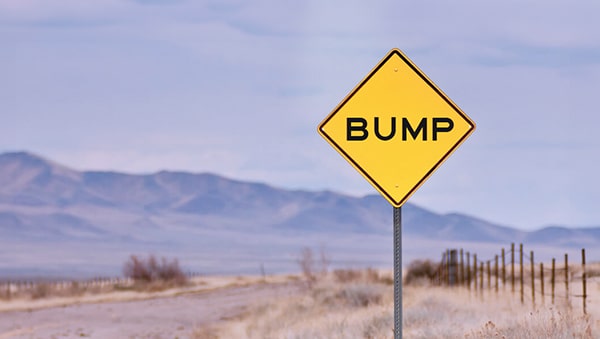
On a Missouri roadway, what condition does a BUMP warning sign indicate?

This sign warns drivers to _____________.
  1. A A low area in the roadway
  2. B A sharp rise in the roadway profile
  3. C A location where drivers should accelerate
  4. D A sharp depression in the roadway profile

Correct answer: B – A sharp rise in the roadway profile

The BUMP sign warns of a sharp rise in the roadway profile. A sharp depression is identified by a DIP sign instead. Recognizing the difference helps a commercial driver prepare for the specific change in the road surface ahead.

Source: Manual on Uniform Traffic Control Devices for Streets and Highways, 11th ed., Rev. 1 — § 2C.26, “BUMP and DIP Signs (W8-1 and W8-2)”