


Delaware CDL Permit Test (DE) Online Simulator

5 out of 5 (36 votes)
80% Passing score
50 Questions
10 Mistakes allowed
Get ready to elevate your CDL permit test preparation in 2026 with Delaware's premier online CDL Permit Test Simulator. This robust tool is not just another practice test; it's a comprehensive simulator designed to mirror the real Delaware CDL test experience. With over 700 questions in its database, each attempt you make offers a fresh set of challenges, ensuring that you're not just memorizing answers, but truly understanding the material. Our Delaware CDL Test Simulator caters to all CDL licenses, including Class A and B. Every session presents you with 50 questions, a mix of multiple choice and true/false types, closely reflecting the actual test format. To pass, you'll need to correctly answer at least 40 questions, but we encourage aiming higher to ensure a comfortable margin on the real test day. The unique feature of our simulator lies in its end-of-test summaries. After completing each test, you'll receive a detailed breakdown of your answers, highlighting areas of strength and those needing improvement. This feedback is crucial for targeted studying, allowing you to focus on sections where you need the most practice. Moreover, our simulator is enhanced with visual learning aids. These include images of road signs and various traffic scenarios, which are incredibly beneficial for visual learners. These aids help in retaining information and understanding practical applications of the rules. Accessibility is a key aspect of our practice tests in 2026. Whether you prefer studying on a desktop, a tablet, or a smartphone, our online platform is optimized for all devices. This flexibility allows you to practice anytime, anywhere, fitting seamlessly into your busy schedule. Delaware's CDL Permit Test Simulator is more than just a practice tool; it's a comprehensive learning experience that prepares you for success. Start using it today and feel confident in your ability to ace the CDL permit test in 2026.
FREE CDL Practice Test App
Pass your Delaware CDL General Knowledge test with the NextDoorDriving app. Real questions and answers—100% free and ad-free.
Download on the App Store

Sample Delaware CDL Test Questions - General Knowledge

Question 1

In Delaware, a highway sign with a blue background generally identifies:

  1. A Road-user services
  2. B Road construction
  3. C General warning conditions
  4. D Mandatory traffic regulations

Correct answer: A – Road-user services

Blue backgrounds are used for road-user service signs. These signs direct travelers to services and facilities rather than warning of construction or general roadway hazards. Orange is associated with temporary traffic control, while yellow is commonly used for warning signs.

Source: 2 DE Admin. Code 2402, Part 2, Table 2A-5 — Common Uses of Sign Colors
Question 2

When is using the horn appropriate?

  1. A Every time you change lanes
  2. B When it may help prevent a collision
  3. C Whenever another vehicle delays you
  4. D Whenever an animal is visible beside the road

Correct answer: B – When it may help prevent a collision

The horn can alert another road user to your presence and help prevent a crash. Use it when necessary for safety, but avoid unnecessary horn use. An unexpected horn can startle other drivers and may create an additional hazard.

Source: Delaware Commercial Driver’s Manual — § 2.5.2, “Communicating Your Presence”

Question 3

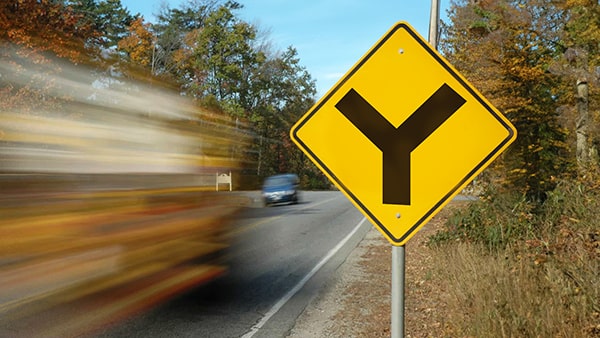
What does a Y-symbol intersection warning sign indicate?

This sign warns drivers to _____________.
  1. A The roadway ends at a T intersection
  2. B The roadway approaches a Y-shaped intersection
  3. C A construction detour begins ahead
  4. D A dip is located within the intersection

Correct answer: B – The roadway approaches a Y-shaped intersection

The Y-symbol sign gives advance notice of a Y-shaped intersection. Delaware’s traffic-control standard permits this sign before an intersection to alert road users to the intersection and the possibility of turning or entering traffic. Drivers should observe the roadway layout and prepare to respond safely.

Source: 2 DE Admin. Code 2402, Part 2, § 2C.46 — Intersection Warning Signs (W2-1 through W2-8, W21-9-DE, W21-9P-DE, W21-10-DE)

Question 4

Which behavior may indicate that a nearby driver is distracted?

  1. A Drifting within or across lanes, changing speed inconsistently, or handling objects while driving
  2. B Using headlights during daylight hours
  3. C Displaying several bumper stickers
  4. D Driving a vehicle with out-of-state registration

Correct answer: A – Drifting within or across lanes, changing speed inconsistently, or handling objects while driving

A distracted driver may drift across lane lines or wander within a lane, travel at inconsistent speeds, or focus on a phone, map, food, or another object. Conversations with passengers may also draw the driver’s attention away from traffic. Give a driver showing these signs plenty of room.

Source: Delaware Commercial Driver’s Manual — § 2.9.3, “Recognizing a Distracted Driver”

Question 5

What does gross combination weight describe?

  1. A The actual weight of the power unit and an empty trailer
  2. B The actual weight of the trailer and its cargo only
  3. C The actual combined weight of the power unit, towed unit or units, and their loads
  4. D The combined weight of the driver and cargo

Correct answer: C – The actual combined weight of the power unit, towed unit or units, and their loads

Gross combination weight is the actual combined weight of the power unit and all towed units, including their loads. It should not be confused with gross combination weight rating, which is a specified or calculated rating. The Delaware CDL manual treats actual weight and weight ratings as separate measurements when discussing combination vehicles.

Source: Delaware Commercial Driver’s Manual — § 3.2.1, “Definitions You Should Know”, 49 CFR § 383.5 — Definitions

Question 6

At an all-way stop in Delaware, which vehicle must you yield to after making a complete stop?

  1. A A vehicle already within the intersection
  2. B A vehicle on your left, regardless of its position
  3. C The largest vehicle approaching the intersection
  4. D No vehicle, because stopping automatically gives you the right-of-way

Correct answer: A – A vehicle already within the intersection

After stopping, yield to a vehicle or pedestrian already in the intersection and to approaching traffic that presents an immediate hazard. Do not proceed until the movement can be made safely. When two vehicles enter from different roads at approximately the same time, the driver on the left yields to the vehicle on the right.

Source: 21 Del. C. § 4164(a), (b) — Stop signs and yield signs, 21 Del. C. § 4131(a), (b) — Vehicle approaching or entering intersection