


Iowa CDL Permit Test (IA) Online Simulator

5 out of 5 (38 votes)
80% Passing score
50 Questions
10 Mistakes allowed
Are you ready to ace your Iowa CDL Permit Test in 2026? Our Online CDL Permit Test Simulator is here to guide you through the process with ease and efficiency. Unlike other CDL practice tests, this simulator is a unique tool that challenges and prepares you for the real deal. With over 700 questions in our database, you'll never face the same test twice. Each session presents 50 new questions, ranging from multiple choice to true or false, mirroring the format of the actual Iowa general knowledge permit test. Our simulator is designed for both Class A and B CDL licenses, ensuring comprehensive coverage no matter your focus. To pass, you'll need to correctly answer at least 40 out of 50 permit test questions, but we encourage you to aim higher for the best results. What sets our Iowa DMV practice test apart? It's the professional touch. Our questions aren't just random; they're crafted and meticulously reviewed by experienced driving instructors, experts who have helped thousands get their licenses. This level of professionalism in our simulator ensures that you're getting the most accurate and relevant practice possible. But here's the best part - it's completely free. We believe in accessible education, so we offer a high-quality simulator without any cost. This is a unique opportunity to practice and master the Iowa CDL test questions in 2026 without the burden of fees, making it as inclusive as possible. You can take our Iowa CDL test as many times as you need, ensuring you're fully prepared and confident before moving on to the actual permit test. This flexibility allows you to learn at your own pace, building your knowledge and confidence with each attempt. So, are you ready to test your skills and knowledge? Our Iowa CDL Test Simulator is just a click away, ready to help you succeed!
FREE CDL Practice Test App
Pass your Iowa CDL General Knowledge test with the NextDoorDriving app. Real questions and answers—100% free and ad-free.
Download on the App Store

Sample Iowa CDL Test Questions - General Knowledge

Question 1

An unblocked cargo article is 5 feet long and weighs 1,500 pounds. How many tiedowns are required at minimum?

  1. A 1
  2. B 2
  3. C 3
  4. D 4

Correct answer: B – 2

An unblocked article that is 5 feet long or shorter requires at least two tiedowns when it weighs more than 1,100 pounds. This article weighs 1,500 pounds, making two the minimum. One tiedown would apply only if an article of this length weighed 1,100 pounds or less.

Source: 49 CFR § 393.110(b)(1), (2)(i) – Additional requirements for determining the minimum number of tiedowns.
Question 2

Which action helps prevent another crash after you stop at an accident scene?

  1. A Leave the vehicle in a travel lane regardless of whether it can be moved
  2. B Stand in the lane and wave traffic around the scene
  3. C Call your supervisor before warning approaching traffic
  4. D Turn on the flashers and place reflective triangles

Correct answer: D – Turn on the flashers and place reflective triangles

The Iowa CDL manual’s first accident-scene step is to protect the area from another crash. Turn on the vehicle’s flashers and set out reflective triangles where approaching drivers can see them in time. If the involved vehicle can be moved safely, getting it to the side of the road also helps protect the scene and maintain traffic flow.

Source: Iowa Commercial Driver’s License Manual — § 2.20.1, “Protect the Area”

Question 3

Why must you select the proper low gear before descending a steep grade?

  1. A It allows you to ignore the service brakes
  2. B Once speed builds, you may be unable to shift lower and could lose engine braking
  3. C It keeps the vehicle at the posted speed automatically
  4. D It prevents all transmission wear

Correct answer: B – Once speed builds, you may be unable to shift lower and could lose engine braking

Choose the proper low gear before starting down the grade. After the vehicle gains speed, the transmission may not shift into a lower gear, and the driver may be unable to return it to any gear. That would eliminate the engine-braking effect needed to help control the descent.

Source: Iowa Commercial Driver’s License Manual — § 2.16.2, “Select the Right Gear before Starting Down the Grade”

Question 4

Which three distances combine to make total stopping distance?

  1. A Stopping, reaction, and perception distances
  2. B Vehicle, following, and reaction distances
  3. C Braking, obstacle, and following distances
  4. D Perception, reaction, and braking distances

Correct answer: D – Perception, reaction, and braking distances

Total stopping distance is the sum of perception distance, reaction distance, and braking distance. Perception distance is traveled while recognizing the hazard, and reaction distance is traveled before physically applying the brakes. Braking distance is the distance traveled from brake application until the vehicle stops.

Source: Iowa Commercial Driver’s License Manual — § 2.6.1, “Stopping Distance”

Question 5

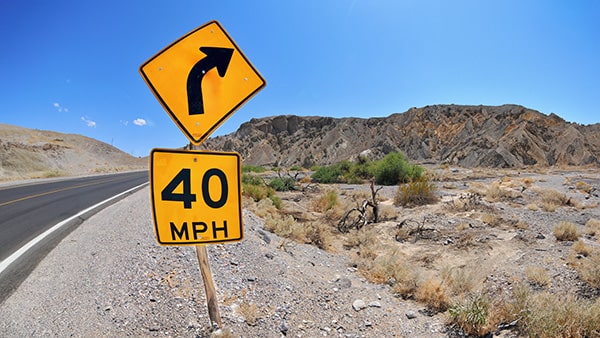
A curve warning sign has a yellow “40 MPH” plaque beneath it. What does the plaque indicate?

This sign warns drivers to _______________.
  1. A Vehicles traveling under 40 mph must use the right lane
  2. B The roadway has a legal minimum speed of 40 mph
  3. C The advisory speed for the curve is 40 mph
  4. D Drivers must travel at least 40 mph through the curve

Correct answer: C – The advisory speed for the curve is 40 mph

In Iowa, a 40 MPH plaque beneath a curve warning sign displays the advisory speed for that curve. The plaque is not a standalone regulatory speed-limit sign; it communicates a recommended operating speed established for the condition. Drivers may need to travel more slowly when road, weather, vehicle, or load conditions require it.

Source: 761 IAC 130.1 – Manual., Manual on Uniform Traffic Control Devices, 11th ed. — § 2C.59, “Advisory Speed Plaque (W13-1P) and Confirmation Advisory Speed Plaque (W13-1aP)”, Iowa Commercial Driver’s License Manual — § 2.6.3, “Speed and Curves”

Question 6

Which description best identifies black ice?

  1. A A thin, clear ice layer through which the road surface remains visible
  2. B Ice that has almost completely melted
  3. C A ridge of ice found only along the shoulder
  4. D A harmless discoloration on the pavement

Correct answer: A – A thin, clear ice layer through which the road surface remains visible

Black ice is a thin, clear layer of ice that allows the pavement beneath it to remain visible. Because it can make the road appear wet rather than frozen, it may be difficult to recognize. When temperatures are below freezing and the pavement looks wet, watch for black ice and reduced traction.

Source: Iowa Commercial Driver’s License Manual — § 2.6.2, “Matching Speed to the Road Surface—Black Ice”