


Montana CDL Class B Practice Test (MT) 3

5 out of 5 (45 votes)
80% Passing score
20 Questions
4 Mistakes allowed
Aspiring commercial drivers, prepare to enhance your knowledge and skills with our Montana CDL Class B Practice Test. This is your third CDL practice test, designed to simulate the real DMV experience, but without the stress of actual testing. It's a crucial step in your preparation, providing a comprehensive understanding of what you need to know before hitting the road. This Montana CDL class B practice test comprises 20 DMV questions and answers, meticulously crafted to reflect the real-world scenarios you'll encounter as a professional driver. To pass, you need to correctly answer at least 16 questions. What sets our Montana CDL practice test apart is its focus on Class B CDL applicants, offering a specific and relevant learning experience. The driving test questions and answers encompass a wide array of topics, essential for every commercial driver. From the basics of pre-trip vehicle inspection to the nuances of shifting gears, including downshifting techniques, every aspect of commercial driving is covered. You'll learn how to navigate hills and steep downgrades, communicate effectively with other road users, and maintain control over your vehicle's speed. Safety is paramount, and our Montana DMV practice test ensures you're well-versed in drug and alcohol awareness, a critical component of responsible driving. The CDL class B practice test also covers emergency situations and cargo transportation, ensuring that you're prepared for any challenge on the road. Our Montana DMV class B practice test offers a unique learning opportunity. No matter how many times you retake it, the questions remain consistent, allowing you to track your progress and focus on areas where you need improvement. It's a stress-free, educational environment, designed to build your confidence and knowledge as you prepare for your Class B CDL. Remember, this Montana DMV CDL practice test is more than just a preparation tool; it's a stepping stone to becoming a skilled, responsible, and professional commercial driver in Montana in 2026!
FREE CDL Practice Test App
Pass your Montana CDL General Knowledge test with the NextDoorDriving app. Real questions and answers—100% free and ad-free.
Download on the App Store

Sample Montana CDL Test Questions - General Knowledge

Question 1

What action is required when approaching a YIELD sign?

When approaching this sign _______________.
  1. A Watch only for children crossing
  2. B Accelerate into the intersection
  3. C Slow to a reasonable speed and yield the right-of-way
  4. D Continue because other traffic must stop

Correct answer: C – Slow to a reasonable speed and yield the right-of-way

A YIELD sign requires you to slow to a reasonable speed and give the right-of-way to other vehicles. Be prepared to stop when necessary before entering the traffic path. The sign does not give you priority over approaching traffic.

Source: Montana Driver Manual — Ch. 3, “Signs: YIELD Sign”
Question 2

How far ahead should a commercial driver generally scan while driving?

  1. A 10 to 12 seconds
  2. B 8 to 10 seconds
  3. C 12 to 15 seconds
  4. D 15 to 17 seconds

Correct answer: C – 12 to 15 seconds

The Montana CDL manual recommends looking at least 12 to 15 seconds ahead. That is approximately one block at lower speeds and about one-quarter mile at highway speeds. Drivers must continue shifting their attention between near and distant conditions rather than focusing only on the farthest point.

Source: Montana Commercial Driver License Manual — § 2.4.1, “Seeing Ahead”

Question 3

What occurs when a vehicle hydroplanes?

  1. A The tires lose contact with the roadway and have little or no traction
  2. B The steering wheel turns but the front wheels remain fixed
  3. C The brakes permanently stop operating
  4. D The vehicle’s suspension rises above its normal height

Correct answer: A – The tires lose contact with the roadway and have little or no traction

During hydroplaning, the tires ride on water or slush and lose contact with the road, leaving little or no traction. Steering and braking ability may be severely reduced. Hydroplaning can occur at speeds as low as 30 mph when there is substantial water, especially when tire pressure is low or tread is worn.

Source: Montana Commercial Driver License Manual — § 2.6.2, “Matching Speed to the Road Surface: Hydroplaning”

Question 4

Which conditions should be treated as tire problems during a commercial-vehicle inspection?

  1. A Incorrect air pressure
  2. B Abnormal wear or tread separation
  3. C Cuts or other visible damage
  4. D All of these conditions

Correct answer: D – All of these conditions

Too much or too little air pressure can make a tire unsafe. Bad wear, tread separation, cuts, and other damage are also inspection concerns. Drivers should additionally look for exposed fabric, damaged valve stems, mismatched tires, and dual tires that contact each other or another part of the vehicle.

Source: Montana Commercial Driver License Manual — § 2.1.3, “Tire Problems”

Question 5

When may a driver who is not part of a moving funeral procession drive between its vehicles?

  1. A Whenever the driver believes there is an emergency
  2. B When the driver normally has the right-of-way
  3. C Whenever the maneuver appears safe
  4. D Only when authorized by police or operating a signaling authorized emergency vehicle

Correct answer: D – Only when authorized by police or operating a signaling authorized emergency vehicle

Montana law generally prohibits a driver from entering between vehicles in a funeral procession while they are moving. The stated exceptions apply when a police officer authorizes the movement or when the driver is operating an authorized emergency vehicle emitting an audible or visible signal. Having the usual right-of-way or believing the maneuver is safe does not create another exception.

Source: Montana Driver Manual — Ch. 4, “Funeral Procession”, MCA § 61-8-383(1) — Vehicles Not in Funeral Procession

Question 6

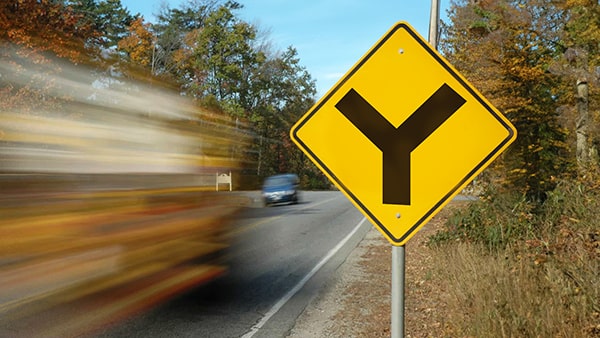
A yellow diamond sign with a black Y-shaped symbol provides advance warning of what?

This sign warns drivers to _____________.
  1. A A T-intersection
  2. B A Y-intersection
  3. C A highway work zone
  4. D A dip at an intersection

Correct answer: B – A Y-intersection

The Y-Intersection warning sign is placed in advance of an intersection with a Y-shaped configuration. It alerts drivers to the presence of the intersection and the possibility of turning or entering traffic. It does not indicate a T-intersection, construction zone, or roadway dip.

Source: Manual on Uniform Traffic Control Devices, 11th ed. — § 2C.41, “Intersection Warning Signs (W2-1 through W2-8)”