


Alabama General Knowledge CDL Prep Test (AL) 4

5 out of 5 (59 votes)
80% Passing score
20 Questions
4 Mistakes allowed
Embarking on the path to earning your Commercial Driver's License in Alabama? Great choice! You've reached your fourth Alabama CDL General Knowledge Practice Test, a crucial step in this exciting process. This specific CDL test is designed to solidify your understanding and prepare you thoroughly for the challenges ahead. Featuring 20 well-curated questions, it demands a minimum of 16 correct answers for a pass. But here's the catch: every time you take this Alabama CDL practice test, the same set of questions will be staring right back at you, ensuring you really grasp the content. What sets this general knowledge practice test apart is the immediate feedback you get on each question. It's not just about knowing if you're right or wrong; it's about understanding why. The detailed explanations provided for each answer enhance your learning, making sure you know the ins and outs of essential driving knowledge. From mastering the art of a pre-trip inspection to understanding how to share the road safely, this CDL practice test covers it all. We delve into the nitty-gritty of basic vehicle control, the nuances of transporting cargo securely, and how to handle emergency situations. All these elements are crucial for not just passing your CDL written test but also for ensuring you're a safe, responsible driver on Alabama's roads. So, gear up and dive into this Alabama DMV CDL practice test. It's a valuable tool in your arsenal, crafted to boost your confidence and knowledge, making sure when you hit the road, you're not just driving - you're excelling.
FREE CDL Practice Test App
Pass your Alabama CDL General Knowledge test with the NextDoorDriving app. Real questions and answers—100% free and ad-free.
Download on the App Store

Sample Alabama CDL Test Questions - General Knowledge

Question 1

What does the Slippery When Wet warning sign indicate?
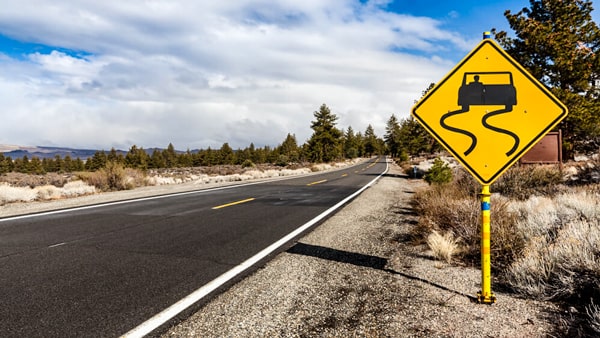
This sign warns drivers to  _________________.
  1. A The roadway may have reduced traction when wet
  2. B Driving is prohibited whenever it rains
  3. C Vehicles are likely to become stuck in mud
  4. D The roadway is equally slippery in all weather

Correct answer: A – The roadway may have reduced traction when wet

The Slippery When Wet sign warns that unexpected slippery conditions may exist when the roadway is wet. Drivers should adjust to the reduced traction and maintain control appropriate to conditions. In Alabama, the standard W8-5 symbol may be accompanied by a plaque explaining the condition, such as WHEN WET, ICE, or STEEL DECK.

Source: MUTCD, 11th ed. with Revision 1 — § 2C.30, “Surface Condition Signs (W8-5, W8-7, W8-8, W8-11, W8-13, and W8-14)”

Question 2

Which statement correctly distinguishes gross combination weight from gross combination weight rating?

  1. A GCW is a single vehicle’s rating, while GCWR is its actual weight
  2. B GCW includes only the power unit, while GCWR includes cargo
  3. C GCW is the combination’s actual weight, while GCWR is the applicable rated value for the combination
  4. D GCW and GCWR are always identical

Correct answer: C – GCW is the combination’s actual weight, while GCWR is the applicable rated value for the combination

Gross combination weight refers to the actual combined weight of the power unit, towed units, and their loads. GCWR is a rating rather than a scale weight. Under the federal CDL definition, GCWR is the greater of the qualifying manufacturer-displayed value or the applicable sum of the power unit’s and towed units’ GVWR or GVW values.

Source: 49 CFR § 383.5 – Definitions

Question 3

In ideal conditions, what following interval should a driver maintain for a 40-foot commercial vehicle traveling at 45 mph?

  1. A 2 seconds
  2. B 3 seconds
  3. C 4 seconds
  4. D 5 seconds

Correct answer: D – 5 seconds

The Alabama CDL manual recommends one second of following time for each 10 feet of vehicle length at speeds below 40 mph, plus another second at higher speeds. A 40-foot vehicle starts with four seconds. At 45 mph, the additional second makes the recommended interval five seconds under ideal conditions; poor conditions require more space.

Source: Alabama Commercial Driver License Manual — § 2.7.1, “Space Ahead”

Question 4

Which tire-safety practice is correct when operating in very hot weather?

  1. A Inspect the tires every two hours or 100 miles
  2. B Keep driving if a tire is too hot to touch
  3. C Release air from tires that become hot
  4. D Check the tires only at the beginning of the day

Correct answer: A – Inspect the tires every two hours or 100 miles

Very hot weather calls for tire inspections every two hours or 100 miles. Heat increases tire pressure, so releasing air from a hot tire can leave it underinflated after it cools. If a tire is too hot to touch, remain stopped until it cools because continued operation could result in a blowout or fire.

Source: Alabama Commercial Driver License Manual — § 2.14.1, “Vehicle Checks”

Question 5

Which pre-trip inspection result indicates a satisfactory brake or suspension condition?

  1. A Brake shoes and pads are free of oil, grease, and brake fluid
  2. B One leaf is missing from a leaf spring
  3. C A spring hanger is cracked
  4. D A broken spring leaf has shifted toward a tire

Correct answer: A – Brake shoes and pads are free of oil, grease, and brake fluid

During an Alabama pre-trip inspection, brake shoes and pads should not have oil, grease, or brake fluid on them. Cracked spring hangers and missing, broken, or shifted spring leaves are suspension defects. The manual warns that any missing or broken leaf could be dangerous, even though one-fourth or more missing can place the vehicle out of service.

Source: Alabama Commercial Driver License Manual — § 2.1.3, “What to Look For”

Question 6

Which driving-related abilities does alcohol affect first as BAC begins to rise?

  1. A Judgment and self-control
  2. B Kidney function
  3. C Physical coordination
  4. D Muscle control

Correct answer: A – Judgment and self-control

The first part of the brain affected by alcohol controls judgment and self-control. This can prevent a person from accurately recognizing increasing impairment. As BAC continues to rise, alcohol increasingly affects vision, coordination, and muscle control, all of which are necessary for safe commercial driving.

Source: Alabama Commercial Driver License Manual — § 2.22.1, “Alcohol and Driving”