


Hawaii CDL General Knowledge Test (HI) 5

5 out of 5 (40 votes)
80% Passing score
50 Questions
10 Mistakes allowed
Aloha! Ready to tackle our fifth Hawaii CDL General Knowledge Practice Test? The practice test is a comprehensive tool designed to assist you in acing your DMV test. This particular test comprises 50 meticulously crafted questions, each aimed at testing your grasp of essential CDL knowledge. Success is gauged by correctly answering at least 40 questions, a benchmark that aligns with the DMV's standard. What sets this Hawaii CDL general practice test apart is its dynamic and comprehensive approach. We understand that repetition can sometimes lead to mere memorization, which is why our DMV practice test is uniquely structured. Each time you engage with the test, you'll encounter a different set of questions. This randomization is key in ensuring that you're not just remembering the sequence of questions, but truly understanding the material. The diversity in our question pool covers a broad spectrum of topics, preparing you for a variety of scenarios you might face in the actual Hawaii CDL written permit test in 2026. This breadth of coverage is crucial for a thorough preparation, ensuring that you're well-equipped to handle any question that comes your way. Moreover, the format and content of our CDL practice test questions are crafted to mirror those you will find in the real written knowledge test. This similarity is an intentional design to give you a realistic taste of the actual exam environment, thereby reducing any surprises or uncertainties on test day. By regularly practicing with our Hawaii CDL practice tests, you'll gain not only knowledge but also confidence in your ability to navigate the real test with ease. In summary, this fifth Hawaii CDL General Knowledge Practice Test is more than just a study tool; it's your ally in mastering the skills and knowledge required for your DMV CDL test in 2026. With a focus on variety, randomization, and realistic replication of the actual test, we are committed to supporting you in achieving your CDL goals.
FREE CDL Practice Test App
Pass your Hawaii CDL General Knowledge test with the NextDoorDriving app. Real questions and answers—100% free and ad-free.
Download on the App Store

Sample Hawaii CDL Test Questions - General Knowledge

Question 1

About how far ahead can you see with properly working low-beam headlights?

  1. A 250 feet
  2. B 200 feet
  3. C 150 feet
  4. D 350 feet

Correct answer: A – 250 feet

Low-beam headlights provide approximately 250 feet of visibility, while high beams provide about 350 to 500 feet. Your speed must allow you to stop within the distance illuminated by your headlights. When low beams are required, a lower speed may be necessary to keep the stopping distance within the visible area.

Source: Hawaii Commercial Driver License Manual — § 2.11.4, “Vehicle Factors”
Question 2

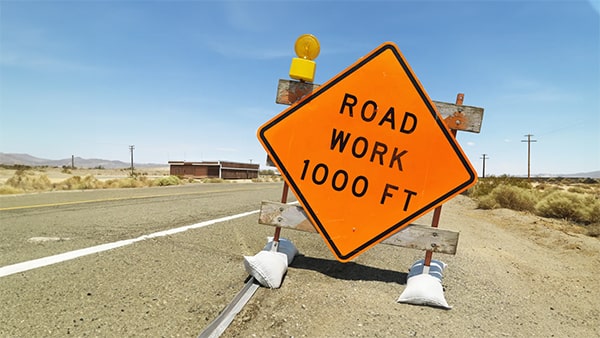
What does an orange ROAD WORK 1000 FT sign indicate?

This sign warns drivers that _____________.
  1. A A reduced speed applies for the next 1,000 feet
  2. B Road work or related restrictions are about 1,000 feet ahead
  3. C The roadway ends in 1,000 feet
  4. D A hazardous intersection is 1,000 feet ahead

Correct answer: B – Road work or related restrictions are about 1,000 feet ahead

In Hawaii, this orange warning sign gives advance notice of road work, an obstruction, or a restriction approximately 1,000 feet ahead. The distance does not describe the length of the work zone or automatically establish a speed limit. Drivers should watch for additional signs and traffic-control devices as they approach the work area.

Source: Manual on Uniform Traffic Control Devices for Streets and Highways, 11th ed. with Revision 1 — § 6H.03, “ROAD (STREET) WORK Sign (W20-1)”

Question 3

Which statement about nighttime fatigue risk is correct?

  1. A High beams should remain on throughout the night
  2. B Drivers are generally more alert at night
  3. C Many heavy-vehicle crashes occur between midnight and 6 a.m.
  4. D Roadway hazards are easier to recognize at night

Correct answer: C – Many heavy-vehicle crashes occur between midnight and 6 a.m.

Many heavy motor-vehicle crashes occur between midnight and 6 a.m. Driving through the night or during hours when you normally sleep increases the risk of fatigue. Darkness also limits visibility, making alertness, adequate rest, and proper use of headlights especially important.

Source: Hawaii Commercial Driver License Manual — § 2.14.2, “Causes of Fatigue”

Question 4

How far ahead should a commercial driver normally look?

  1. A 8 to 10 seconds
  2. B 10 to 12 seconds
  3. C 12 to 15 seconds
  4. D 15 to 18 seconds

Correct answer: C – 12 to 15 seconds

Good drivers look at least 12 to 15 seconds ahead while also checking nearby traffic and hazards. At lower speeds, this is about one block; at highway speeds, it is approximately one-quarter mile. This scanning distance provides more time to adjust speed or position smoothly when conditions change.

Source: Hawaii Commercial Driver License Manual — § 2.4.1, “Seeing Ahead”

Question 5

Which two measurements can be used to determine when to shift gears?

  1. A Engine sound and coolant temperature
  2. B Engine speed and road speed
  3. C Time in the current gear and clutch movement
  4. D Clutch pressure and falling air pressure

Correct answer: B – Engine speed and road speed

Engine speed and road speed are the two primary measurements used to determine when to shift. The tachometer shows when the engine reaches the appropriate rpm range, while the speedometer helps match each gear to a suitable road speed. With experience, engine sound may provide an additional clue, but it does not replace knowing the proper rpm and speed ranges.

Source: Hawaii Commercial Driver License Manual — § 2.3.1, “Manual Transmissions”

Question 6

All hazardous materials may be loaded and unloaded using identical procedures.

  1. A True
  2. B False

Correct answer: B – False

Federal hazardous-materials regulations include general handling rules as well as separate requirements based on a material’s hazard class and compatibility. Explosives, corrosives, compressed gases, radioactive materials, and other products can require different loading, unloading, or segregation procedures. Drivers must identify the material and follow the requirements applicable to that shipment.

Source: Hawaii Commercial Driver License Manual — § 9.4, “Loading and Unloading”, 49 CFR § 177.848 — Segregation of hazardous materials